Beyond the H-1B: India’s Tech Talent Has a New Future

 an hour ago
The tightening of H-1B visa and green card rules in the United States has raised concerns among Indian technology professionals who have traditionally looked to America for career advancement. At the peak, more than 283,000 Indian software engineers held active H-1B work visas. The numbers have since declined, reflecting not only restrictive immigration policies but also a fundamental transformation in the global technology industry. The era when conventional software coding alone guaranteed employment and overseas opportunities is drawing to a close. For India, however, this transition could become an opportunity to retain talent, strengthen domestic capabilities and build a more competitive technology ecosystem.
The changing employment landscape is evident in the scale of global technology layoffs. According to Layoffs.fyi, more than 122,000 tech jobs were eliminated across 278 companies in 2025. By early October 2026, another 130,000-plus jobs had reportedly disappeared across 311 companies. The combined losses exceed 250,000 in less than two years. AI is increasingly influencing these decisions: according to the tracker’s founder, Roger Lee, artificial intelligence was cited in 33% of technology layoff events in 2026, compared with just 1% in 2024. Although layoffs have multiple causes, including restructuring and cost-cutting, the growing role of AI signals a structural shift in the demand for conventional technical skills.
Yet the technology industry faces a paradox: widespread job cuts coexist with persistent shortages of specialised talent. Basic coding and repetitive tasks are increasingly automated, while expertise in artificial intelligence, cybersecurity, cloud computing, data engineering and advanced systems design remains in demand. The challenge is not simply a shortage of jobs or workers, but a mismatch between the skills employers require and those available in the labour market. This imbalance is likely to persist as businesses integrate AI into their operations. Professionals who fail to upgrade their capabilities may find fewer opportunities, while those who combine technical proficiency with domain knowledge, critical thinking and problem-solving could enjoy significant advantages.
The United States itself recognises this contradiction. In a letter to the American government, Emily M. Dickens, chief administrative officer of the Society for Human Resource Management (SHRM), argued that employers continue to rely on the H-1B programme as part of their efforts to recruit and retain the talent they need. SHRM research in 2026 found that nearly 68% of organisations struggled to recruit for full-time positions, while 53% of HR professionals said hiring had become more difficult than a year earlier. Among organisations using H-1B sponsorship, 65% cited the need for specialised expertise, 51% pointed to critical skills shortages and 49% said they could not find sufficiently qualified American candidates. These findings suggest that restricting skilled immigration cannot, by itself, resolve the deeper workforce challenges facing the US economy.
India must draw its own lessons from this changing global environment. The country’s technology industry has traditionally benefited from its large pool of engineering graduates and its strength in software services. However, an education system that places excessive emphasis on conventional coding cannot adequately prepare workers for an AI-driven economy. Nasscom has called for closer collaboration between academia and industry to develop an AI-native workforce. Educational institutions must emphasise engineering judgment, domain expertise, practical problem-solving and the ability to verify AI-generated outputs. Employers, too, must strengthen mentoring, improve foundational training and invest in early-career professionals. The objective should be to create adaptable talent capable of learning continuously, rather than training workers for jobs that automation may soon transform.
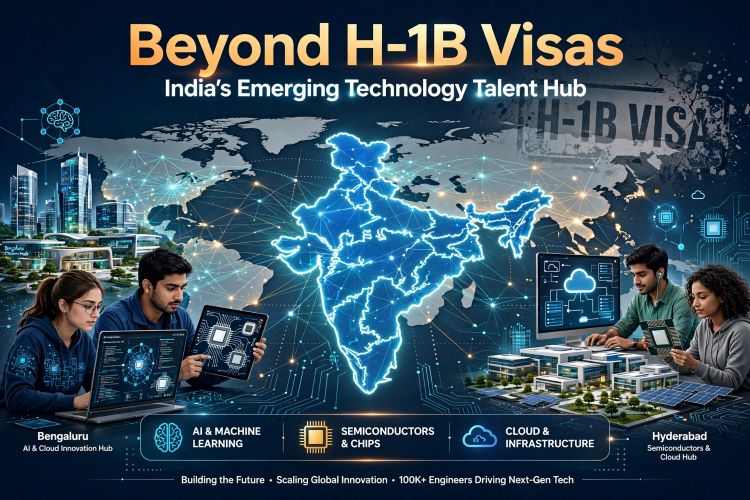
One promising destination for such talent is India’s rapidly expanding Global Capability Centre (GCC) ecosystem. These centres, established as wholly owned subsidiaries of multinational companies, undertake technology development, research and development, analytics, engineering, finance and other specialised functions for their parent organisations. According to a joint report by Nasscom and Zinnov, India’s GCC ecosystem expanded to 2,117 centres operating through 3,728 units by FY2025-26. The sector employed approximately 2.36 million professionals and generated $98.4 billion in revenue. Since FY2021, the number of centres has grown by 32%, with 506 Forbes Global 2000 companies establishing operations in India. This expansion demonstrates that the country is increasingly becoming a destination for high-value work rather than merely a provider of low-cost outsourcing services.
Artificial intelligence is accelerating this transformation. Nearly half of the GCCs established since FY2021 were reportedly designed with AI at their core, while more than 1,200 centres have integrated artificial intelligence and machine learning into their operations. More than 250 dedicated Centres of Excellence and an estimated pool of 250,000 AI professionals further strengthen India’s capabilities. The GCC workforce of 2.36 million is roughly four times the estimated number of Indians working in the United States on H-1B visas at any given time. Although the two figures measure different employment categories and should not be treated as directly equivalent, the comparison highlights the scale of opportunities emerging within India. With appropriate investment in research, leadership and advanced engineering, GCCs can offer Indian professionals access to global projects without requiring them to relocate abroad.
The startup ecosystem offers another avenue for absorbing and developing technology talent. India’s expanding base of startups and unicorns is creating opportunities in AI, fintech, health technology, enterprise software and other knowledge-intensive sectors. According to the Startup India programme, more than 223,000 startups had received DPIIT recognition, while recognised startups had generated over 2.33 million direct jobs by FY2025-26. These figures cover all sectors and do not represent technology employment alone, but they illustrate the potential of entrepreneurship to generate new work. Startups can also offer professionals opportunities to develop products, build businesses and assume responsibilities that may be harder to access in established organisations. Realising this potential will require easier access to capital, stronger research partnerships and a supportive regulatory environment.
For Indian technology professionals whose prospects in the US are narrowing, returning home need not represent a career setback. The expanding GCC sector, domestic technology companies and startups can provide alternatives, particularly for those with advanced AI, engineering, cybersecurity and product-development skills. However, opportunities will not automatically match every displaced worker’s experience or salary expectations. India must improve the quality of employment, strengthen professional development and create pathways for experienced returnees to transfer knowledge, mentor younger workers and establish new ventures. Companies should also recognise the value of international experience rather than treating returning professionals merely as an additional source of labour. A successful transition will depend on matching talent with productive work, not simply increasing the number of people available for hire.
Ultimately, talent moves towards opportunity, and opportunity follows economic growth, investment and innovation. For decades, the United States attracted Indian professionals because its technology industry offered scale, research opportunities and competitive careers. As India and other Asian economies expand their technological capabilities, the direction of professional mobility may gradually diversify. Restrictions on H-1B visas and green cards are not the end of the road for Indian talent; nor should they be the sole reason for choosing to return. The real challenge is to build an economy in which skilled professionals can pursue ambitious careers at home. If India invests in education, advanced research, AI capabilities and high-value employment, the narrowing American visa pathway could become a catalyst for a broader transformation: from exporting technology talent to becoming a global centre of technological innovation.
(Author is Managing Director of BP Services, an NCR-based health NGO, and a regular TEW columnist.)











[[comment.comment_text]]