Battle of Visions: A Comparative Analysis of Congress' Nyay Patra and BJP's Sankalp Patra for 2024 Lok Sabha Elections

 2 years, 6 months ago
Manoj Kumar Pathak
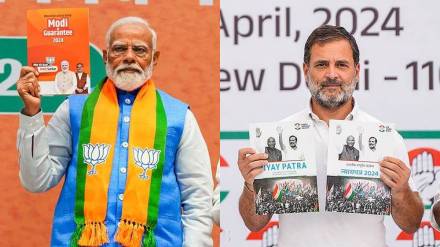
In the run-up to the Lok Sabha elections, the battle of manifestos has intensified between the two major political contenders, the Congress party and the Bharatiya Janata Party (BJP). With their respective documents named 'Nyay Patra' and 'Sankalp Patra', the parties aim to showcase their vision and commitments for the future of India. Let's delve into a comparative analysis of these manifestos, exploring their key promises and policy proposals.
Economic Policies and Welfare Programs:
Congress: The Congress party has put forth a plan to implement a 10% quota in jobs and educational institutions for economically weaker sections across all castes and communities. They also pledge to fill approximately 30 lakh vacancies in central government posts and introduce a Rajasthan model of cashless insurance for universal healthcare.
BJP: On the other hand, the BJP's manifesto promises to extend health coverage under the Ayushman Bharat Yojana to senior citizens above 75 years. Additionally, they aim to double the loan limit under the MUDRA Yojana from Rs 10 lakhs to 20 lakhs. Furthermore, the BJP commits to reducing electricity bills to zero for numerous families and continuing the free ration scheme for the next five years.
Social Initiatives and Women Empowerment:
Congress: The Congress party vows to conduct a nationwide socio-economic and caste census to inform their policies accurately. They also promise to provide training opportunities for women in various sectors to enhance their participation in the workforce.
BJP: In contrast, the BJP's manifesto focuses on empowering women through training programs in sectors like IT, tourism, education, healthcare, and retail. They aspire to make 3 crore women 'Lakhpati Didis' and offer training for rural women to become drone pilots.
Agricultural Support and Law Enforcement:
Congress: The Congress party's manifesto includes a promise to provide a legal guarantee for Minimum Support Prices (MSP) of crops, ensuring fair compensation for farmers as recommended by the Swaminathan Commission.
BJP: On the agricultural front, the BJP pledges to increase the MSP of crops and launch a Krishi Infrastructure Mission to bolster agricultural infrastructure across the nation.
Both manifestos present contrasting approaches to address key issues concerning the economy, social welfare, and agriculture. As the election date approaches, it remains to be seen which party's vision resonates more with the electorate and shapes the future trajectory of the nation.
Here's a comparative table highlighting the key promises made in the Congress and BJP manifestos for the upcoming Lok Sabha elections:
| Congress Manifesto (Nyay Patra) | BJP Manifesto (Sankalp Patra) |
| - Nationwide socio-economic and caste census - Constitutional amendment to raise cap on reservations - 10% quota in jobs and educational institutions for EWS - Right to Apprenticeship Act for diploma holders/graduates - Legal guarantee to Minimum Support Prices (MSP) - Restoration of Jammu and Kashmir's statehood - Scrapping of the Agnipath Scheme - Adoption of Rajasthan model for cashless insurance - National minimum wage of Rs 400 per day - Launch of Mahalakshmi scheme for poor families - Scrapping of contractualisation of regular jobs - Filling nearly 30 lakh vacancies in central government posts | - Health cover for senior citizens under Ayushman Bharat Yojana - Mudra loan expansion from Rs 10 Lakhs to Rs 20 Lakhs - Ayushman cover for transgender community - Reduction of electricity bills to zero under PM Surya Ghar Muft Bijli Yojana - Continuation of free ration scheme for the next five years - Expansion of Vande Bharat trains and introduction of new models - One Nation, One Election and consideration of Uniform Civil Code (UCC) - Infrastructural development across various sectors, including modernisation of highways, railways, airways, and waterways - Promotion of research on tribal heritage with establishment of Digital Janjatiya Kala Academy - Women empowerment through training programs and NaMo Drone Didi Yojana for rural women - Allocation of Rs 1 lakh crore for scientific research in India - Adoption of comprehensive approach to disaster management and enhancement of resilience in Himalayan states - Making 3 crore women Lakhpati Didis and enactment of strict law to prevent misconduct in recruitment examinations - Continual increase of MSP for crops and launch of Krishi Infrastructure Mission and Bharat Krishi satellite for farm-related activitie |




[[comment.comment_text]]