Bridging Skies, Building Futures

 1 year, 3 months ago
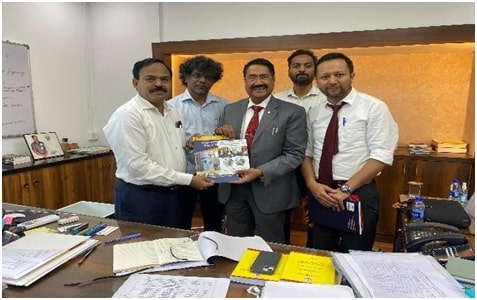
In an unprecedented fusion of altitude and attitude, the University of Ladakh and Chennai’s Anna University have inked a powerful partnership to establish India’s first Drone Research and Innovation Centre dedicated to high-altitude environments. The strategic alliance, announced during Vice Chancellor Prof. Saket Kushwaha’s visit to Chennai, aims to transform Ladakh from a distant frontier into the beating heart of drone technology suited for rugged terrains and thin-air extremes.
Prof. Kushwaha, hosted by Anna University’s MIT Dean Prof. K. Ravichandran and Centre for Aerospace Research (CASR) Director Prof. K. Senthil Kumar, hailed the collaboration as a new era of “collaborative federalism”—a synergy between Tamil Nadu’s aerospace prowess and Ladakh’s unique geography. The joint effort will develop unmanned aerial vehicles (UAVs) capable of operating in harsh climates, where conventional drones often fail.
“This is not just a project—it’s a blueprint for India’s high-altitude drone supremacy.” — Prof. Kushwaha
The upcoming Drone Research and Innovation Centre in Ladakh will target three transformative domains: lightweight, battery-efficient UAVs; precision agriculture using aerial mapping; and robust surveillance for remote and border areas. With India leaning increasingly on drones for everything from disaster relief to military reconnaissance, this project answers a critical national need—especially after the success of recent operations like ‘Sindoor’ along the country’s frontier zones.
Anna University’s CASR has already signed a training MoU, with rapid rollout planned. As per Prof. Senthil Kumar, the goal is not only technical advancement but also regional empowerment: students from Ladakh will be trained in UAV design, programming, and aerial data processing. With internships, drone startups, and skill-based certification on the horizon, the initiative ties into the National Education Policy’s vision of innovation-led, inclusive education.
“Whether it’s a farm or a frontline, drones can now become Ladakh’s eyes in the sky.” — Prof. Senthil Kumar
But technology won’t fly solo. The partners have committed to sustainability at every step, with all projects undergoing environmental impact assessments to protect Ladakh’s fragile ecology. This ecological foresight adds depth and responsibility to the otherwise tech-heavy initiative.
The momentum continues with a national workshop scheduled for July 2025 at the Leh campus. Titled “Challenges and Research Opportunities in High-Altitude Drones,” the two-day conclave will gather defense analysts, drone technologists, climate scientists, and policymakers under one roof to script India’s UAV roadmap for mountain zones. An official invite has also been extended to Tamil Nadu’s Higher Education Secretary, P. Sankar, IAS, to visit Ladakh—marking a rare north-south academic handshake with geopolitical implications.
From Snowy Peaks to Silicon Skies: India Eyes Leadership in High-Altitude UAV Innovation
If this project succeeds, it will serve not only as a leap for drone science but also as a model of educational and regional equity—where innovation is no longer confined to metros but rises with the mountains. In this extraordinary convergence of geography, technology, and vision, the skies over Ladakh are no longer silent. They are preparing for takeoff.









[[comment.comment_text]]