Rajatarangini: Kalhana’s Kashmir: From Epic Wisdom to Historical Truth: India’s Timeless Legacy
 an hour ago
The Mahabharata, Arthashastra, and Rajatarangini are three great works of Indian intellectual history whose manuscripts are included in UNESCO's Memory of the World Regional Register for Asia and the Pacific (2026). This is significantly more than just a typical cultural accomplishment. It is an international acknowledgement of India's rich intellectual heritage and remarkable civilisational legacy.
This acknowledgement is important since these three pieces, which were written in various historical periods, reflect separate but related facets of Indian philosophy. The Mahabharata is a comprehensive investigation of human nature, moral quandaries, responsibility, dharma, and power struggles rather than just an epic. Beyond India, its philosophical profundity and timeless stories have had a significant impact on the literature, art, and culture of many Asian nations.
Kashmir: History, Heritage & Identity
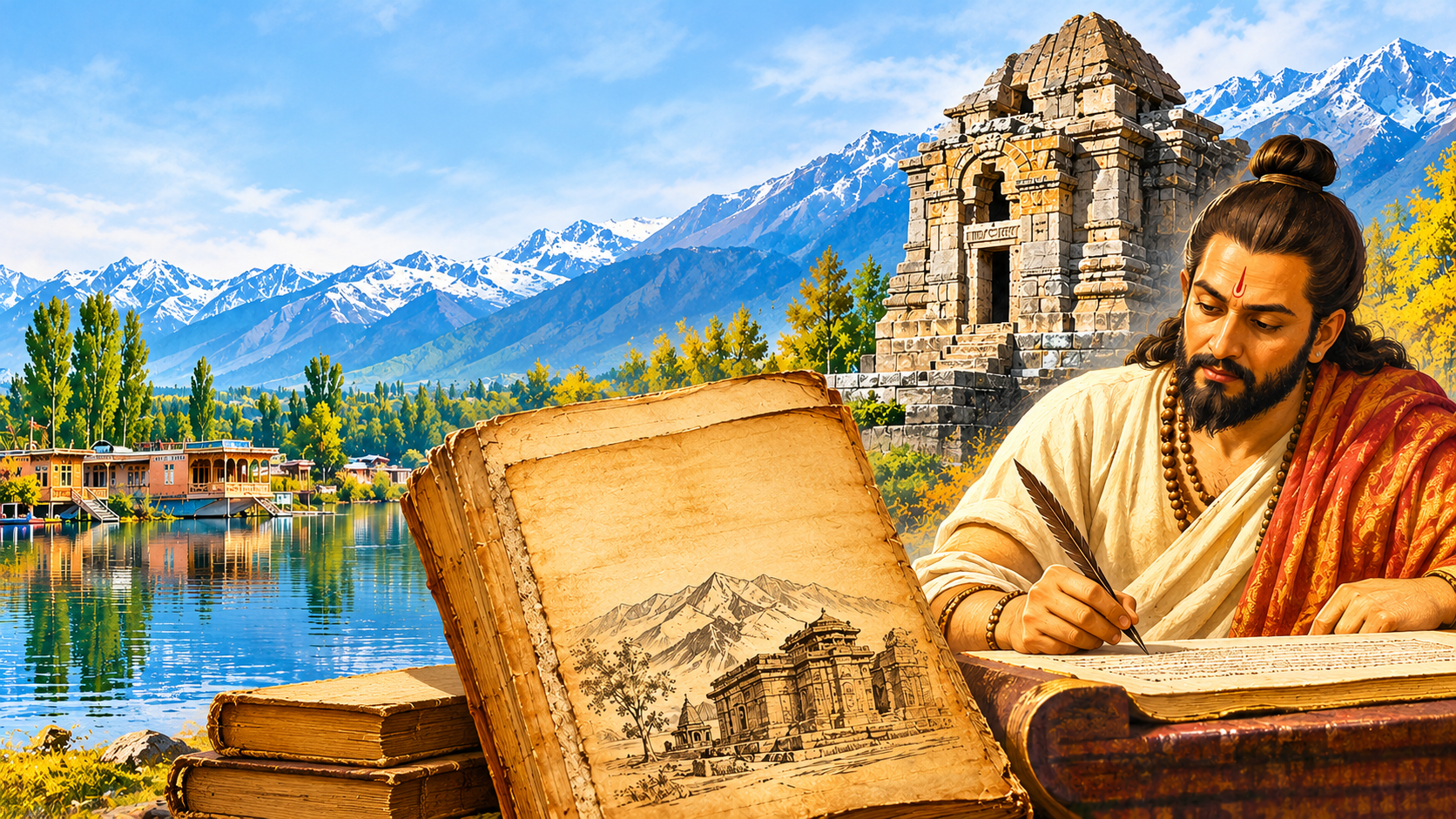
Kalhana's Rajatarangini, written in Sanskrit, is a remarkable historical narrative that holds a unique position in Indian historiography from antiquity to the Middle Ages. In addition to painting a vivid picture of the region's modern civilisation, religious customs, cultural life, art, architecture, and economy, it offers a methodical account of Kashmir's monarchs and dynasties up until the twelfth century.
Kashmir is the most generally used and approved of the four spellings: Kashmeer, Kashamir, Kashmere, and Kashmir. The region is referred to as Kashir in the Kashmiri language, while the language itself is called Shur.
The etymology of the term 'Kashmir' has been the subject of several theories. One legend holds that Sage Kashyapa reclaimed and settled the valley, earning it the name Kashyapapura, which eventually became Kashmir. Another version links the name to Samir (air) and Ka (water), implying a reference to its healthful climate. According to a third version, 'name' comes from the words 'Kas' (spring) and 'Mir' (mountain), which reflects the area's rugged terrain and abundance of natural springs.
Although the exact linguistic origin of the word is still up for question among academics, the historic relationship with Sage Kashyapa seems to be more likely of these explanations.
Kalhana: India’s Historical Conscience
One of the first Indian historians to undertake a diligent, chronological account of the past was Kalhana. Whenever feasible, he cited his sources, and he was transparent about any gaps in the evidence. He also provided an explanation for the exclusion of thirty-five monarchs whose records were lost or whose reigns were deemed unimportant by earlier chroniclers. Since then, contemporary Indian historians have scrutinised the chronological irregularities in his story, even up to the Saptarishi Era.
In his Rajatarangini from the twelfth century, Kalhana documented the dynastic history of Kashmir from the customarily dated reign of King Gonanda (1184 BCE) until his modern-day monarch, Jayasimha. As a result, Kashmir developed an impressive history-writing culture. In his Second Rajatarangini, published in the fifteenth century, Jonaraja continued this tradition, bringing the story up to Zain-ul-Abidin's rule.
Kalhana did not operate in a vacuum. He cited eleven older Kashmiri historical texts, such as Helaraja's Parthivavali, Suvrata's history of Kashmir, and Kshemendra's Nripavali. In contrast to traditional royal chronicles, his story also sheds light on common people, society, and daily life. According to H. H. Wilson, Rajatarangini is the only Sanskrit work that truly qualifies as history. Despite its frequently unpleasant depiction of mediaeval realities, Jawaharlal Nehru also recognised its historical value.
Kalhana's comprehensive study of prior literary and historical works was credited by Sir Aurel Stein with his historical competency. His narratives also demonstrate a deep comprehension of geography and combat.
Kalhana's lasting influence is found in his treatment of history as a methodical search for proof, intellectual integrity, and impartiality rather than as a celebration of royalty.
Kalhana: History Beyond Power
One of the most notable works of historical writing from mediaeval India is Kalhana's Rajatarangini, which was written between 1148 and 1150 CE. In contrast to court poets who exalted their royal sponsors, Kalhana composed independently of both pecuniary gain and royal favour. His dedication was to historical truth rather than power.
According to Kalhana, a historian must maintain the same objectivity and lack of bias as a judge. "Shlaghyah sa eva gunavan raga-dvesha-bahishkrita, / Bhootartha-kathane yasya sthairyam iva Saraswati," he said. A worthy historian is just someone who tells the truth without bias or prejudice.
In accordance with this idea, Kalhana analysed eleven previous Kashmiri historical works, assessed their merits and faults, and attempted to address their weaknesses. His goal was to produce a chronicle based on facts, chronology, and critical analysis.
Eight Waves of Kashmir’s History
Rajatarangini, which divides Kashmir's monarchs into eight Tarangas (waves), compares the rise and fall of dynasties to waves in a river that never stops flowing. The story takes place over several centuries, starting with mythical leaders and progressing to historically recognisable characters like Ashoka, the Huna monarch Mihirakula, the Karkota dynasty, Queen Didda of the Lohara dynasty, and monarch Harsha. Jayasimha, Kalhana's contemporary, brings it to a close.
The chronicle provides a remarkable account of political rivalry, court intrigues, rebellions, military structures, judicial practices, and the role of queens in affairs of state, all of which go beyond dynastic succession.
No King Beyond Criticism
Kalhana is unique because he refuses to use his royal accomplishments to mask his moral and political shortcomings. He documented Lalitaditya's excesses in alcohol consumption and sensuality while acknowledging his military victories and support of literature and the arts. In the same vein, he acknowledged Harsha's benevolence but denounced his extravagance, harsh taxes, expensive military expeditions, and devastation of temples for their valuable metals.
Beyond specific leaders, Kalhana also criticised the governmental apparatus. He uncovered administrative abuse, crooked officials who extorted common people, and the practice of paying officials with land gifts instead of cash compensation.
He said, "Vishavriksho niyogi cha madevashritya vardhate, / Chitram karoti tasyaiva sthanasyanabhigamyatam," comparing corrupt officials to toxic trees that damage the same institutions that support them.
His story shows a society where power abuse and administrative corruption have the potential to be just as damaging as actual political instability.
l leaders and progressing to historically recognisable characters like Ashoka, the Huna monarch Mihirakula, the Karkota dynasty, Queen Didda of the Lohara dynasty, and monarch Harsha. Jayasimha, Kalhana's contemporary, brings it to a close.
The chronicle provides a remarkable account of political rivalry, court intrigues, rebellions, military structures, judicial practices, and the role of queens in affairs of state, all of which go beyond dynastic succession.
Beyond the Throne: Society and Power
Rajatarangini's enduring importance stems from its ability to go beyond royal biographies and portray the political, administrative, and social realities of its day. Kalhana was an observer who examined authority, exposed its excesses, and recorded its consequences. He was more than just a king's historian.
His writings serve as a powerful reminder that history should never be used as a tool for political exaltation, even after more than nine centuries. Its most important lesson is timeless: kings have power over kingdoms, but they have no control over the past.
Kalhana's lasting influence stems from his courage in putting historical truth ahead of royal authority—a standard that still applies to historians today, just as it did in Kashmir during the twelfth century.
Kashmir’s Social and Economic Evolution
The social and economic structure of Kashmir is revealed in Kalhana's Rajatarangini. While the traditional Kshatriya, Vaishya, and Shudra divisions were less distinct, Brahmins dominated social life and political authority. Brahmins and groups like the Nishadas, Kiratas, Kaivartas, Dombas, Shvapakas, and Chandalas seem to have made up the majority of society. Interestingly, Kalhana makes no explicit mention to untouchability and does not usually portray these groups adversely, suggesting that vocational disparities may have impacted social structures.
Similar to Vaishyas, merchants were mostly involved in trade and agriculture. But since Kashmir's commercial heyday in the seventh and ninth centuries, their power has diminished. Kalhana parodies moneylenders and exploitative traders, likening them to gourds that drain the flesh and blood of their victims. A diversified occupational society is reflected in his narrative, which also includes references to teachers, artisans, shopkeepers, astrologers, doctors, and warriors.
Particularly noteworthy are the increasing allusions to Kayasthas in the later cantos. They seem to have been selected based on administrative function rather than caste or religious identification, maybe as royal officials in charge of land administration and revenue collection once foreign trade declined.
However, Kalhana harshly denounces their corruption, drawing negative comparisons between them and spiders and crabs: Hanti sarvam tu karyasthah kritaghnah praptasambhavah, pitaram karkato hanti mataram hanti puttika. The spider destroys its mother, and the crab destroys its father, but everything is destroyed by the unappreciative Kayastha.
Through these observations, Rajatarangini becomes more than just a history of monarchs; rather, it becomes an insightful depiction of Kashmir's administrative reality, social hierarchies, occupational groups, and economic shifts.
Women in Medieval Kashmir: Power and Paradox
Additionally, Rajatarangini provides insightful information about the situation and status of women in modern-day Kashmiri society. As a poet and historian, Kalhana depicts women's socioeconomic status and daily circumstances while also openly celebrating feminine beauty. The purdah system did not restrict Kashmiri women. Queens were active in concerns of governance and even military activities, and they took part in royal ceremonies, such as the holy anointing of kings. Even temple dancers enjoyed overthrowing the king, according to Kalhana.
Although the text describes situations in which widows received their deceased husbands' possessions, they were subject to some social limitations. Additionally, sati was practiced. Three of King Shankaravarman's queens are said to have committed sati after his death. There are reports of slaves and even a sister who immolated herself with her brother, proving that the practice was not exclusive to royalty.
The exploitation of devadasis and their use by rulers are among the darker facets of social life that Kalhana reveals. Some queens supposedly allowed ministers who supported their aspirations to have sex with them because they were motivated by the desire to secure the throne for their respective sons.
This unsettling aspect is reflected in the following Sanskrit verse: Putrayo rājalābhāya spardhayārbhyāüge svamantriṇe. "Sadakṣiṇā dattā nidhunanaśraddhā dhanadānaiḥ
The poem also reflects popular notions about superstition, magic, and sorcery. It also depicts some members of the wealthy classes and the Kashmiri monarchy as benefactors of science, philosophy, architecture, music, dancing, and religion.
As a result, Rajatarangini is more than just a history of kings and dynasties; it is also an insightful social record that captures the intricacies, paradoxes, and cultural life of mediaeval Kashmir.
Rajatarangini: The Truth of History
Subsequent archaeological findings have confirmed the historical veracity of Kalhana's Rajatarangini. A number of geographical allusions in the book were confirmed by Dr. Bühler's research, and Kalhana's chronological framework was further supported by currency hoards containing gold, silver, copper, and brass coins. H. H. Wilson said that Rajatarangini was essentially the only Sanskrit composition to date that could be considered a historical work, acknowledging its extraordinary historical significance.
But Kalhana's contribution goes beyond only documenting dynasties and monarchs. He also taught rulers valuable lessons through perceptive views on government and historiography. At one point, he warns against letting rural towns amass more than a year's worth of grain stockpiles for fear that influential landowners may consolidate their power and endanger the state. These insights demonstrate his comprehension of the complex interrelationships among political authority, economic resources, and societal stability.
The ability of Kalhana to combine disparate historical narratives into a cohesive story while maintaining a wonderfully vivid image of the culture, politics, and government of his era is what gives Rajatarangini its lasting significance. For future generations, his work will continue to be a priceless intellectual legacy.
As a result, when it is included in UNESCO's Memory of the World Regional Register for Asia and the Pacific in 2026, it is recognised as much more than merely an ancient manuscript. It pays tribute to India's outstanding intellectual heritage.
Equally significant are the government's continuous attempts to locate, conserve, and digitise old texts. In the end, a civilisation honours its heritage by making the accumulated knowledge accessible, pertinent, and important to future generations and the wider world, rather than just by preserving its past.
Niraj Krishna








[[comment.comment_text]]