Foundations of Pakistan: The 1947 Partition and Western Interests

 2 months ago
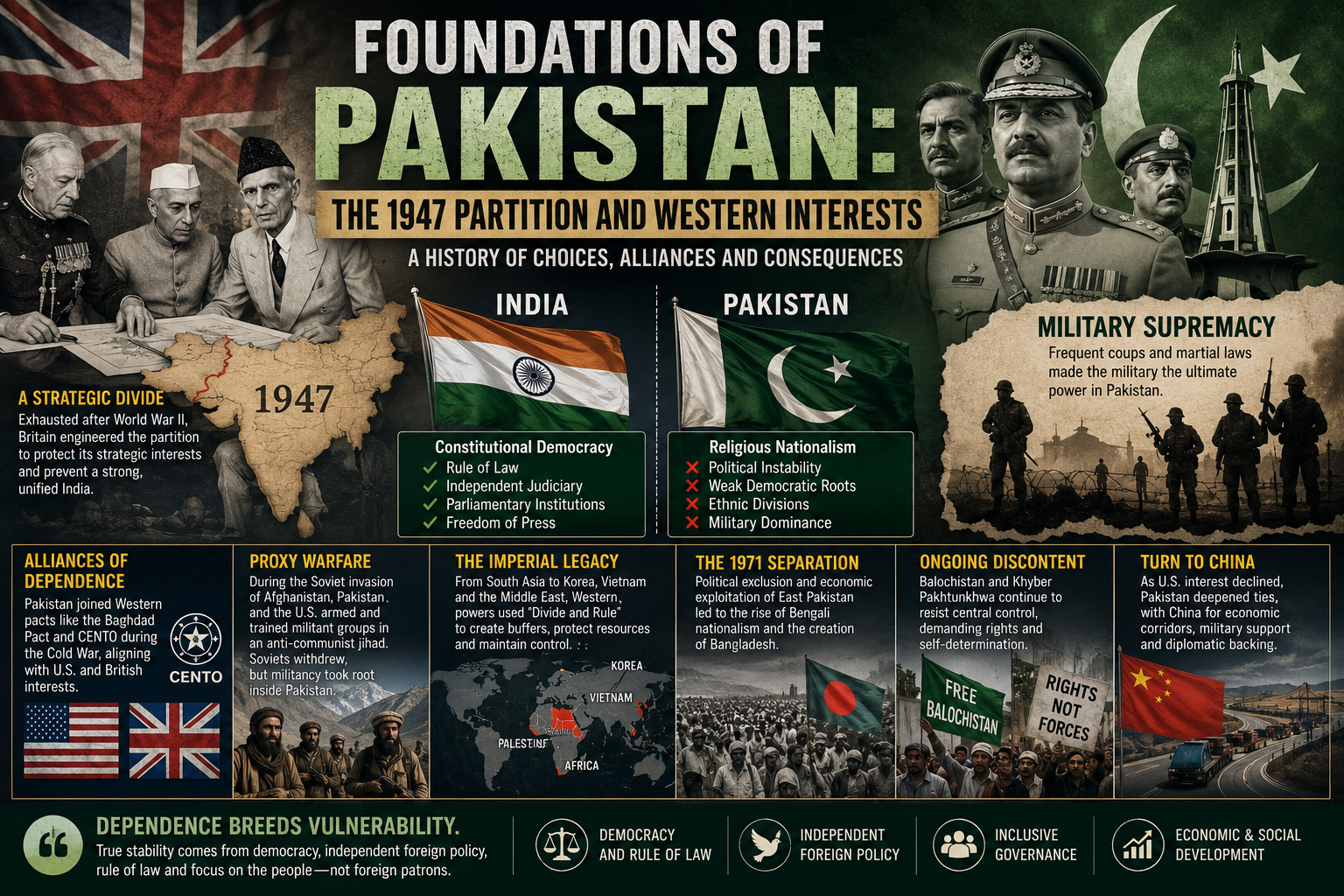
The partition of British India in August 1947 was not merely a reaction to internal demands for a separate Muslim homeland, but a deliberate move driven by British strategic concerns. Facing exhaustion after World War II, Great Britain struggled to manage vast overseas territories while battling a growing and intense Indian national movement led by the Indian National Congress [00:49]. Colonial planners feared that a unified, nationalist Indian government would pursue economic self-reliance, prioritize domestic industrial development, and dismantle Western influence across the region.
Divergent Paths: Constitutional Democracy vs. Religious Nationalism
Following independence, India and Pakistan charted radically different governance models. India focused on establishing a secular constitutional democracy characterized by the rule of law, independent judiciary and parliamentary institutions, and freedom of the press. In contrast, Pakistan was founded on the basis of religious identity. This fundamental premise soon generated political instability, as recurring debate over religious orthodoxy prevented the state from establishing stable, long-lasting democratic institutions.
Building a state primarily on shared religious faith presents structural vulnerabilities because local and ethnic loyalties frequently prove stronger than broader religious ties. Distinct ethnic identities—such as Balochi, Pashtun, or Bengali—often define social cohesion more deeply than a shared Islamic identity. When a state relies solely on religion rather than constitutional mechanisms, one dominant ethnic group can easily centralize power at the expense of others, igniting severe internal friction.
Institutional Breakdown and the Rise of Military Supremacy
Unlike democratic systems that rely on regular elections to remain accountable to the public, Pakistan suffered from repeated constitutional failures and frequent military intervention. Over time, the Pakistan Armed Forces systematically weakened civil institutions to become the paramount authority in the country. Under General Zia-ul-Haq, the military went so far as to position itself as the official guardian of the Islamic state, cementing its influence over all governance and public life.
To sustain its domestic dominance and stave off political collapse, Pakistan’s ruling establishment sought security and financial alliances with foreign powers. During the early Cold War, Pakistan joined Western-aligned anti-communist pacts like the Baghdad Pact, which later evolved into the Central Treaty Organization (CENTO). While India adopted a Non-Aligned Movement stance to maintain strategic autonomy. Pakistan tied its national security agenda closely to British and American objectives.
Proxy Warfare and the Anti-Soviet Afghan Campaign
Pakistan's geopolitical utility to the West peaked following the Soviet invasion of Afghanistan. Working alongside the United States, Pakistan helped mobilize and train militant Islamic groups under the banner of an anti-communist holy war. While this campaign ultimately forced a Soviet withdrawal and contributed to the dissolution of the USSR, it entrenched militant networks within Pakistan's own borders, burdening the nation's long-term security and internal stability.
Rather than building a self-sustaining economy or strong civilian institutions, Pakistan's military apparatus repeatedly leveraged its militant assets and strategic geography for external patronage. Its location at the crossroads of Iran, Afghanistan, and China made it an essential partner for external powers seeking regional leverage. Consequently, Pakistan's national interest was repeatedly subordinated to serving the strategic goals of foreign powers in exchange for military aid and diplomatic backing.
The Imperial Legacy: Divide and Rule Across Global Frontiers
The partitioning of South Asia reflects a broader geopolitical pattern deployed by Western powers during the mid-20th century. Similar territorial partitions—such as in Korea, Vietnam, and Palestine—were utilized during decolonization to establish regional buffers and protect Western commercial or security assets. In the Middle East and Africa, foreign powers routinely installed or backed compliant minority regimes and created small oil-producing states to maintain leverage over crucial natural resources.
The structural defect of prioritizing religious identity over regional and ethnic aspirations culminated in the 1971 liberation of Bangladesh . Bengalis in East Pakistan faced systematic political exclusion and economic exploitation by the West Pakistani military and political elite. The resulting nationalist movement proved that shared religious bonds could not overcome deep linguistic, cultural, and political disparities, causing the state's first major territorial split.
Persistent Regional Discontent in Balochistan and Khyber Pakhtunkhwa
The internal pressures that brought about the 1971 separation remain active in contemporary Pakistan. Regions like Balochistan and Khyber Pakhtunkhwa (formerly the North-West Frontier Province) continue to experience political alienation and growing nationalist movements targeting central military control. Excessive reliance on military force to suppress local self-determination movement runs the risk of fracturing the military's internal cohesion and eroding state stability further.
As American interest in South Asia waned following its withdrawal from Afghanistan, Pakistan increasingly turned to China as a primary strategic backer. By serving as a trade corridor connecting Beijing to West Asia and facilitating regional diplomatic shifts, Pakistan secured new financial and military lifelines. At the same time, its persistent involvement in neighbor states' affairs—including recent political developments in Bangladesh—underscores its ongoing attempts to project regional influence.
The Consequences of External Dependence
Pakistan's political trajectory illustrates the risks of building statecraft around religious identity and relying on foreign powers for institutional survival. External powers routinely exploit client states for their own immediate geopolitical goals, leaving the client vulnerable when alliances shift. True national stability and economic growth stem from independent foreign policy, democratic governance, adherence to the constitutional rule of law, and a focus on domestic socioeconomic development.











[[comment.comment_text]]