Mental Health Is Not a Day
 2 hours ago
The hoarding went up near the bus stop in the first week of October. A teal ribbon, a calm face, a helpline number in small type, an invitation to a webinar on managing stress. A woman waited beneath it each morning on her way between two jobs, and again each evening on her way home, and it is fair to say the poster was never quite meant for her. By the first week of November it would be taken down. The tiredness she carried up three flights of stairs would not. It had been there long before October arrived, and it would stay long after the month had moved on.
Every year, mental health arrives in full force. Around the tenth of October it is suddenly everywhere: campaigns and webinars, lit-up buildings, workplaces declaring a wellness week, all of it sincere and much of it useful. And then, as reliably, it recedes. The ribbons come down, the inboxes return to their usual traffic, and the subject goes quiet again until the calendar brings it back.
This year the World Federation for Mental Health has chosen the theme “Lived Experiences Heard: Real Voices, Real Change”. It is worth taking at its word, because the most common lived experience is not the dramatic one. It is the woman at the bus stop, and the man who meets every deadline while something sits unnamed on his chest: the quiet, steady, undiagnosed struggle that no single day is built to reach. We have, it is true, started to talk about all this, sometimes too loosely. But talking about mental health is not the same as tending to it.
The tending is where we fall short, and we fall short unevenly. India’s last National Mental Health Survey, in 2015-16, found that, for most mental disorders, somewhere between three-quarters and nine in ten of the people who needed care received none at all. A decade on, a systematic review published this June in the journal SSM - Mental Health, led by researchers at the George Institute for Global Health, examined why. Looking across twenty-six studies of Indian adolescents, it found the same barriers again and again: stigma above all, but also a low ability among young people, parents and teachers alike to recognise distress, too few services built for the young, and a fear that a confidence once shared would not be kept. It noted, too, how little we know about the adolescents hardest to reach, those in crowded settlements and places where help was never near.
Read together, these tell a plain story. The difficulty is not that people lack the will to look after their minds. It is that recognising distress is itself a skill few of us were ever taught, and that the help, where it exists, gathers in the cities and the clinics and rarely travels to where most lives are lived.
Before help, there is recognition. And before recognition, someone has to ask twice. The part we think about most in our own work is this. We prepare children with great seriousness for their examinations, and graduates, lately, for their soft skills and their interviews. Somewhere in between, the skills for living a life go untaught. The capacity to notice what one is feeling before it becomes a crisis, to sit with a difficult emotion without being governed by it, to ask for help, to decide, to repair a strained relationship: these are not luxuries of temperament handed out at birth. The World Health Organization has long grouped them as life skills, self-awareness, coping with emotions and with stress, interpersonal skill, decision-making and the rest, and its plainest point about them is the one most easily missed. They can be learned. The National Education Policy of 2020 gestures this way when it speaks of life skills in schools, which is a beginning, though a line on paper is not yet a lesson in a classroom.
What we see in practice is that a person who holds these skills meets a hard season differently. The loss, the move, the failure, the slow erosion of a role that once defined them, arrives all the same, but it does not find them wholly unequipped. This is prevention in its most ordinary sense, and like most prevention it is quieter and kinder than the cure it spares.
To call it prevention is not to hand each person a private burden and look away. Mental health kept as an everyday practice cannot mean therapy for all; for most families that is neither affordable nor near. It can mean something more modest and more reachable: the care of the mind treated as ordinary maintenance, the way we have slowly learned to treat the care of the body, and built into the places people already are. A teacher who can name what a withdrawn child might be carrying. A workplace where rest is not a confession of weakness. A primary health worker equipped to listen before a crisis, not only after. A household in which “how are you” is sometimes a real question.
None of this is the individual’s to arrange alone. It asks something of schools, employers, the health system and the state, as much as of any one of us. But it returns something to the person too, which a campaign rarely does: the sense that one’s own mind is not a mystery to be feared or a diagnosis to be hidden, but something one can learn to tend, a little, every day. She climbs the stairs. She says she is fine. Nobody asks twice.
The hoarding by the bus stop will come down this year, as it does every year, and that is no scandal; a day can begin a conversation the other three hundred and sixty-four might never have started on their own. The question it leaves behind is only whether the conversation ends with it. Mental health is not a date on the calendar, to be observed and then filed away. It is a way of paying attention, owed to the woman on the stairs as much as to anyone in a brighter room, and owed to her not for one month, but for all of them.
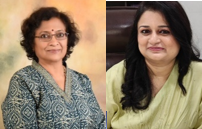
Dr. Vinaya Prabha, an Integrative Cognitive BehaviorPsychotherapist with over thirty years of clinical experience, is the founder of ReAlign Within™, a pioneer of online counselling in India and the author of Unbroken: Becoming Herself. Dr. Himani Upadhyaya, an integrative CBT therapist and RCI-licensed Rehabilitation Psychologist, is its co-founder. Together they write on mental health, burnout and the inner life of high-achieving professionals. Write to them at consultvinayaprabha@gmail.com or visit www.vinayaprabha.com.
(Authors, Dr. Vinaya Prabha and Dr. Himani Upadhyaya, are reputed Integrative CBT Therapist and RCI-licensed Rehabilitation Psychologists. Dr Prabha has also written a book: Unbroken: Becoming Herself.)


[[comment.comment_text]]