Durga Puja Keeps Britain’s Bengali Roots Alive

 a minute ago
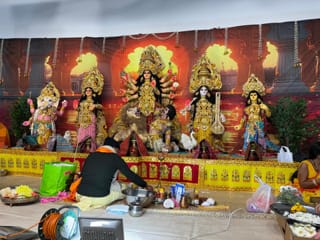
From Birmingham’s 50-year-old Durga Puja to ancestral rites on the banks of the Thames, Britain’s Bengali communities are blending tradition, faith and identity, proving that distance from home has done little to diminish the spirit of the festival.
As Durga Puja draws near, Bengali communities across Britain are once again preparing to celebrate their most cherished festival. Yet these celebrations are no longer simply recreations of a tradition from home. Over the decades, Durga Puja in the UK has evolved into a defining expression of community identity, cultural continuity and intergenerational belonging.
This year, four distinctive celebrations across Birmingham, Cambridge and London highlight how Britain’s Bengali diaspora continues to preserve its heritage while adapting traditions to a new social and cultural landscape.
In Birmingham, the Nabarun Hindu Bengali Cultural Association is marking a landmark year with the golden jubilee of its Durga Puja. Established in 1976, the festival has grown into one of the oldest and most enduring Bengali community events in the United Kingdom. Scheduled from 16 to 20 October at Kings Heath Community Centre, the celebration will feature traditional rituals, Pushpanjali, Arati, community dining and a packed cultural programme.
The significance of the anniversary extends beyond the festival itself. Nabarun’s journey reflects the history of Bengali migration and settlement in Britain, charting how a small community initiative developed into an established cultural institution that has helped successive generations remain connected to their roots.
A similar story of continuity is unfolding in Cambridge, where the Cambridge ICS Durga Puja reaches its 25th year. What began as a community gathering has developed into one of the region’s well-known Bengali cultural events. Held at Netherhall School and Community Centre, the festival attracts families from across Cambridge and neighbouring towns. For many attendees, the event serves as an important link between generations. Children growing up in Britain are introduced to Bengali traditions, language and customs, while older members of the community find a sense of familiarity and belonging. As it approaches its silver jubilee, the Cambridge celebration highlights the growing confidence and permanence of Britain’s regional Bengali communities.
Meanwhile, in London, the Bharat Sevashram Sangha Durga Puja continues to offer a distinct blend of religious devotion and spiritual reflection. The Sangha’s work in Britain, which began under the guidance of Swami Purnyanandaji Maharaj and expanded through the efforts of Swami Nirliptanandaji Maharaj, has established a strong spiritual presence within the diaspora. Its annual Durga Puja is characterised not only by traditional worship but also by an emphasis on service, community welfare and spiritual engagement. In an increasingly secular world, the celebration continues to provide a space where faith remains at the centre of community life.
Adding a unique dimension to this year’s festivities is the initiative undertaken by the Bangladesh Hindu Association UK (BHA UK). Alongside its Durga Puja celebrations, the organisation is arranging Mahalaya and Tarpan on the banks of the River Thames, bringing one of Bengal’s most deeply rooted ancestral traditions into the heart of the British capital. The observance of Tarpan, a ritual offering made in remembrance of ancestors, occupies a special place in Bengali Hindu culture. Conducting the ceremony beside the Thames symbolises both continuity and adaptation, preserving a centuries-old tradition while embedding it within a distinctly British setting. BHA UK will also host its Durga Puja celebrations in London, following the traditional calendar from Sasthi through Vijayadashami.
Taken together, these four celebrations represent different strands of the British Bengali experience. Nabarun’s golden jubilee honours half a century of cultural perseverance; Cambridge reflects the growth of a thriving regional community;
Bharat Sevashram Sangha underscores the enduring role of spirituality; and BHA UK’s Thames-side Tarpan demonstrates how tradition can be reimagined in a diaspora setting. More than religious festivals, these events reveal how migrant communities preserve memory, identity and belonging across generations. In an era of global mobility and cultural change, Durga Puja remains a powerful reminder that heritage is sustained not by geography, but by the collective commitment of a community determined to keep its roots alive. For Britain’s Bengalis, that commitment continues to find its fullest expression each autumn, when devotion, culture and community come together under the banner of Durga Puja.
(The author, a Special Correspondent for TEW covering Scotland, London, and Birmingham, is an active researcher and social activist. She works to deepen UK–India ties through cultural and cross-tradition exchange.)









[[comment.comment_text]]