Dhunuchi Naach: Where Devotion Finds Its Rhythm

 an hour ago
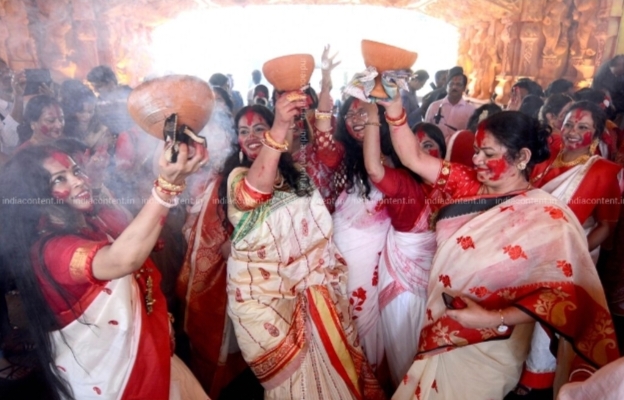
Fire trembles in an earthen bowl. Incense smoke rises in slow spirals, the dhak beats grow louder, and a devotee begins to sway before Goddess Durga. Soon, measured steps give way to sweeping movements, the smoke thickens, and the ritual becomes a dance. In Bengal, this is Dhunuchi Naach—a moment when devotion takes hold of the body and worship finds its rhythm.
As the sound of the traditional Bengali drum fills the air, the burning incense burner moves with the dancer’s gestures. Smoke curls upwards, lamps flicker before the goddess, and the boundary between prayer and performance begins to dissolve. For a few moments, the entire space seems to move to the same rhythm. What unfolds is not merely a spectacle for the audience but an offering through which devotees express their faith.
Dhunuchi Naach occupies a distinctive place in Bengal’s Durga Puja celebrations. The dance takes its name from the dhunuchi, a traditional earthen incense burner in which coconut husk, charcoal and fragrant incense are used to produce thick, swirling smoke. Held in the hands, the vessel becomes an instrument of worship. As the dhak sets the pace, devotees move in rhythm, their gestures blending reverence with the exuberance of celebration.
The performance demands concentration, coordination and a sense of rhythm. Dancers must maintain their balance while holding a burning vessel, adjusting their movements to the changing tempo of the drums. Some dance with a dhunuchi in each hand, while experienced performers attempt more demanding movements. The visual effect can be dramatic, but the essence of the dance lies not in acrobatics. It is an act of devotion expressed through the body.
The dance is closely associated with the sandhya aarti, the evening worship of Goddess Durga during the festival. As lamps are raised and prayers are offered, incense fills the air and the sound of the dhak gathers intensity. The dance becomes a natural extension of the ritual, drawing worshippers into a collective experience in which music, movement and faith reinforce one another.
Over time, Dhunuchi Naach has also become a highlight of community Durga Puja celebrations. In neighbourhood pandals across Bengal, people of different ages participate, while crowds gather to watch and encourage the dancers. Organised performances and competitions have added a public dimension to the tradition, giving younger generations opportunities to learn and participate. Yet the connection between dance and devotion remains central to its appeal.
Its strength lies partly in its inclusive character. Dhunuchi Naach is not confined to trained performers or professional dancers. Ordinary devotees can take part, turning worship into a shared cultural experience. The dance creates a sense of belonging among people who may differ in age, occupation and social background but come together to celebrate the goddess. In this collective participation, the festival becomes more than a religious observance; it becomes an expression of community life.
Durga Puja celebrates the victory of Goddess Durga over the demon Mahishasura and symbolises the triumph of good over evil. Within this larger narrative, Dhunuchi Naach expresses reverence for the goddess through the language of movement. The rising smoke, rhythmic gestures and collective energy create an atmosphere in which worship becomes both intimate and public. Each dancer may have an individual relationship with the divine, yet the performance unfolds as a shared act of faith.
The tradition also reflects Bengal’s distinctive relationship with religion and culture. Devotion often finds expression through music, theatre, poetry, art and public celebration. Religious practices are not always confined to formal prayer; they also take shape in the everyday rhythms of community life. Dhunuchi Naach belongs to this cultural world, where ritual becomes a living experience passed from one generation to the next.
Its visual appeal has helped the dance travel beyond traditional puja spaces. Performances are seen at cultural programmes and festive gatherings outside Bengal, introducing wider audiences to a distinctive element of Bengali heritage. As Durga Puja has gained visibility across India and among Bengali communities overseas, Dhunuchi Naach has travelled with it. The combination of fire, smoke, percussion and movement makes it instantly recognisable, while its participatory character allows people unfamiliar with the tradition to appreciate its emotional power.
Yet the wider popularity of the dance also raises a question familiar to many living traditions: how can a cultural practice evolve without losing the meaning that sustains it? Contemporary performances may introduce choreographed movements, competitions and more elaborate presentations. These developments can help keep the tradition relevant, especially for younger participants. But if spectacle becomes the principal attraction, the ritual significance risks being pushed into the background.
Preserving Dhunuchi Naach does not require keeping it frozen in time. Traditions survive because communities continue to practise, adapt and reinterpret them. What matters is that the dance retains its association with worship and remains connected to the cultural setting from which it draws its meaning. Its future depends as much on the understanding of participants as on the enthusiasm of audiences.
The tradition also offers a reminder that cultural heritage is not preserved only in monuments, museums or written records. Much of it lives in gestures, sounds, skills and collective memories. A traditional drum, an earthen vessel and a sequence of movements can carry histories that are rarely documented but remain deeply embedded in community life. When young people learn the dance from elders, they inherit not merely a performance but a way of participating in a shared cultural world.
When the drums fall silent and the incense smoke slowly disperses, Dhunuchi Naach leaves behind more than a striking visual memory. It carries the warmth of collective worship, the energy of a community and the continuity of a cultural inheritance. The earthen burner may be set aside, but the experience lingers in the rhythm of the music and the emotions of those who took part.
For Bengal, Dhunuchi Naach is more than a Durga Puja performance. It is a living expression of faith, identity and belonging. In the movement of the dancer, the fragrance of incense and the beat of the dhak, devotion finds its rhythm—and culture continues to move from one generation to the next.
(The author, a senior journalist of Bihar, is a known commentator on governance, development, and diversity issues.)









[[comment.comment_text]]