IGNOU, OSOU Sign Five-Year MoU to Expand Open Learning, AI-Driven Education and Regional Access
 3 months, 1 week ago
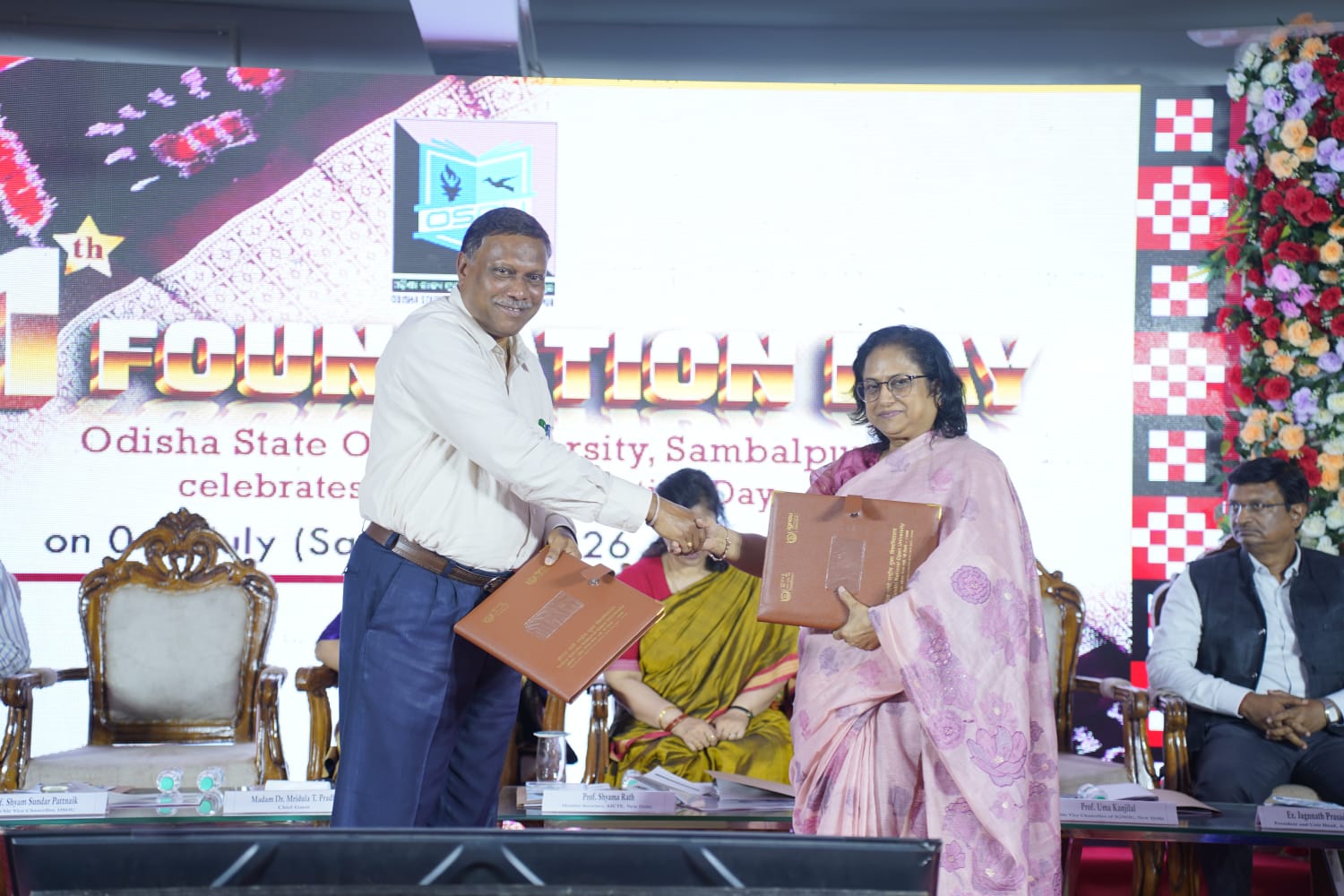
New Delhi/Sambalpur, EW-NN: The Indira Gandhi National Open University (IGNOU) and the Odisha State Open University (OSOU) have signed a five-year Memorandum of Understanding (MoU) aimed at expanding access to affordable, technology-enabled and multilingual higher education. The agreement was signed on July 4 during OSOU's 11th Foundation Day celebrations in Sambalpur.
The MoU establishes a comprehensive framework for academic collaboration between the country's largest open university and Odisha's state open university, with the objective of making higher education more inclusive, skill-oriented and digitally accessible. The agreement is expected to particularly benefit learners in rural, tribal and coastal regions by improving access to quality academic programmes and modern learning technologies.
The memorandum was signed by IGNOU Vice Chancellor Uma Kanjilal and OSOU Vice Chancellor Shyam Sundar Pattnaik in the presence of senior academicians and industry leaders, including Mridula T. Pradhan, Bhimaraya Metri, Sukumar Mishra, Shyama Rath and Jagannath Prasad Nayak.
What the MoU Means
The agreement goes beyond a routine institutional partnership and creates a roadmap for long-term academic cooperation between the two universities.
Under the MoU, IGNOU and OSOU will jointly develop and offer certificate, diploma, undergraduate, postgraduate, vocational and research programmes. Special emphasis will be placed on emerging disciplines such as artificial intelligence, data science, cybersecurity, entrepreneurship, digital humanities and Indian knowledge systems, reflecting the growing demand for future-ready skills.
One of the most significant provisions of the agreement is the co-development of self-learning materials, digital content and multilingual educational resources. Subject to regulatory approval, IGNOU's academic programmes may also be delivered in regional languages through OSOU's network of study centres, making higher education more accessible to students who prefer learning in their mother tongue.
The collaboration also covers the development of digital learning infrastructure, including AI-enabled learning management systems, virtual classrooms, online assessment mechanisms, learner support services and open educational resources. Faculty development programmes, joint research projects and expanded counselling and outreach services for disadvantaged communities also form key components of the partnership.
A joint Monitoring and Implementation Committee, co-chaired by the Vice Chancellors of both universities, will supervise implementation of the agreement and periodically review progress throughout its five-year tenure.
Addressing the gathering, Prof. Uma Kanjilal said open and distance learning institutions must now move beyond conventional teaching methods and embrace artificial intelligence-powered learning platforms, mobile-based education, digital evaluation systems and skill-oriented programmes while continuing to strengthen academic quality.
The partnership is expected to reinforce IGNOU's national outreach by extending its academic expertise to new learner communities, while enabling OSOU to accelerate its transformation into a technology-driven, learner-centric university. Education experts believe the collaboration aligns with the objectives of expanding digital education, improving employability and enhancing equitable access to higher education envisioned under India's education reforms.
With the agreement now in force, both universities are expected to jointly create a wider portfolio of academic opportunities that combine flexible learning with technology, regional language accessibility and industry-relevant skills, strengthening the role of open and distance education in meeting the country's growing demand for lifelong learning.










[[comment.comment_text]]