Rate Hike Cushions Banks? CORPORATE CREDIT AT Rs69 TRN

 2 hours ago
An expensive market is ahead. Banks are tizzy. Markets rock and roll. Costly loans may cause thaw with a rate rise phenomenon first time after almost three years.
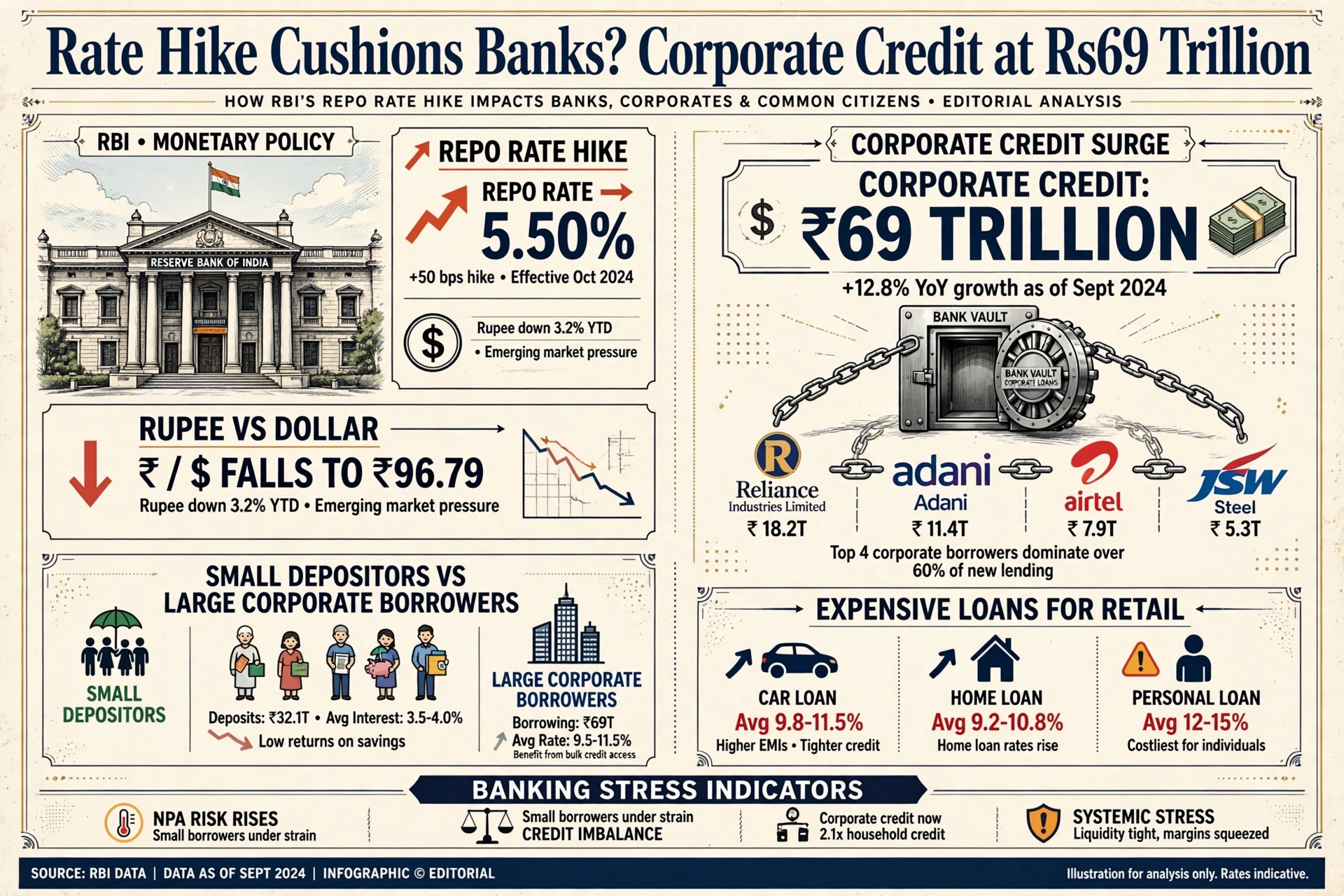
The RBI’s October 2026 repo rate hike to 5.50 percent was its first increase since February 2023, when the rate reached 6.50 percent. After cutting rates in 2025 and holding the repo rate at 5.25 percent, the RBI raised it by 25 basis points on October 7, 2026, signalling a shift towards calibrated tightening.
Country may have to wriggle out of a situation created by global upheavals, Gulf struggles with Houthis, US-Iran-Ukraine war, the US professional visa cuts, other tantrums, currency fluxes and fuel uncertainties.
With the rupee near a never before low vis a vis the US dollar around Rs 96.79 to Rs96.84 could make car, home and personal loans costlier as banks pass on higher borrowing costs.
Weak monsoon rains linked to El Niño have compounded price pressures in Asia's third-largest economy.
Rate rise is considered a positive move for the health of the gasping banking sector deep in stress, if not distress. Banks have locked up large sums in long-term loans.
India’s major corporate borrowers span infrastructure, energy, telecom and heavy industry. Reliance Industries borrows to fund refining, petrochemicals and Jio expansion; the Adani Group finances ports, power, airports and green energy. JSW Steel and Tata Steel tap domestic and international loans for capacity expansion, while Bharti Airtel uses substantial credit to fund telecom operations and network growth.
Banks subsidise their lending costs borne largely by small depositors.
However, the RBI decision to increase the repo rate and shift to a "calibrated tightening" stance does not provide an immediate or broad "rejuvenation" for banks, though it presents a mixed set of impacts. The deposit costs also face pressure to adjust upward as competition for customer funds intensifies.
Higher borrowing costs can slow down credit demand in rate-sensitive segments like housing, auto, and retail loans, even though the RBI raised its GDP growth forecast to 7.1 percent. The growth figures are as per the new index calibration and may not reflect the reality.
The rate hike reflects concerns over rising inflation as US draws more funds as dollar strengthens.
RBI Governor Sanjay Malhotra reaffirmed the commitment to price and financial stability, while signalling liquidity management measures to contain excess liquidity and curb excessive rupee volatility.
Indian banks face a deposit squeeze as household savings shift to mutual funds and equities, pushing up funding costs. To protect margins, lenders are taking greater retail credit risks, while gaps in board expertise on cybersecurity and modern risk management add to governance concerns.
Huge Outstanding
The outstanding corporate credit grew significantly within a single fiscal year, rising from Rs 63,19,057 crore in FY2024–25 to the current Rs69,21,734 crore (Rs 69.21 trillion) in FY2025–26.
Out of this massive credit base, loans deployed specifically to large industries account for roughly Rs 32.3 lakh crore, growing at 17.7 percent year-on-year rate due to a resurgence in infrastructure, manufacturing, and green energy projects.
Large Loans
Large corporate loans are highly concentrated among institutional lenders and massive tickets. Massive loans above Rs 100 crore make up 28 percent of the total outstanding loans across the entire Indian banking system. Large corporate demand is primarily driven by working capital needs and capital expenditure in sectors like petroleum, infrastructure, power, chemicals, and engineering.
Reliance Industries has a total group debt of around Rs3.74 lakh crore, while the Adani Group’s debt is estimated at Rs2.6–3.7 lakh crore and Bharti Airtel’s total or net debt at around Rs1.95 lakh crore. JSW and Vedanta alos have huge borrowings.
The country's largest public sector lender, State Bank of India (SBI), holds a massive corporate loan book of Rs 14.24 lakh crore as of March 2026.
Due to high corporate bond yields, major corporations have shifted away from debt markets and back to mainstream bank credit, accelerating the volume of locked-up capital in traditional banks.
When corporate loans "lock up" in the form of non-performing assets (NPAs) or structural stress, the figures remain highly significant. Often the actual hit is taken by the banks and small depositors. Large loans are written off dumping the cost on depositors.
The banks have written off close to Rs 10 lakh crore in loans given to large corporates and the services sector over the last 12 financial years.
While a write-off removes the bad debt from a bank's active balance sheet to free up lending flexibility, actual recovery from large defaulting corporate accounts historically hovers around 25 to 28 percent through insolvency channels like the National Company Law Tribunal (NCLT).
Short-Term Customer Slash
When banks lock up huge sums in long-term corporate loans or bad debts, they trigger a dangerous timing mismatch by using short-term customer deposits to fund projects that take twenty years to pay back. This imbalance forces banks to keep extra cash on hand and severely hurts their profit margins.
Furthermore, these massive loans trap a high amount of mandatory capital buffers under central bank rules. If a giant corporate borrower defaults, the bank is forced to immediately pull money from its own operating profits to cover the loss, which can instantly wipe out an entire quarter of earnings.
Finally, because so much money is tied up for decades, the overall velocity of credit slows down drastically crowding out smaller, higher interest-paying borrowers.
When large corporate loans lock up—either as long-term infrastructure debt or Non-Performing Assets (NPAs)—it severely restricts a bank’s operational capacity, strains liquidity and ignites cheap short-term fights.
Risk Weights and Provisions
Under the RBI framework, banks must set aside capital against corporate loans according to their risk weights. Large corporate loans can tie up substantial capital, limiting funds available for other lending, including retail and MSME loans. If a major corporate loan turns into NPA, provisions reduce operating profits; a large default can significantly erode quarterly earnings.
When banks lock substantial funds into long-term corporate projects, their lending capacity is constrained. This hits fresh credit to MSMEs and retail borrowers though they pay higher interest rates for shorter-tenure loans.
Expecting a major shift is not likely but the rate rise could give a cushion to the banks as credit demand could come down by large healthy companies. It may protect the depositors with less NPAs, as large loans often turn into, and cost of managing finances, are likely to be cut.
(Author, a well-recognised senior journalist and commentator, has served as a Professor & Dean at the capital-based IIMC.)











[[comment.comment_text]]