The Illusion of Demographic Strength

 41 minutes ago
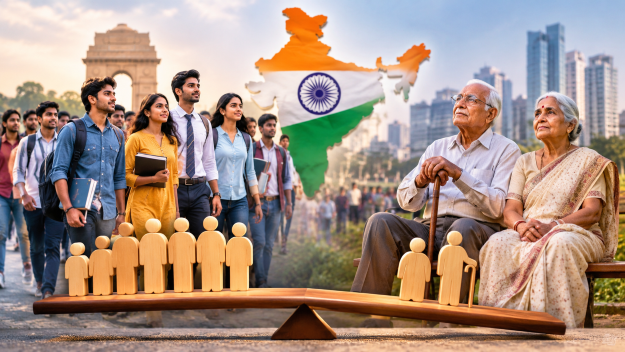
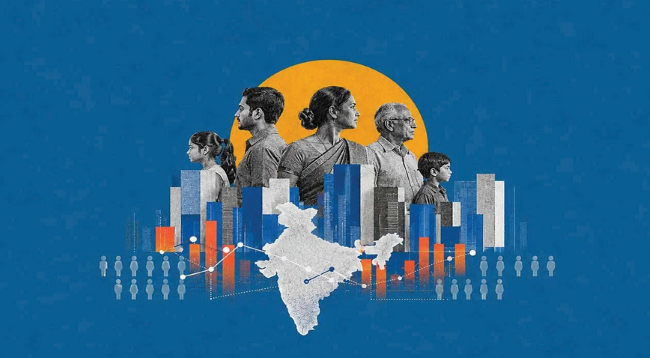
India's demographic transition is changing not only the size of its population but also the questions we ask about it. For decades, demographic success was measured through numbers, whether the country had too many people or enough to fuel economic growth. Today, however, population size alone reveals very little about India's future. The defining question is no longer how many people the country has, but how many will be capable of sustaining its economy, supporting an ageing society, and driving innovation in the decades ahead.
However, as we celebrate and debate India's demographic size, we may be asking the wrong question altogether. For decades, demographic policy and public debate were shaped by the challenge of managing rapid population growth, making fertility reduction and family planning central to India's development agenda. Today, however, the country's demographic reality is fundamentally different. With the total fertility rate now below the replacement level, the challenge is no longer one of containing population growth but of preparing for a future in which a relatively smaller working-age population will be expected to sustain economic growth, support an ageing society, and finance future development.
This highlights what can be called the demographic illusion. A sheerly large population offers a sense of comfort that a nation of over 1.4 billion will never fall short of human capital, and that it will always be there in large numbers. However, Demography is not just about counting heads, it is about understanding who makes up the population and what its potential is. Having a large population does not automatically mean having a large proportion of the population that contributes to and sustains the economy.
The importance of this distinction becomes apparent because demographic transitions tend to manifest gradually rather than suddenly. While the population may still grow for a while due to demographic momentum, the number of individuals entering the workforce in the decades to come would steadily fall if fertility remains below the replacement level. In parallel, with longer life expectancy due to improvements in health care, the proportion of the elderly population in India would rise considerably. This would not result in an immediate population shortage, but in increased pressure on each individual who is still productive.
The transition will therefore require a completely different policy discourse for India. In place of ‘How many?’, policymakers need to ask, ‘How many will there be to back up the aged, stimulate the economy and help fund future growth?’
For much of modern history, demographic strength was equated with numbers. That understanding is increasingly inadequate in the face of changing demographic realities. Demographic strength no longer relies just on the number of people living within the boundaries of a country, or the size of a country's working-age population, but is more often related to the human capital of that population, its health, education, skills, productivity, resilience, and capacity to participate meaningfully in economic and social life. A particular complexity of the Indian demographic transition is that the country is transitioning towards population ageing and decline without having already achieved universal, broad-based prosperity. Population ageing arrived in the advanced economies after decades of industrialisation, rising incomes, and the provision of education for all, as well as comprehensive healthcare systems and retirement provisions. India’s transition is beginning in a context of very limited resources, as a low- to middle-income country that might have to shoulder the weight of an ageing population in an economically poor and institutionally ill-prepared way. The challenge is not merely that India is becoming an ageing society. It’s that the nation is ageing before building the economic resilience, institutional capacity and human capital that helped wealthier countries to age with more dignity.
An economy on fewer shoulders
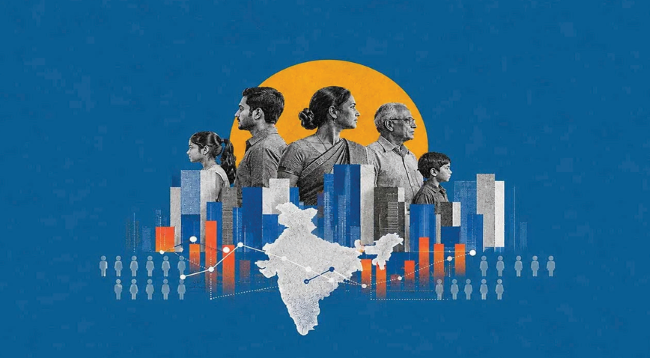
India is undergoing a demographic transition that is changing the relationship between generations. As people live longer, their proportion in the population will increase. At the same time, fertility rates are below the replacement level, which means the number of young adults entering the labour market in the coming decades will decline relative to the past. The consequence of this dramatic demographic transformation is that fewer working-age adults will be tasked to sustain economic growth while supporting an ageing society through taxes, the healthcare system, pensions, and family care.
This change in demographic arithmetic means each worker in the future workforce will be more important to the economy. In the past, when each successive cohort of young adults was larger, any learning deficiencies, ill health, joblessness, or skill shortages could be offset by population size, that demographic buffer is now shrinking.
With a narrower base of workers, each child who receives adequate nutrition, education, health care, and skills constitutes a larger part of the country's productive future. This shifts the need to invest in children from social obligation to demographic necessity.
India's challenge, however, extends beyond preparing future generations. The country also continues to underutilise a significant share of its existing workforce. Yet preparing future generations alone will not be enough. India also continues to underutilise a substantial share of its existing workforce. Millions of educated youth face unemployment or underemployment; women's participation in the workforce continues to languish below potential, and highly skilled professionals are emigrating.
The challenges of unemployment, gender disparity, or migration have been addressed as separate problems, but in a time of demographic transition, these represent productivity losses that are increasingly difficult for India to replace. When working-age people become a smaller fraction of the total population, the cost of each person not fully contributing increases over the long term. Unless India can fully utilise the capabilities of its existing and future workforce, its capacity to support a growing older population while sustaining long-term economic growth will become increasingly constrained.
The economics of demographic continuity
For nearly a century, modern economic policy has operated on an implicit demographic assumption that future generations will be larger or at least comparable in size to those preceding them. This assumption quietly shaped everything from education planning and labour markets to fiscal policy and urban expansion. Economic losses occurring today could often be dispersed across larger future populations, while the costs of social protection, pensions and healthcare were supported by continuously expanding tax-paying cohorts.
India's demographic transition challenges this assumption for the first time. Economic growth can no longer depend upon demographic succession, the expectation that each generation will naturally replenish or exceed the productive capacity of the previous one. Instead, prosperity increasingly depends on demographic continuity, maintaining the health, productivity, and functional independence of the same population over a much longer period. Growth, therefore, shifts from being driven by demographic expansion to being sustained through demographic preservation.
This represents a structural change in the logic of development itself. In a society characterisedby demographic abundance, governments primarily faced the task of expanding opportunity. In a society characterised by demographic scarcity, the greater challenge is preventing the erosion of productive capacity over decades. The central economic resource is no longer the continual arrival of new workers, but the cumulative capabilities retained within existing generations. Population ageing, therefore, transforms longevity from a welfare achievement into an economic variable.
Longer lives contribute to development only if they are accompanied by sustained health, productivity and institutional support, otherwise, longevity increases dependency without proportionately expanding productive capacity.
Consequently, demographic transition requires policymakers to think less in terms of annual economic performance and more in terms of intergenerational resilience. The defining measure of success is no longer how rapidly the workforce expands, but how effectively society preserves its economic, social and institutional capacities across increasingly smaller generations.
Institutional resilience
India’s demographic transition, often framed as a shift in age structure, is more truly a shift in the environment within which development must take place. The age when demographic abundance could silently offset weaknesses in institutional performance is coming to an end. As ageing accelerates and fertility remains well below replacement, resilience will rely less on demographic plenitude and more on the capacity of institutions to foster health, productivity, and engagement through the life course. The crucial demographic question is no longer whether India has sufficient population, but whether generations will become so much smaller as to be able to maintain the economic and social obligations left to them by much larger ones.
This requires a corresponding shift in governance. Demographic policy can no longer remain confined to managing fertility or responding to ageing after its consequences emerge. Instead, it must become anticipatory, recognising that capability lost at any stage of life carries consequences that extend across decades and are increasingly difficult to offset in a society with smaller successive cohorts. In this sense, demographic sustainability will no longer be secured by population growth, but by institutional capacity—the ability to preserve, renew and support human capabilities throughout longer lives.
India’s most profound demographic advantage, thus, rests not on the quantity of its population, but on the quality of institutions it underpins. The twenty-first century’s critical demographic shift is not simply from a young population to an old, but a transition from demographic abundance to institutional resilience - from counting the people to protecting their capabilities.
(Authors: Aneesh K. A. is a Fellow at the Centre for Studies in Population and Development (CSPD), CHRIST (Deemed to be University), Delhi, while Aleena Elza Mathew is an intern at the same centre at the university’s Delhi NCR Campus.)




[[comment.comment_text]]