Ankara’s Ambitions, Trump’s Blessing: How India Should Worry the Mecca Pact

 2 months ago
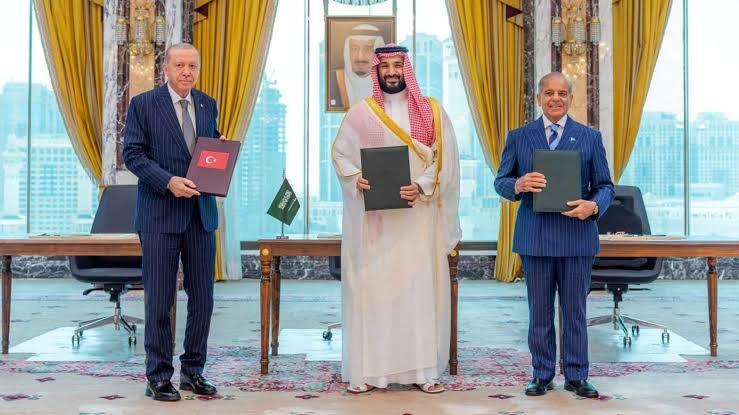
The recent formalisation of the Mecca Joint Defence Agreement between Saudi Arabia, Turkey, and Pakistan marks a seismic realignment in regional security dynamics. Fueling the debate, Turkish mouthpiece Yeni Safak published an un-bylined piece floating the prospect of Bangladesh joining this trilateral alliance, explicitly framing the shift as a way for Dhaka to escape "bilateral asymmetry" with New Delhi. Adding significant geopolitical weight to this trilateral development, U.S. President Donald Trump publicly endorsed the pact, posting on Truth Social that he was "very happy" to see these key partners step up to defend themselves in a "more meaningful way". This implicit American blessing effectively greenlights an emerging, alternative security structure—one anchored by a NATO member, a nuclear power, and the Arab world's wealthiest custodian.
For India, the immediate analytical imperative is to disaggregate the alliance's members, as not all present an equal threat. The Saudi posture remains largely transactional and pragmatic; Riyadh's deep economic reliance on India—evidenced by massive trade volumes, a $100 billion investment commitment, and strong energy ties—ensures that the Kingdom will not jeopardize its crucial relationship with New Delhi for Islamabad's sake. The Saudi motivation lies in burden-sharing and building a multi-layered defense deterrent post-oil, rather than forming an anti-India bloc. Trump’s approval reinforces this dynamic, validating the deal as a burden-shifting apparatus that relieves Washington of sole security guarantees while keeping U.S. allies aligned.
The real winner—and primary security challenge for India—is Ankara. Struggling with economic volatility, Turkey gains a lucrative market for its booming military-industrial complex, securing cash inflows and access to Saudi capital to fund high-tech projects like the KAAN fighter jet and advanced drone platforms. Beyond hardware, Ankara is systematically exporting its brand of political Islamism under a polished, sophisticated diplomatic umbrella. By aggressively pushing to expand the pact to include Bangladesh and positioning itself as a central node in rerouted trade corridors, Turkey seeks to widen its strategic footprint in South Asia while remaining persistently vocal on sensitive Indian domestic matters and Kashmir.
The potential expansion of this pact to Bangladesh carries deep strategic implications for New Delhi's immediate neighborhood. Since the 2024 political shifts in Dhaka, Turkey has steadily sought to deepen its defense ties with Bangladesh, using its soft power and ideological affinity to counter Indian influence. Should Dhaka fall into Ankara's orbit under the guise of an "independent foreign policy," India risks facing an increasingly coordinated defense footprint along its eastern border. Coupled with Turkey’s willingness to bankroll and export heavy armaments, South Asia could see a rapid shift in conventional defense equilibrium.
Ultimately, Trump’s endorsement leaves India navigating a far more complex geopolitical landscape. Washington's tacit approval of a self-sustaining regional alliance frees Turkey and Pakistan to deepen operational and military-industrial synergy without facing Western pushback. To counter these implications, New Delhi must maintain a strategy of patient deterrence. While continuing to leverage its irreplaceable economic ties with Riyadh, India must remain vigilant against Turkey's ideological and military overtures in Dhaka, ensuring that its neighborhood policy actively counters Ankara's expanding ambitions in South Asia.







[[comment.comment_text]]