A Tale of Three Cousins: An Appeal for Global Peace & Brotherhood
 1 day, 1 hour ago
There are moments in the history of humanity when we must pause, look beyond the immediate passions of our time, and ask ourselves a simple but profound question: What have we learned from our past, and what kind of world are we going to leave for the generations that will come after us?
Today, when innocent human beings are being killed, children are being orphaned, women are losing their husbands, and families are being destroyed by wars and hatred, this question has acquired an urgency that cannot be ignored. It is therefore time to look back into history—not to reopen old wounds, but to discover the things that unite us.
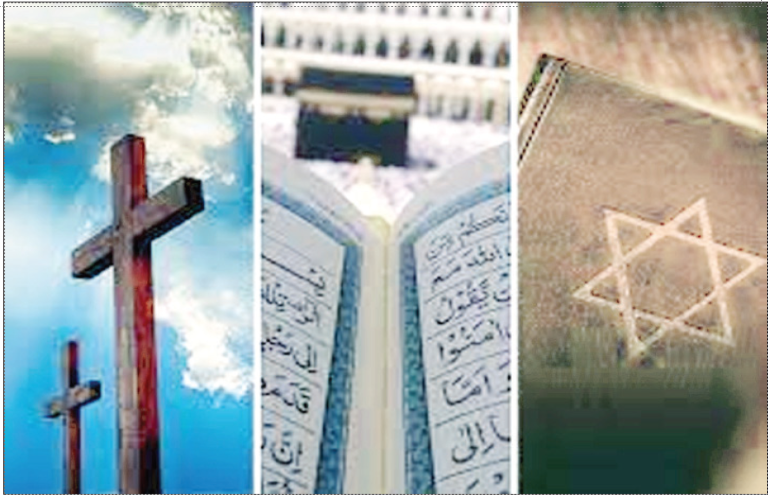
Judaism, Christianity, and Islam are commonly described as the three great Abrahamic faiths. As cousins, the followers of these faiths have sometimes fought one another, and history contains periods of intense conflict among them. But history also contains something equally important: shared faith, shared prophets, shared sacred places, intellectual exchange, coexistence, friendship, and long periods of peaceful cooperation. The time has come to remember these forgotten chapters of our common history.
One Creator, One Humanity
The story begins with the creation of the universe. The Torah, in the opening chapter of Genesis, declares that God created the heavens and the earth and describes the divine command: "Let there be light," and there was light. The Bible likewise begins its account of creation with the belief in one Creator whose command brings order out of darkness. The Qur'an repeatedly presents God as the Creator of the heavens and the earth, emphasizing His absolute sovereignty over creation through the famous phrase "Kun fayakun"—"Be, and it is."
The Creator of the universe is not presented as the God of one race alone; God is the Creator of all humanity. The Qur'an explicitly places Abraham, Noah, Moses, Jesus, and other prophets within a continuing chain of revelation, instructing Muslims to believe in what was revealed to them all. This provides an extraordinary foundation for understanding among Jews, Christians, and Muslims. We may differ profoundly in theology and religious doctrine, but we cannot honestly deny that we share a remarkable historical and spiritual inheritance.
At the heart of this shared heritage stands Abraham. Judaism traces its covenantal history through Abraham and his descendants. Christianity inherited the Hebrew Scriptures and placed Jesus within the history of the people of Israel. Islam regards Abraham—Ibrahim (A.S.)—as one of the greatest prophets and a model of devotion to the One God. While Moses, Jesus, and Muhammad occupy distinct places in their respective theological traditions, all three are central figures in the religious history of billions.
The message that emerges from this shared lineage should not be one of hatred, but of responsibility. If we truly believe that there is one Creator, then the human family ultimately belongs to one creation. We may belong to different nations, speak different languages, and follow different religious traditions, but no child chooses the country into which they are born—and no innocent child should become the victim of a war created by adults.
Sacred Ground and Historical Ties
Few places on earth demonstrate this common heritage more powerfully than Jerusalem. Jerusalem is sacred to Jews, Christians, and Muslims alike:
It has been at the center of Jewish religious history for millennia.
It is intimately associated with the life, crucifixion, and resurrection of Jesus in Christian tradition.
It contains the Al-Aqsa Mosque and the Dome of the Rock, making it one of the holiest centers of Islam.
A Muslim cannot be judged by the actions of an extremist.
A Christian cannot be judged by the crimes committed by an army claiming Christian justification.
A Jew cannot be judged by the policies of a government simply because it identifies itself with the Jewish people.
What did we do when wars were being fought?
What did we do when children were being killed?
Did we remain silent, or did we have the courage to say: Enough?
Yet Jerusalem has also been one of the great theaters of human conflict. This history should teach us an important lesson: a sacred place does not become more sacred when human beings kill one another over it. Its sanctity should make us more compassionate, not more violent. The holiness of Jerusalem should serve as a reason for dialogue, mutual respect, and coexistence—not a justification for hatred.
This shared connection extends beyond sacred sites to historical models of governance and scholarship. After the Prophet Muhammad’s migration to Medina, agreements were established among the city's diverse communities. The Constitution of Medina contained provisions recognizing Jewish groups, detailing mutual obligations and security arrangements. While modern scholarship notes that relations were complex and not every community was party to the exact same agreement, the record demonstrates that relations between Muslims and Jews cannot be reduced to a permanent story of hatred. There were alliances, trade, shared scholarship, and peaceful coexistence alongside periods of disagreement.
Similarly, the history of Christianity and Islam contains periods of deep warfare, particularly during the Crusades. Yet even during those difficult centuries, diplomacy, personal respect, and intellectual exchanges endured across religious boundaries. One of the most important lessons of history is that enemies can become negotiators, negotiators can become partners, and societies that once fought each other can eventually live side by side. History must not be used merely as a weapon; it should be used as a teacher.
Consider the era of Salahuddin Ayyubi (Saladin). While he fought Crusader forces as a celebrated medieval Muslim leader, the intellectual world around him was not divided into sealed compartments. The great Jewish philosopher and physician Moses Maimonides (Musa ibn Maymun) lived in Egypt during this period, serving as a prominent physician at the court of Saladin’s vizier and treating members of Saladin’s family. Knowledge crossed religious boundaries: a Jewish physician served Muslim rulers, a Muslim ruler valued the wisdom of a Jewish scholar, and scholars of all three faiths contributed to a shared civilization.
Overcoming Tragedy and Modern Conflicts
The Jewish people have experienced terrible persecution throughout history, culminating in the Holocaust in Nazi-occupied Europe, where approximately six million Jews were murdered. That horrific crime must never be minimized, forgotten, or justified. At the same time, we must distinguish between hatred directed against a people and the political actions of particular governments or regimes.
No religion or community should be collectively blamed for the crimes of individuals or political systems:
Human beings must be judged as human beings.
Today, perhaps the most urgent challenge facing Jews, Muslims, and Christians is the Israeli-Palestinian conflict. We must think and speak honestly. Israel is a reality—it exists as a state with a population whose security and future cannot simply be wished away. At the same time, the Palestinian people are also a reality—their history, identity, aspirations, dignity, and right to live in security and freedom cannot simply be erased.
Neither side can annihilate the other; neither side can make the other disappear. History repeatedly demonstrates that attempts to destroy an entire people or erase an identity produce only more suffering, resistance, and generations of hatred. The biblical and Qur'anic narrative of Pharaoh and Moses offers a profound moral lesson: Pharaoh possessed enormous power and sought to destroy the Israelites, yet he could not extinguish them. No powerful ruler can permanently erase a people by force.
Therefore, Israel must recognize that the Palestinian people cannot be eliminated or permanently denied their identity and aspirations. Equally, Muslims and Palestinians must recognize that Israel exists and that the security and dignity of Israeli civilians must be respected. The answer cannot be annihilation. The answer must ultimately be coexistence, justice, security, and a political settlement that secures a peaceful future for both peoples.
Universal Brotherhood and a Call to Action
This appeal extends beyond the Abrahamic traditions. India’s ancient civilizational philosophy offers one of humanity’s most beautiful universal messages: Vasudhaiva Kutumbakam—"The entire world is one family." This philosophy challenges us to look beyond narrow identities and recognize our place in a larger human family.
In an age of nuclear weapons, artificial intelligence, climate change, global communications, and economic interdependence, no country or community can live isolated from the rest of humanity. A war in one region impacts food prices, energy supplies, migration, and international security thousands of kilometers away. The world has become one single neighborhood—and we must learn to behave like good neighbors.
Whatever our theological differences, the moral teachings of the world's great spiritual traditions call us toward justice, charity, compassion, and the sanctity of human life. The purpose of religion cannot be to make human beings less humane. If our interpretation of faith leads us to hate those who are different, we must pause and ask whether we have understood its true spirit.
All political disputes can be negotiated. All territorial disputes, security arrangements, and borders can be discussed, and international guarantees can be forged. But the life of an innocent child, once taken, can never be returned.
A New Chapter for Future Generations
Let us remember the suffering of the Jewish people without turning that memory into hatred against another people. Let us recognize the suffering of Palestinians without allowing that suffering to become hatred against an entire religious community. Let us recognize the historical suffering of Christians and Muslims without using old wars to justify new ones. Let the synagogue, the church, the mosque, and all places of worship stand not as symbols of division, but as reminders of humanity's shared search for God, meaning, morality, and peace.
The coming generations will judge us. They will ask:
Let us be able to answer that we did not remain silent. We spoke for peace, for humanity, and for the children. Let us leave this planet as a garden, not a graveyard. Let Jewish, Christian, Muslim, Hindu, Buddhist children, and children of every faith or no faith grow up together without inheriting the hatred of their ancestors. Let them ask questions, study history, disagree peacefully, pray according to their conscience, and become friends. Let them discover what we too often forget: before we are members of any specific community, we are human beings. We are children of the same earth, we breathe the same air, we depend upon the same planet, and we ultimately stand before the same Creator.
Let us save coming generations from the wars that have consumed too many before them. God created the light—let us not return humanity to darkness.
Let there be peace. Let there be justice. Let there be friendship. Let there be humanity. Let there be love.
May the children of Abraham, together with all the children of God, live side by side in peace. Let us leave behind the bitterness of the past and place our faith in the sweetness and brightness of a shared future.
The three cousins may follow different paths of faith, but their future, like that of all humanity, depends on learning to live together. The choice before us is clear: perpetuate the conflicts of history or begin writing a new chapter of understanding. For the sake of our children, we must choose peace.
(The author, a former Cabinet Minister and Acting Chief Minister in UP government, is a widely respected political leader and educationist. A life President for The Organisation of Nuclear Disarmament and World Peace, he has extensively traveled to the US, UK, Turkey, Afghanistan, Hong Kong, Italy, Russia, Iran, Iraq,Kuwait and South East Asian countries.)






[[comment.comment_text]]