The Sociology and Politics of Delimitation

 2 months, 3 weeks ago
Gerrymandering, Regional Rifts, and the Imperative for Opposition Unity
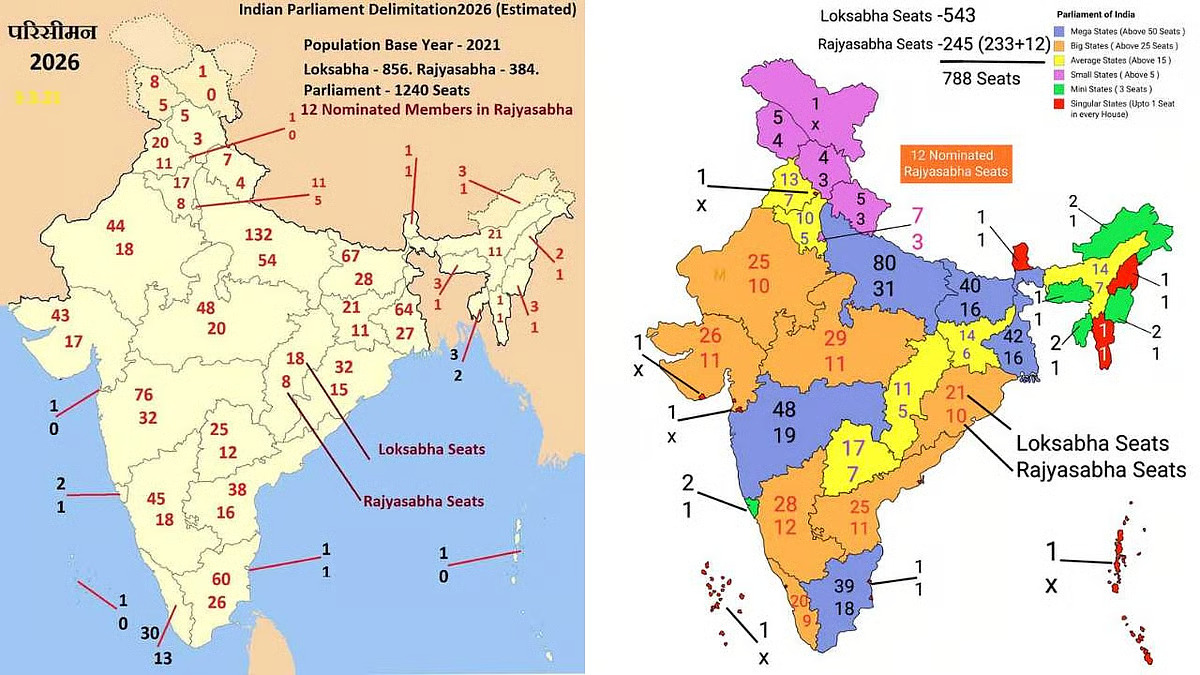
Delimitation in India has evolved into one of the most fraught political battlegrounds of the recent years, raising fundamental questions about representation, federalism, and political equity. What was historically intended as a routine administrative exercise to ensure equal vote value across parliamentary constituencies is now intensely politicized. As the country approaches the post-2026 threshold established by the 84th Constitutional Amendment, the upcoming redrawing of electoral maps threatens to alter the balance of power between regions, social classes, and political coalitions.
The North-South Rift and the Weaponisation of Women’s Quota
The parliamentary drama surrounding the recent legislative session underscored how delimitation has become tangled with broader political maneuvers. The ruling National Democratic Alliance (NDA) presented its proposals strategically embedded within the Women’s Reservation Bill. When the legislative push stalled in the Lok Sabha without the required two-thirds majority, the ruling coalition framed the opposition’s resistance as an attempt to deny political empowerment to 49 percent of the population. In response, the Congress-led INDIA bloc clarified that while they fully supported women's reservation—having passed similar legislation in 2023—they opposed passing a delimitation framework prior to the release of official census data.
For the southern states, this debate strikes at the very heart of Indian federalism. Having successfully implemented national population control and family planning policies over the past several decades, states in the South now face the prospect of political penalization. A population-based redistricting exercise would disproportionately increase the parliamentary representation of faster-growing northern states.
Because northern regions form the core electoral stronghold of the BJP-led coalition, southern regional parties view the prospective boundary shift as a structural dilution of their national electoral clout, made worse by linking it to gender quotas.
These concerns are not entirely theoretical, as recent events demonstrate how boundary changes can be deployed strategically even under existing frameworks. The 2023 delimitation exercise in Assam, conducted under Section 8A of the Representation of the People Act, 1950, showed how constituency boundaries can be redrawn using older census data. Critics argue that such selective exercises offer a template for altering voter distributions to favor the governing party well before a full national census is conducted.
Comparative Lessons from the American Experience with Gerrymandering
To understand how electoral geography can be reshaped for political advantage, India’s political landscape can be analyzed alongside the United States' long history with congressional redistricting. Following every decennial census, American state governments redraw legislative boundaries to match population shifts. Because this process is largely managed by state legislatures and governors, the party controlling state government holds immense power to shape districts in ways that entrench its own dominance—a practice known as gerrymandering.
Over the past decade, technological advancements have transformed gerrymandering from a crude political art into a high-precision science. The integration of advanced computing, granular demographic mapping, and dark money has allowed ruling parties in various American states to construct district maps that endure despite significant shifts in overall voter sentiment. As a result, parties can maintain legislative majorities even when losing the statewide popular vote.
American redistricting generally relies on three types of gerrymandering: partisan (benefitting the governing party), bipartisan (protecting incumbents across parties), and racial one that targets non-White minorities.
In practice, boundary manipulators rely on two primary techniques: "cracking" (dividing a target group's voters across multiple districts to dilute their voting power) and "packing" (concentrating a target group into a single district to minimize their impact across neighboring seats). While the U.S. Supreme Court ruled in Miller v. Johnson (1995) that racial gerrymandering violates constitutional rights, key protections were later weakened by decisions such as Shelby County v. Holder (2013).
The American judicial response offers a sobering lesson regarding reliance on courts to fix structural political distortions. In the landmark 2019 case Rucho v. Common Cause, the U.S. Supreme Court ruled 5–4 that partisan gerrymandering represents a nonjusticiable political question beyond the scope of federal judicial review. By leaving remedies entirely to elected officials and state courts, the ruling underscored how difficult it is to undo electoral map manipulation once it becomes embedded in statutory law.
Minority Vote Dilution and the Institutional Shifts in India
Applying these concepts to India highlights serious concerns regarding how delimitation might be deployed by the current ruling dispensation. The current regime is primarily planning to replicate what we see in American system as “racial” gerrymandering. In India’s case the targeted communities are not separate races, but other religious minorities, Muslims in particular.
The primary apprehension is that redrawing constituency lines could systematically dilute the electoral weight of minority communities. Using the dual mechanics of ‘cracking’ and ‘packing’ concentrated minority populations could either be split across three or four adjacent seats to erase their decisive margin, or packed into a single seat to reduce the total number of minority-influential constituencies nationwide.
This spatial strategy aligns with broader patterns observed in contemporary Indian politics. Since the rise of Hindutva-led political dominance, political strategy has increasingly relied on two parallel approaches: rendering minority vote banks electorally redundant and consolidating majority community voters against the social bases of secular opposition parties. Through targeted boundary shifts, this strategy aims to ensure that even if opposition parties form alliances, the underlying geography renders victory significantly harder to attain.
Beyond spatial restructuring, changes to institutional oversight have further deepened anxieties about electoral fairness. A key example is the passage of the Chief Election Commissioner and Other Election Commissioners Act, 2023, which removed the Chief Justice of India from the selection panel and replaced them with a Cabinet Minister. This shift gave the executive branch decisive control over appointments to the Election Commission of India (ECI), removing a key judicial safeguard for electoral neutrality.
The Imperative for Opposition Unity and Coalition Strategy
While institutional shifts and redrawn maps present formidable hurdles, the opposition’s primary weakness remains its internal division. The BJP’s persistent dominance over the past twelve years is not solely the product of organizational strength or state resources; it is equally sustained by a fragmented opposition vote. Rather than mounting sustained, structured resistance—such as demanding formal vote divisions in Parliament or building grass-roots movements modeled on the farmers' protests—opposition parties have frequently succumbed to short-term rivalries.
Recent electoral statistics illustrate how vote splitting undermines anti-BJP majorities in state contests. In the West Bengal assembly elections, the BJP secured 45.84% of the vote, while the combined anti-BJP vote was split between the TMC (40.80%), CPI(M) (4.45%), and Congress (2.97%). Similarly, in Delhi, the Aam Aadmi Party (43.57%) and Congress (6.34%) contested separately, allowing the BJP (45.56%) to win by splitting the non-BJP vote share, which collectively exceeded 49%.
To counter the combined challenges of institutional changes and upcoming delimitation, the Congress party must shift away from last-minute electoral pacts and proactively establish stable, state-specific coalitions with regional parties. Without a coherent national arrangement that accommodates regional strengths, fragmented vote shares will continue to enable the governing coalition's legislative majorities.
In the current political scenario, therefore, the delimitation is far more than a technical adjustment of boundary lines; it is a structural reorientation of political representation. Navigating this shift requires a double response: defending federal principles and minority representation against manipulative map-making, while building a disciplined, unified electoral coalition capable of offering a clear national alternative.
(The author, a senior Congress politician, has served multiple terms as The member of Parliament.)








[[comment.comment_text]]