Drawing the Line: Section 16 of the EC Act and the Limits of Official Protection

 2 weeks, 6 days ago
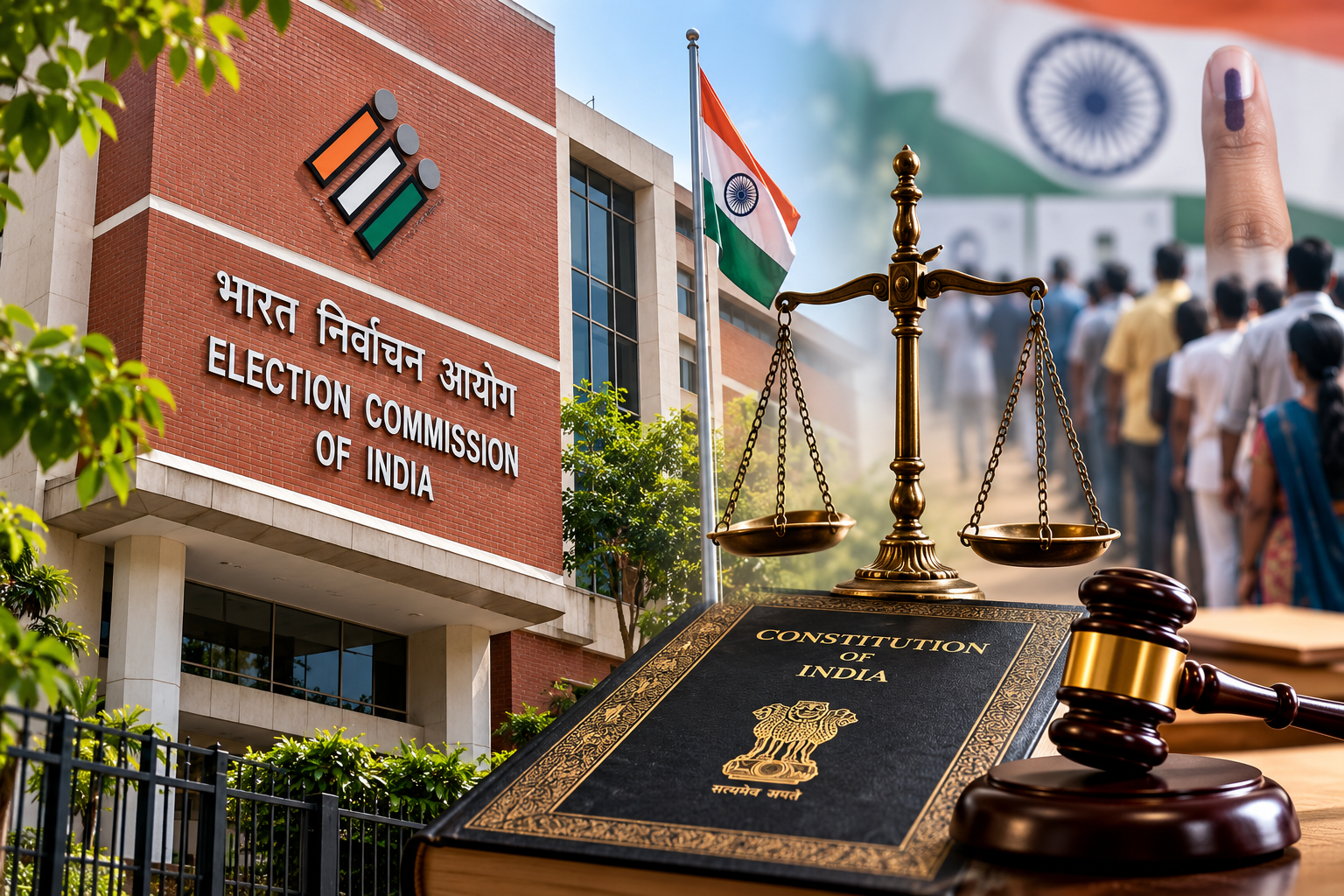
A democracy is at its most vulnerable when the same institution tasked with ensuring its justice is granted legal protection so expansive that its boundaries themselves start to come under investigation. The strength of democracy is found in holding an office accountable and subjecting it to the law, not in giving it unrestricted power. The Election Commission is not like other government agencies. It is the protector of the democratic process as a whole, which is how power is transferred. Its choices have an impact on everything from electoral rolls to election credibility. Therefore, the Commission's accountability and transparency are equally as important as its independence. Independence may cease to be democratic power and turn into a privilege of power when it is released from responsibility. This is the exact point at which the 2023 law's Section 16 becomes central to the democratic discourse.
Democracy is protected by the Election Commission. However, to what extent can a guardian be shielded from responsibility by the law? This unsettling question is made even more acute by Section 16 of the 2023 statute, given the Commission's recent internal conflicts and criticism of its rulings. Giving the exact organisation tasked with protecting the election process particular immunity from scrutiny could turn into its weakest link rather than a bulwark for democratic transparency when grave concerns are raised about its operation.
This is where the 2023 law's Section 16 poses a very unsettling query on the fundamentals of democracy. The clause protects former office holders as well as current Chief Election Commissioners and Election Commissioners from civil and criminal prosecutions for any act, deed, or statement made while performing official duties. To put it another way, even if the office closes, the legal protection afforded by official actions might not.
Legally speaking, this does not grant immunity for all private behaviour or automatically stop all arrests or police investigations. However, the true democratic question is far more significant: what practical means of guaranteeing accountability are left when grave concerns are raised regarding the official behaviour of the highest constitutional guardians of the election process?
This is the most critical democratic test for Section 16. The Election Commission may need to be shielded from destructive litigation and political pressure. However, institutional independence itself may be questioned when the delicate balance between responsibility and protection is upset. Just because an office has a significant duty does not give it unrestricted protection in a democracy. Conversely, the needs for accountability become more apparent as public power increases.
Election guardians must be autonomous within the law, not outside of it. The main democratic worry about Section 16 is that it might become so powerful as to stifle the voice of accountability.
An essential prerequisite for democracy is the Election Commission's independence. The 2023 statute that governs the appointment of Election Commissioners included Section 16 in this context. Importantly, the original bill did not have this provision. The government introduced a new Clause 15A on December 12, 2023, when the bill was being considered. This clause later became Section 16 of the statute that was passed. The claimed justification was to let the CEC and Election Commissioners carry out their official duties "fearlessly, freely, and fairly" by shielding them against malicious or vexatious litigation. To put it another way, the government was taking care of an actual institutional issue: shielding Election Commissioners from pointless legal action.
That argument makes sense on its own. However, democracy faces its more difficult dilemma at this very moment. Immunity and independence are two different things. While immunity shields an institution from some types of legal action, independence releases it from outside pressure. Independence is essential to democracy, but immunity can only be justified when its limits and the corresponding accountability systems are well-defined.
The judiciary is not immune from judicial scrutiny because of judicial independence. An official with administrative autonomy is still subject to the law. So why should the Election Commission be evaluated differently?
Undoubtedly, a democratic watchdog needs to be brave, but it shouldn't become unaccountable. It must be shielded from political pressure but not from impartial examination of grave accusations. Therefore, the essential query is: Does Section 16 safeguard institutional independence, or does the scope of its protection impede the pursuit of accountability?
The Election Commission is a constitutional organisation created under Article 324 and charged with guaranteeing free and fair elections; it is not a typical administrative body. The democratic transfer of power, political equality, and citizens' ability to vote are all directly impacted by its decisions. Thus, the independence of the Commission is required under the Constitution. However, the Constitution does not shield its authority from responsibility. For a constitutional institution, autonomy is exerting independent authority within the bounds of the law, not being above the law. The basic criterion of democratic government is that constitutional responsibility must increase with public power.
Whether Election Commissioners should have legal protection while carrying out their official duties is not the true matter underlying Section 16. They need to be shielded against vexatious lawsuits and political pressure. The question is whether we are unintentionally shutting the door to accountability by defending independence.
It makes sense that the Commission could struggle to operate impartially if every losing candidate or political party could take Election Commissioners to court following each election judgement. However, how can defending against pointless lawsuits also compromise the potential for an impartial investigation of grave accusations? Instead of shielding commissioners from accountability, democracy has to insulate them from the fear of litigation.
This is where the more complex issue pertaining to Section 16 arises. Public officials are not exceptionally given limited legal protection for actions taken in their official capacity in democracies all over the world. The true test is whether the boundaries of that protection are well-defined and whether there is still a way to hold someone accountable when those boundaries are crossed.
There must be a reliable channel for independent investigation and judicial review if there are substantial claims that an electoral decision violated individuals' rights, that the law was wilfully broken, or that official authority was misused. Because independence is a prerequisite for responsibility in a democracy, not an alternative to it. The organisation tasked with safeguarding the people's right to vote cannot be kept out of the public's line of inquiry.
At this point, calling Section 16 a clear violation of Article 14 would be a legal judgement that can only be reached by the judiciary. However, the clause undoubtedly calls into question the equality principle found in the constitution. Why—and to what degree—should a constitutional official receive extra legal protection for his official behaviour when the average citizen is held accountable for his actions? Only when such protection preserves autonomous decision-making without eliminating accountability can it be justified democratically. Therefore, the debate is not just about the privilege but also about its boundaries: how far should the shield go, who should be in charge of it, and how and for whom should the door to justice stay open if it is crossed?
This argument is unsettling because of the history of Section 16. The original bill, which was presented to the Rajya Sabha on August 10, 2023, addressed the appointment, qualifications, selection, tenure, service conditions, and removal of election commissioners in detail. However, it did not include a clause that would have provided special protection in civil or criminal proceedings pertaining to official duties. The administration added this safeguard to the Bill on December 12 during parliamentary discussions by introducing a new Clause 15A, which later became Section 16. The bill was approved on December 21, signed into law by the President on December 28, and went into effect on January 2, 2024. In other words, this safeguard was introduced during the legislative process and was not a necessary component of the original legislative structure. Because of this, concerns over its rationale, boundaries, and compatibility with democratic accountability are completely valid.
Section 16 has gained fresh significance because of recent disputes inside the Election Commission, including 14 formal objections allegedly filed by two Election Commissioners over various rulings, including the SIR. There have also been political calls for CEC Gyanesh Kumar to be arrested. The veracity of those claims is a different issue that must be resolved by due process. However, the incident raises an important question: how can serious accusations be fairly investigated, responsibility guaranteed, and institutional independence preserved at the same time? That is Section 16's true democratic test.
"Unlimited power" is the most perilous term in a democracy. Democracy restricts power rather than eliminating it. Democracy emerged from the understanding that unbridled authority had the potential to eventually overpower individual liberties. For this reason, the administration is constrained by law, the judiciary itself functions within constitutional bounds, the President is subject to the Constitution, the government is answerable to Parliament and the court, and ministers must answer to Parliament for their actions. Therefore, how can the Election Commission, which is tasked with ensuring the equity of the process by which democratic power is transferred, deviate from this fundamental tenet?
The independence of the Election Commission should not be questioned. The Opposition must be allowed to contest its decisions without intimidating it; Election Commissioners must not be afraid to enforce the law for fear of legal action; and it must be sufficiently independent that even the ruling government cannot put political pressure on it. However, invulnerability is not the same as independence. The law is the source of authority for a strong institution; an institution that is unassailable raises the question of who controls its boundaries. It may be important to defend against malicious and misleading lawsuits, but doing so cannot impede the pursuit of an impartial examination into grave and well-supported claims. A watchdog free from outside pressure is necessary for democracy, but it must also be accountable.
After all, elections involve more than just a technical process involving ballots, electronic voting machines, and vote counting. They are the most important public contract of trust in democracy. When a voter enters a polling place, they do so with the hope that their name will stay on the electoral roll, their vote will be recorded, their selection will be tallied, and the transfer of power will represent the will of the people. Because of this, when significant concerns are raised about the impartiality, decision-making, or official behaviour of the organization tasked with protecting elections, the crisis transcends the organization and instead affects the public's belief in democracy.
This is the point at which the Section 16 controversy becomes important. The issue is not whether Election Commissioners should face legal action in response to every grievance, political accusation, or malicious litigation. The actual question is: What reliable channel of accountability should be available if significant, well-supported, and legally legitimate concerns about the use of official power ever come up? Through legislation, judicial review, openness, and independent institutional scrutiny, an organisation tasked with monitoring democracy must continue to be subject to democratic oversight.
The Election Commission does not own democracy; rather, it is its protector. It needs protection but also accountability; independence but within the law; and authority but within the Constitution. A democracy's capacity to keep even its most powerful institutions within the bounds of the law is what truly makes it strong, not how much authority its institutions have.
Because of this, the key concern posed by Section 16 is one that defends democracy itself rather than any particular person or position: if the organisation tasked with ensuring election integrity is shielded from accountability, then who protects the guardians? Democracy requires an independent Election Commission, but it is an accountable Election Commission that earns the public's trust.







[[comment.comment_text]]