Behind Closed Doors: The Hidden Face of Child Labour

 an hour ago
A commercial establishment can generally be identified and inspected but a private residence does not present the same degree of visibility and hence this makes domestic child labour difficult to identify through conventional enforcement mechanisms.
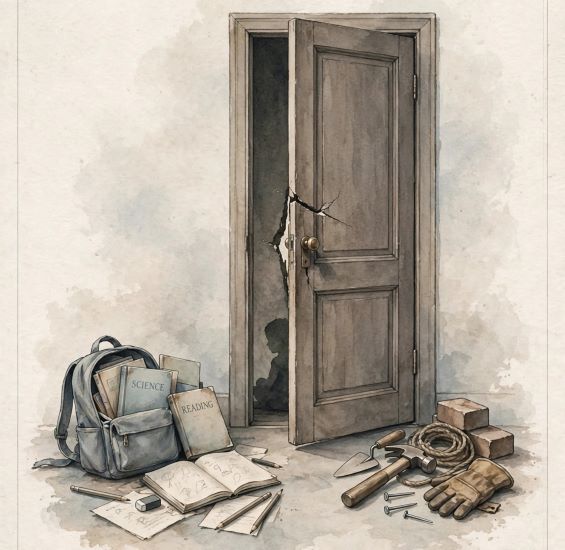
Unfortunately, child labour remains one of the less visible social concerns in our society, particularly when it occurs within private households. While children working in commercial spaces are easily noticed but children employed as domestic workers or household helpers often remain outside public scrutiny which is a cause of concern. Since their workplace is a private residence, their working conditions are rarely documented or reported. Hence the issue requires examination not only as a labour-law violation but also as a question of education, child protection, household vulnerability and social responsibility.
The most sensitive aspect of the problem is the engagement of children as domestic servants and in such cases, a child may be brought from a financially vulnerable family into another household on the assurance of accommodation, care or education. In practice, however, the child may become responsible for cleaning, washing utensils, cooking, caring for younger children and performing other domestic duties for extended periods. Education is discontinued and the child is in real meaning effectively treated as an employee. Thus the arrangement raises serious legal and child-protection concerns.
The law governing the subject is Child and Adolescent Labour (Prohibition and Regulation) Act, 1986, as amended in 2016. The amended law distinguishes between a “child”, meaning a person who has not completed 14 years of age, and an “adolescent”, meaning a person who has completed 14 years but has not completed 18 years. The law generally prohibits the employment of children below 14 years, subject to limited exceptions expressly provided in theAct and for adolescents, employment is prohibited in occupations and processes classified as hazardous.
The issue of domestic work is significant because the Schedule to the Act expressly includes “employment of children as domestic workers or servants” among the occupations prohibited for children. Consequently, the description used by a household whether “maid”, “helper”, “domestic help” or another term does not determine the legality of the arrangement. The age of the child and the actual nature of the work are legally relevant. Article 24 of the Constitution of India prohibits the employment of children below 14 years in factories, mines or other hazardous employment. Theconstitutional protection has to be read alongside the statutory framework governing child labour and education. The Right of Children to Free and Compulsory Education Act, 2009provides for free and compulsory education for children between six and fourteen years of age. Unfortunately, society seems to be flouting the law.
A child who leaves school to work as a domestic helper reflects more than a labour-law concern as the child is also being deprived of an important legal and developmental entitlement. Interrupted education reduces the likelihood of acquiring formal qualifications and marketable skills, which can subsequently restrict employment opportunities and a child labour can therefore reproduce economic vulnerability rather than eliminate it. This is one reason why the response to child labour cannot be limited to removing children from workplaces.
Their return to education and continued participation in the schooling system must form part of the intervention by the concerned authorities. A commercial establishment can generally be identified and inspected but a private residence does not present the same degree of visibility and hence this makes domestic child labour difficult to identify through conventional enforcement mechanisms.The issue becomes more pronounced where the child is a live-in domestic worker. Here the employer's residence becomes both the child's workplace and, potentially, the child's place of residence. In such circumstances working hours can become difficult to establish, and the child may have limited contact with people outside the household and the absence of independent contact is a serious vulnerability. Families with unstable incomes may view a child's employment as a means of reducing household expenses and in some cases, sending a child to another household may be perceived as providing access to food, clothing, accommodation or education that the family itself cannot afford. Undoubtedly, this creates a difficult policy problem. Simply removing a child from employment without addressing the family's economic circumstances may not provide a sustainable solution. If the household remains financially vulnerable, the child may return to work or another child in the family may subsequently enter employment. This indicates the need to connect child-labour enforcement with social-protection and livelihood interventions. The objective should be to ensure that the economic survival of a household does not depend upon the labour of a child.
Girl children require particular attention . The vulnerability can become greater when a girl is living away from her family and has limited ability to communicate her circumstances. A child performing age-appropriate chores within her own family is not equivalent to a child being placed in another household to perform domestic work on a regular basis. Not every case of child labour will involve the same degree of exploitation. Circumstances involving withholding of wages, coercion, confinement, bondage, trafficking or abuse require a broader legal response.
The Juvenile Justice (Care and Protection of Children) Act, 2015 also contains a specific provision dealing with exploitation of a child employee, including circumstances involving bondage for employment or withholding or using the child's earnings. This establishes an important principle for enforcement: the child should be treated primarily as a person requiring protection rather than as an offender. Where the facts indicate trafficking, forced labour, physical abuse, sexual abuse or other criminal conduct, the applicable criminal provisions would also need to be considered by the competent authorities. The child needs to be assessed for educational needs, family circumstances, health and safety concerns and other vulnerabilities. Where appropriate, the child should be restored to education and linked with the relevant child-protection mechanisms. If the economic circumstances of the family that contributed to the child's employment remain unchanged, the intervention may have only a temporary effect.
A sustainable child-labour policy must therefore operate at two levels: protect the child and reduce the vulnerability of the household. The problem requires coordination among several institutions. Government institutions like LabourDepartment, Social Welfare Institutions, law enforcements agencies have a big role to play. Parents need to understand the risks of sending children into domestic employment. Employers need to understand their legal responsibilities and the teachers/communityinstitutions need to recognise signs of school exclusion and possible exploitation. Civil society organisations can contribute through awareness, documentation, legal assistance, rehabilitation and community-level monitoring.
A child may be cheaper, easier to control and less likely to negotiate working conditions than an adult but households employing domestic workers must also examine the age and status of the persons they employ and comply with applicable laws. The argument that a child is being provided with food and accommodation cannot automatically justify employmentnor can the claim that the child is being “treated like family” substitute for legal compliance. The social cost of this child labour cannot be measured only in terms of hours worked or wages earned. It includes the education that was missed, the skills that were never developed and the opportunities that may never return. For a poor household, the income from a child's labour may appear significant in the short term but from the perspective of the child's entire life, however, the cost can be much greater. Development cannot be considered complete if some children remain outside the education system and inside other people's households as domestic workers. We need to create conditions in which families do not need to send children to work, employers do not demand child labour, schools are able to retain vulnerable children, and the child-protection system can intervene before exploitation becomes severe. The most effective response will therefore require accurate data, strict implementation of the law, early identification, educational retention, family support, rehabilitation and sustained community awareness.
The most effective response will therefore require accurate data, strict implementation of the law, early identification, educational retention, family support, rehabilitation and sustained community awareness. There should be the systematic reduction of the conditions that allow children to enter labour in the first place.
(The author, a lawyer by profession, actively engages in public policy, research, and discourse on border tourism in the Kashmir Valley. Email: lawtahirmajeed@gmail.com)









[[comment.comment_text]]