Police State or Democracy? (When Power Fears the People)
 an hour ago
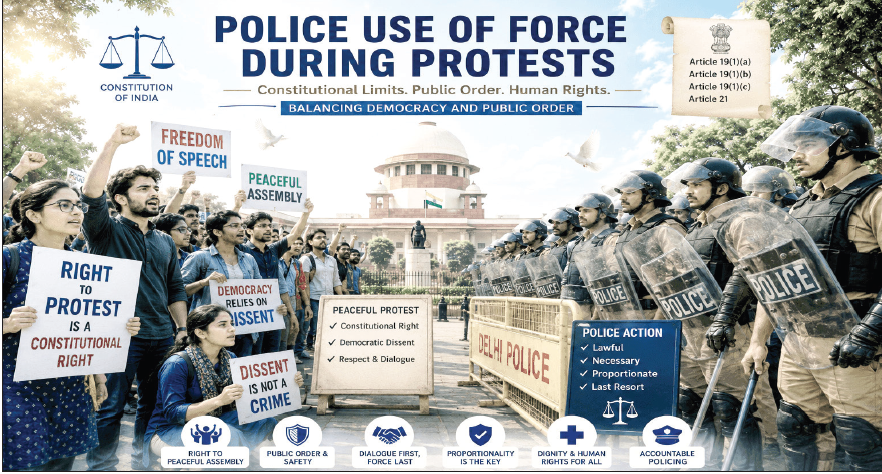
The way individuals in positions of authority handle those who disagree with them defines democracy, not the size of the majority. The right to rule is granted by winning an election, not the authority to suppress the populace. Democracy starts to erode from the inside out when nonviolent demonstrations are viewed as possible crimes, youth enquiries as security risks, and dissent as a law-and-order issue. Even if the Constitution, Parliament, and elections are still in place, government limitations and police surveillance start to stifle civil liberties.
An unsettling dilemma for Indian democracy has been brought up by the events surrounding rallies against Chief Election Commissioner Gyanesh Kumar in Delhi in October 2026: Is opposition being addressed through discussion or by the use of the police force?
Police are not tools of the state's terror but rather protectors of citizens' liberties in a democracy. The problem transcends administrative overreach and becomes a constitutional crisis when the government exploits law and order as a barrier against criticism and the police are used as a tool to quell opposition. The debate is not about any particular political party but rather about democracy itself: will India continue to be a democracy or progressively turn into a police state?
Institutions and Public Dissent
For democracy to be credible, the Election Commission's objectivity is essential. When disagreements arise over decisions involving the Chief Election Commissioner and other Election Commissioners, when crucial procedures like the Special Intensive Revision (SIR) of electoral rolls are scrutinised, and when the Commission's operations raise questions, the solution should be transparency that dispels suspicion rather than avoiding accountability.
Concerns regarding the Commission's internal decision-making and conflicts were made public by reports in The Indian Express. Documentary proof and judicial scrutiny are required to establish the truthfulness of accusations and the validity of decisions. However, it goes against the fundamental essence of democracy to make constitutional institutions unquestionable.
In light of this, the Delhi Police's role has come under criticism due to rallies by the opposition and the youth-led Cockroach Janata Party calling for the removal of the Chief Election Commissioner.
Who disagrees with the government is not the question; rather, it is whether opposition will be met with force or reason. It does not prove an officeholder's guilt to demand their resignation. However, merely labelling a protest movement as political cannot take away its rights. In a democracy, the police are constrained by the Constitution and the government by accountability; neither is above the voice of the people.
Delhi: Fear or Security?
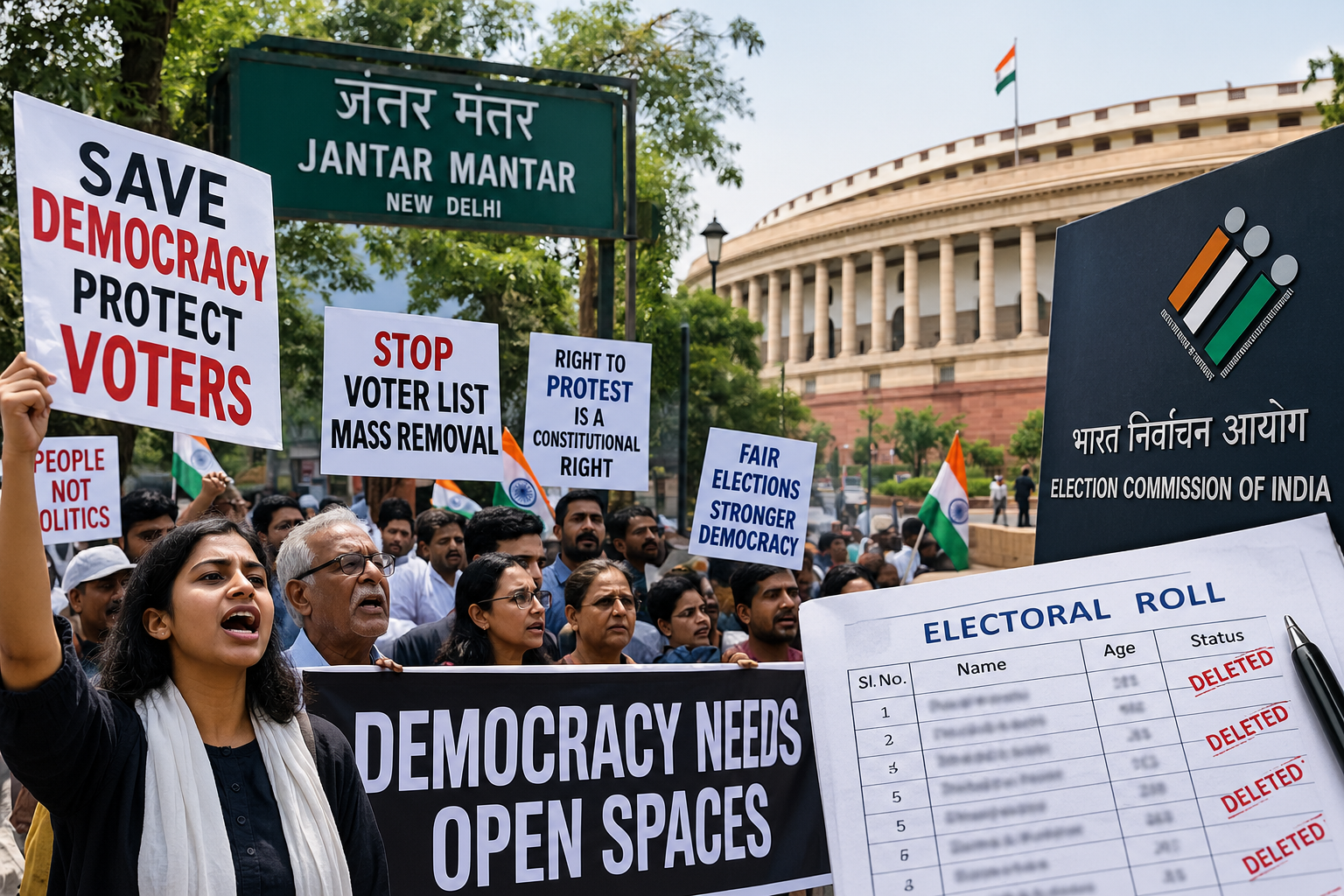
Questions that go well beyond law and order are raised by the restrictions put in place prior to the planned protests in Delhi on 9-10 October. These include extensive barricading, restrictions at metro stations, railway services, city borders, and public spaces, and claims that young people were detained only on suspicion of joining the demonstrations. The fundamental idea of civil liberty is in jeopardy.
Instead of repressing criticism, the government should work to avert bloodshed. The steps taken in the name of security must be closely examined when fear of a possible protest interferes with travel across the capital, keeps patients from getting to hospitals, or results in citizens being stopped just because they could take part in a demonstration. Every restriction must have a proportionate rationale, a clear legal foundation, and a proved necessity.
The citizens' constitutional right to peaceful dissent is not terminated by refusing authorisation for a protest. Instead of treating every objectionable voice as a threat and silencing it, the administration's duty is to support protests under appropriate circumstances.
The distinction between public safety and a rule of fear starts to blur when a government starts to dread the opinions of its people and the police start to be used as tools to stifle opposition. In a democracy, people expect answers from those in authority; they shouldn't be met with silence, arrest, or barricades.
Police: Guardians or Power’s Shield?
The purpose of the police is to enforce the law, not to punish people who oppose the government. It is not just police behaviour that is in jeopardy when asking questions is considered a criminal and nonviolent protest is labelled as a security threat; the fundamental essence of democracy is on trial.
The Indian Express reported on the events of October 10, including widespread protester imprisonment, movement limitations, and a thick security cordon surrounding Jantar Mantar. Concerns were also expressed regarding the purported deportation of YouTuber Dhruv Rathee from his home and the suspected detention of Cockroach Janata Party leaders at an airport. An unbiased examination of the circumstances and legality of these instances is necessary. The government must provide an explanation of the legal laws and justifications for any restrictions on citizens' liberties.
While Article 21 of the Constitution protects life and individual liberty, Article 19 ensures freedom of expression and the right to peaceful assembly. Reasonable limitations may be placed on these rights, but they cannot be arbitrarily suppressed in the name of security. The Constitution gives the police the power to uphold law and order, not the power to supersede it.
Violence and legal infractions must prompt the proper response. However, stopping all demonstrators based just on suspicion, hindering journalists in their work, or ignoring claims of harassment of women—if proven—would cast doubt on police objectivity. The degree to which citizens' rights are upheld, rather than the quantity of persons arrested, is the real litmus test for law enforcement.
A police state is more than just one with a lot of protection. It is one in which people in positions of authority start treating dissent as a crime and use the law as a cover to restrict freedom. Although calling India a police state would be premature, it would be risky to ignore such tendencies. Abolition of the Constitution is not necessarily the first step toward democratic decay. Even when accountability erodes and rights are increasingly susceptible to the will of those in power, institutions, elections, and courts may continue to exist.
Democracy's body may still be alive, but its soul will start to bleed the day the police stop upholding the law and start acting as a shield for the powerful, and people start to fear asking questions in their own nation. We disregard that warning at our own risk.
Government Accountability and the Judiciary
The irony of democracy is that when the Supreme Court must step in to defend people' rights, the issue is no longer just one of police conduct but also one of the government's comprehension of its constitutional duties. It is the police's responsibility to enforce the law; it is not their right to break it. An unbiased investigation and accountability are necessary if Delhi's detentions and limitations have violated civil freedoms. No one is elevated above the Constitution by wearing a uniform.
The same constitutional principles must be applied to issues pertaining to the Election Commission's operations. Transparent responses are required due to documented complaints, the decision-making process, and differences among commissioners. Just as constitutional office does not grant immunity from scrutiny, political accusations do not immediately prove guilt.
Democracy is protected by judicial intervention, but the government cannot consistently use this protection to avoid taking responsibility for its actions. The legitimacy of constitutional institutions depends on putting their decision-makers under unbiased examination rather than protecting their officeholders. The question is not who the powerful want to support, but rather whose liberties the Constitution is meant to safeguard.
Police State or Democracy?
The demand for Gyanesh Kumar's resignation is only one aspect of the current problem. It affects citizens' freedom, the legitimacy of constitutional institutions, and the core of democracy. Transparency is required to address concerns regarding the Election Commission, and dialogue—rather than the use of force—must be used to address public protests. In a democracy, the people give power its authority; it does not obtain permission to silence them.
The problem is no longer only one of law and order when a nonviolent demonstration results in the capital being transformed into a fortress, citizens' freedom of movement is restricted, and dissenters are arrested out of fear of unrest. It turns becomes a matter of a state apparatus obstructing civil liberties and the Constitution. The police are not protectors of the powerful; they are defenders of the Constitution. Instead of following the rules of political power, their uniforms must represent the discipline of the law.
India is referred to as the Mother of Democracy by Prime Minister Narendra Modi. However, election successes, legislative majorities, or shows of power do not really test democracy. Respecting dissent and listening to criticism without coercion or fear is the true test. A majority gives a government the authority to rule, but it does not give it permission to deny citizens their basic rights.
The threat of a police state starts to loom within democracy itself when a government fears questions, when a system perceives nonviolent protest as a conspiracy, and when the police are used as a tool to silence citizens. The official suspension of the Constitution does not always lead to the erosion of democracy. Sometimes the Constitution's very spirit gradually fades while it is still intact on paper.
The government must remember that citizens are not subjects of political authority and are entitled to free rights under the Constitution. Their criticism is not a weakness but evidence of democracy's vitality.
Therefore, the question is not just how strong the government is, but also how free its people are in the face of that might. One issue is often raised when those in positions of power start to fear the opinions of their own citizens: Is this what we call democracy?
(The author, a Doctorate in Laws, is a senior lawyer and civil society activist.)







[[comment.comment_text]]