The Indus Treaty and the Cost of Broken Trust

 3 months, 2 weeks ago
Water has always been more than a natural resource in South Asia—it is a strategic asset, an economic lifeline and, increasingly, a diplomatic instrument. Few agreements illustrate this reality better than the Indus Waters Treaty (IWT), signed in 1960, which for over six decades stood as a rare example of sustained cooperation between India and Pakistan despite wars, military crises and prolonged diplomatic hostility. Today, however, the treaty finds itself at the centre of an intense political and strategic confrontation. Following India's decision in April 2025 to place the treaty "in abeyance" after the Pahalgam terrorist attack, Pakistan has launched an aggressive diplomatic campaign to internationalise the issue, portraying New Delhi's move as a violation of international law and an attempt to "weaponise water." Yet behind this narrative lies a more complex reality. The controversy is not merely about river waters; it is equally about terrorism, national security, international diplomacy, climate resilience, economic vulnerability and Pakistan's long-standing internal water management failures.
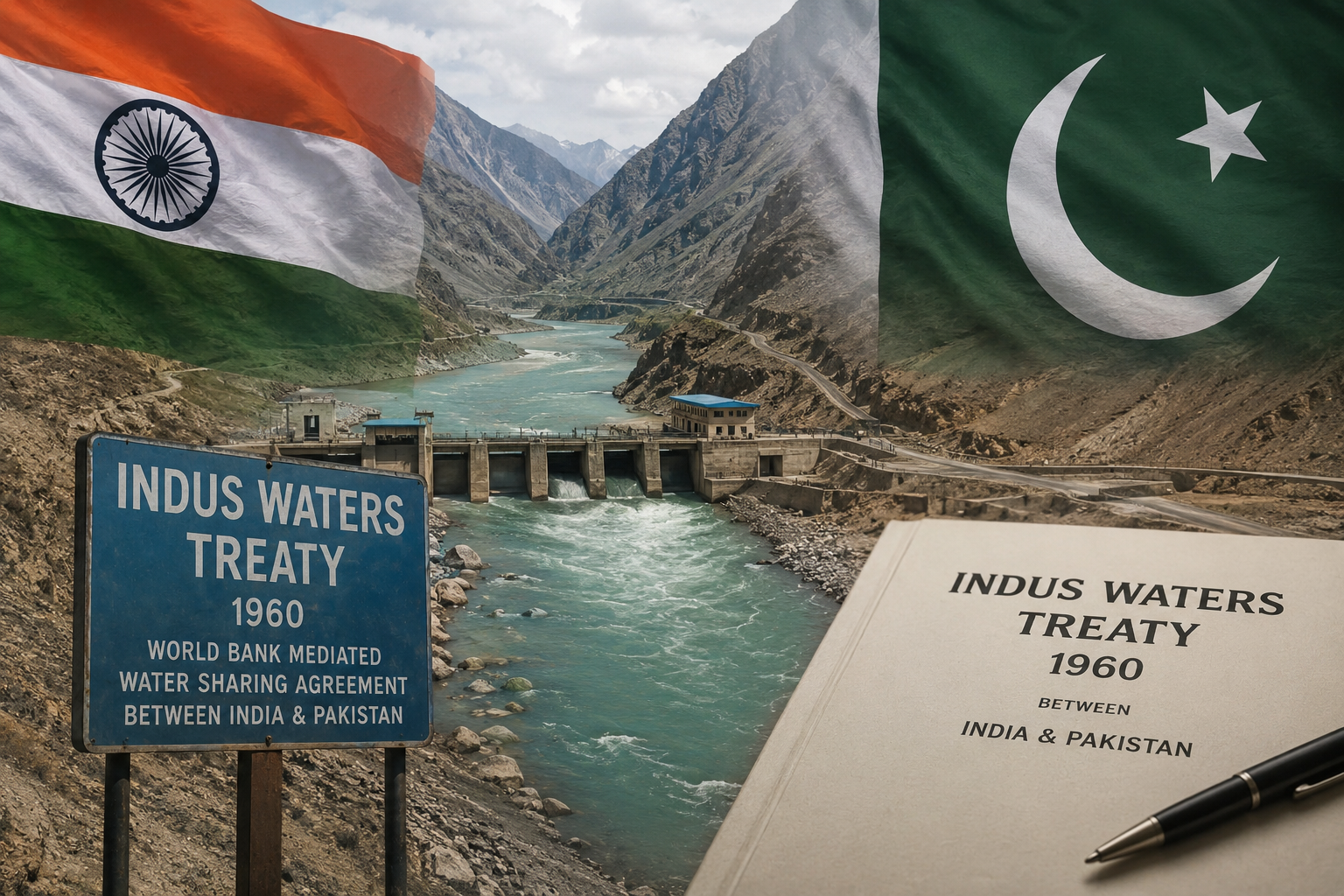
The Indus Waters Treaty was negotiated after nearly a decade of discussions and was signed on September 19, 1960, with the mediation of the World Bank. It divided the six rivers of the Indus basin between the two countries. India received unrestricted rights over the eastern rivers—the Ravi, Beas and Sutlej—while Pakistan obtained the bulk of the waters from the western rivers—the Indus, Jhelum and Chenab. India retained limited rights to generate hydroelectric power, undertake domestic use and carry out specified irrigation projects on the western rivers without materially affecting downstream flows.
The treaty has often been described as one of the world's most successful transboundary water-sharing agreements. Remarkably, it survived the wars of 1965, 1971 and 1999, periods of military mobilisation, repeated diplomatic breakdowns and numerous terrorist attacks. Throughout these decades, both countries continued to exchange hydrological data and hold meetings through the Permanent Indus Commission, demonstrating that technical cooperation could endure even when political relations had collapsed.
That continuity changed dramatically after the terrorist attack in Pahalgam in April 2025. Holding Pakistan-based terrorist organisations responsible, India announced that it was placing the treaty in abeyance until Pakistan took credible and irreversible action against cross-border terrorism. The decision represented a significant shift in New Delhi's Pakistan policy. For decades, India had consciously insulated humanitarian and technical agreements from broader political disputes. The latest decision indicated that security considerations would now increasingly influence bilateral cooperation.
India's argument is based on a broader principle rather than solely on water management. Successive governments honoured the treaty even after major terrorist attacks, including the Parliament attack in 2001, the Mumbai attacks of 2008, the Uri attack in 2016 and the Pulwama attack in 2019. The Pahalgam attack appears to have marked a policy threshold, with New Delhi signalling that no bilateral arrangement can remain entirely insulated from sustained cross-border terrorism.
Pakistan has responded with an extensive diplomatic offensive. Its leadership maintains that the treaty remains legally binding and cannot be suspended unilaterally. Pakistani officials have repeatedly described India's decision as the "weaponisation of water" and warned that altering treaty arrangements could destabilise the region. Foreign Minister Ishaq Dar has argued that depriving Pakistan of its allocated waters would endanger regional peace. Climate Change Minister Musadik Malik has accused India of violating international norms, while Pakistan Peoples Party Chairman Bilawal Bhutto Zardari has warned against any attempts to change river flows.
These statements serve multiple political objectives. They seek to present Pakistan as a victim of coercive diplomacy while shifting international attention away from allegations concerning cross-border terrorism. By framing the dispute as a humanitarian and environmental issue, Islamabad hopes to attract sympathy from international organisations, environmental groups and countries concerned with global water security.
The strategy also reflects Pakistan's broader foreign policy approach of internationalising bilateral disputes with India. Since New Delhi consistently maintains that issues between the two countries should be resolved bilaterally under the Simla Agreement of 1972, Islamabad has frequently sought third-party involvement in disputes relating to Kashmir, security and now water resources. The Indus Waters Treaty provides Pakistan with another platform to mobilise international opinion against India.
However, Pakistan's diplomatic narrative often overlooks the structural causes of its own water crisis. Independent studies by Pakistani institutions, international organisations and water experts have repeatedly concluded that the country's growing water scarcity is driven primarily by domestic factors. Pakistan has one of the world's lowest per capita water storage capacities. Much of its irrigation infrastructure dates back several decades and suffers from poor maintenance. Nearly 90 per cent of available freshwater is consumed by agriculture, much of it through inefficient flood irrigation that results in enormous transmission losses.
Rapid population growth has sharply increased demand for water while urbanisation has placed additional pressure on groundwater reserves. Climate change has further aggravated the situation through irregular monsoons, accelerated glacier melt, prolonged droughts and increasingly destructive floods. Together, these factors have created a chronic water management crisis that predates India's recent decision regarding the treaty.
Successive Pakistani governments have acknowledged many of these challenges. Official policy documents have recommended building additional reservoirs, modernising irrigation systems, improving groundwater regulation and introducing more efficient agricultural practices. Progress, however, has been slow because of political disagreements, financial constraints and institutional weaknesses.
Consequently, attributing Pakistan's water insecurity entirely to India's actions does not withstand closer scrutiny. Even if the treaty continues unchanged, Pakistan would still face serious water shortages unless fundamental reforms are undertaken.
Another important aspect often missing from public debate is the practical limitation on India's present capabilities. Despite political rhetoric suggesting that India can immediately stop water flowing into Pakistan, the engineering reality is considerably different. India currently lacks sufficient storage infrastructure on the western rivers to significantly alter river flows in the short term. Most Indian hydroelectric projects on these rivers are run-of-the-river facilities that generate electricity without creating large reservoirs.
Developing substantial storage capacity would require major investments, environmental clearances and several years of construction. Therefore, while India's policy shift has strategic significance, its immediate hydrological impact is likely to remain limited.
The legal dimension of the dispute is equally complex. Pakistan argues that the treaty contains no provision permitting unilateral suspension or withdrawal. India maintains that the broader circumstances governing bilateral relations have fundamentally changed due to persistent cross-border terrorism. International legal scholars remain divided over whether doctrines relating to fundamental changes in circumstances can be invoked in relation to the treaty. Consequently, the issue is likely to remain contested in diplomatic as well as legal forums.
Beyond legal arguments, the treaty now carries significant geopolitical implications. India's decision signals that future bilateral cooperation may increasingly be linked to Pakistan's actions on terrorism. It reflects a broader evolution in New Delhi's strategic thinking—from compartmentalising issues to integrating national security considerations across economic, diplomatic and institutional engagement.
For Pakistan, internationalising the treaty serves domestic as well as diplomatic purposes. It helps project external responsibility for internal economic stress, reinforces nationalist political narratives and diverts attention from longstanding governance challenges in the water sector. While India's decision undoubtedly raises important legal and diplomatic questions, it would be misleading to suggest that Pakistan's water insecurity is primarily the consequence of New Delhi's actions.
Ultimately, the future of the Indus Waters Treaty will depend less on legal arguments than on the broader political relationship between the two countries. No water-sharing agreement can function effectively in an environment characterised by persistent terrorism, deep strategic mistrust and minimal diplomatic engagement. Equally, neither country benefits from turning water into an instrument of confrontation.
The Indus basin supports the livelihoods of hundreds of millions of people across both countries. Its rivers should ideally remain a source of cooperation rather than conflict. However, lasting cooperation requires reciprocal trust, responsible state conduct and adherence to international commitments. Until the security deficit between India and Pakistan is meaningfully addressed, disputes over the treaty are likely to persist. Pakistan's attempt to internationalise the issue may generate diplomatic attention, but it cannot substitute for addressing the structural weaknesses within its own water management system or the larger political conditions that have brought one of the world's most enduring water treaties to its present crossroads.











[[comment.comment_text]]