India’s Strong Disaster Response Keeps Flood Damage in Check

 2 months, 3 weeks ago
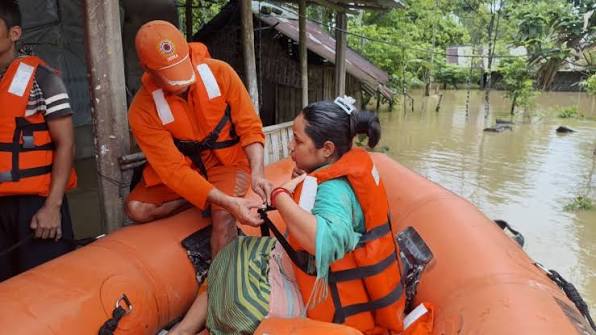
Many states in the country are currently under the grip of floods. The situation looks especially severe in Assam and Jammu and Kashmir. There has been loss of life and property. People have left their homes and taken shelter in relief camps. The good news is that the army, National Disaster Response Force (NDRF), State Disaster Response Force (SDRF), and fire and emergency service personnel were quickly deployed for rescue and relief work. Because of this, the damage in the flood-affected areas was kept to a minimum.
A Regular Challenge Floods in Assam happen almost every year. Millions of people get affected. Floods have become a regular part of life there. According to the National Flood Commission, about 40 percent of the state falls in the flood-prone area. This is because the state lies in the basin of the Brahmaputra river, and more than 50 rivers that start from the Himalayas join it. Even though floods are part of a natural cycle, India has a strong system to reduce the damage as much as possible.
A Strong Ecosystem for Disaster Management We must give credit to Prime Minister Narendra Modi and Home Minister Amit Shah for building a disaster management system that not only meets global standards but also provides leadership to many other countries. Today, India ranks among the top six countries in the world for disaster management. The loss from natural disasters in India is only 0.45 percent of the total GDP.
Figures from the Last Two Decades
A Story of Improvement If we look at the numbers from the past twenty years, it is clear that disaster management in the country has been improving every year. In 2013-14, natural disasters caused 5,677 deaths. In 2024-25, the number came down to 3,080. The highest loss of cattle was in 2006-07, when 4.55 lakh animals died. In 2023-24, this number was 1.19 lakh. In 2007-08, more than 35 lakh houses were affected by natural disasters. In 2023-24, only 1.4 lakh houses suffered damage. These figures clearly show that preparation, coordination, and quick response have improved a lot.
The responsibility for disaster management in the country lies with Union Home Minister Amit Shah. He keeps saying that India is moving towards zero deaths from natural disasters. He is not only talking about physical measures. He is giving more importance to reducing the effects of climate change that cause these disasters. To reduce disasters, we must deal with the conditions that cause climate change.
Global Leadership and Institutional Framework India is now seen as a global leader in disaster management. In the last 12 years, the Indian government has set high standards in capacity building, speed, efficiency, and accuracy. Disaster management plans are being prepared for every district in the states. Action plans are ready for dealing with every kind of natural disaster. As a result, India has achieved zero human deaths in several disasters. The record of dealing with cyclones with very little damage shows how the Centre, states, and local bodies can work together and achieve big success.
The Modi government has built strong institutions like the National Disaster Management Authority (NDMA), National Disaster Response Force (NDRF), and Coalition for Disaster Resilient Infrastructure (CDRI). Because of these, India has established itself as a global leader in disaster management.
We have seen the readiness and efficiency of the National Disaster Response Force (NDRF) many times. In every disaster, the NDRF’s response has been praiseworthy. Their record of saving lives is excellent. So far, this force has saved the lives of more than 1,68,000 people who were in danger.
India is now working on predicting future disasters in advance, doing research beforehand, and adopting global standards while adapting them to India’s geographical conditions. Even before the monsoon started, Home Minister Amit Shah had directed all states to strengthen their arrangements for any possible disaster. He also ordered the formation and activation of flood management teams. An integrated system for flood forecasting was made active at both central and state levels. Special attention was given to Himalayan regions and high-risk states, which were kept on alert mode. Early warning systems were specially linked to Jammu and Kashmir, Ladakh, Uttarakhand, Himachal Pradesh, Arunachal Pradesh, and Sikkim.
Talking only about the monsoon, after Assam, Uttar Pradesh is considered the most flood-prone area in India. Bihar is also one of the highest-risk states. In Uttar Pradesh, about 7.34 million hectares of land come under the threat of floods. In Bihar, 73 percent of the total area remains under flood risk. Here also, the Home Minister has taken charge himself. Teams of the National Disaster Response Force (NDRF) have been sent to Bihar and Uttar Pradesh. Extra rescue workers are also being deployed. We cannot stop natural disasters completely, but it is our responsibility to protect ourselves from them and reduce the damage.











[[comment.comment_text]]