India’s Cities Are Growing Faster Than Their Infrastructure

 1 month, 2 weeks ago
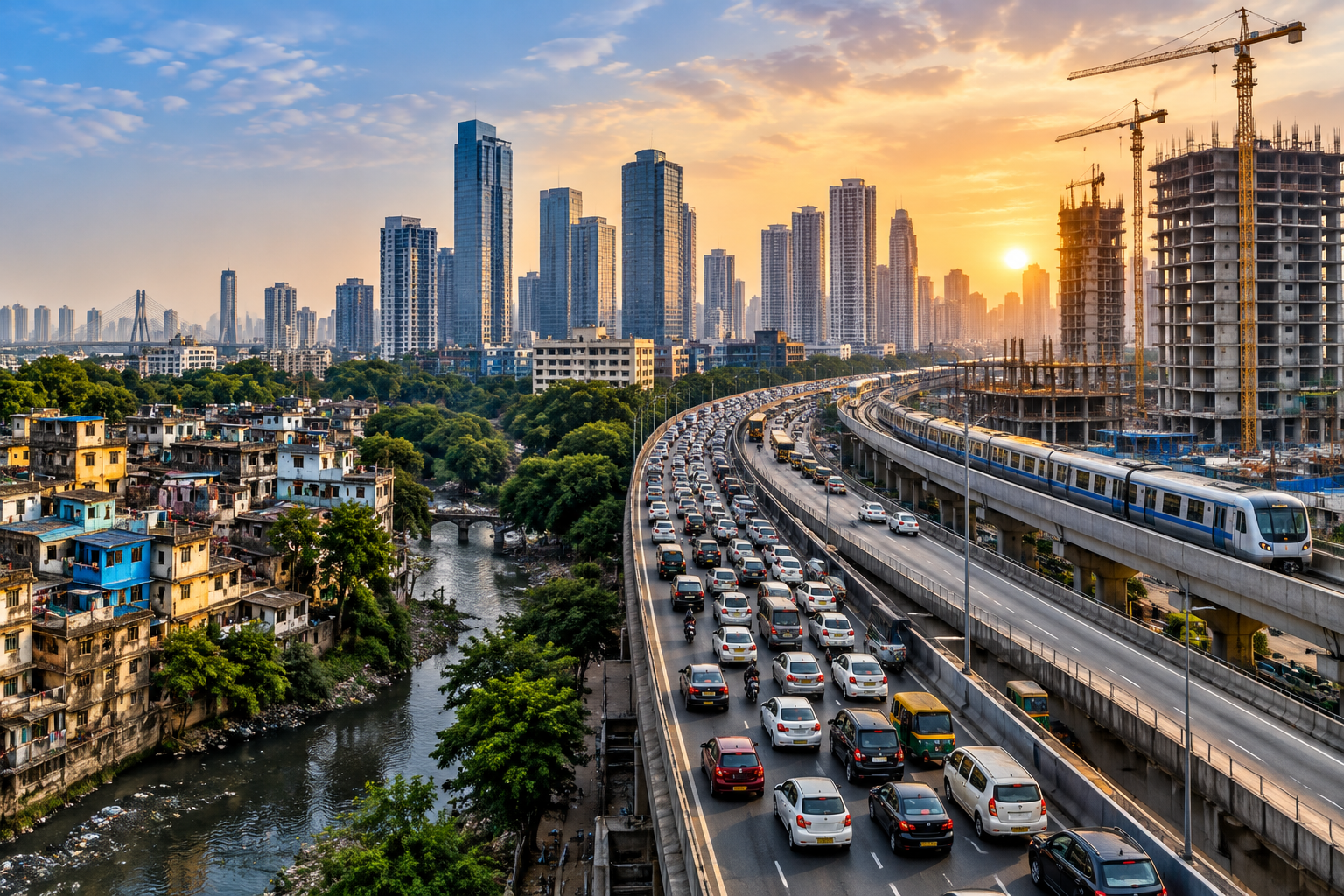
India’s urban transformation is no longer a gradual demographic shift; it is the defining economic reality of the country’s next phase of growth. Mumbai, Delhi NCR, Bengaluru, Hyderabad and Pune are expanding as magnets for capital, talent, technology and enterprise, while a new generation of Tier-2 and Tier-3 cities is rapidly emerging.
This is good news. Urbanisation is not a crisis. It is a consequence of aspiration.
Millions of Indians move towards cities because cities offer jobs, education, entrepreneurship, connectivity and opportunity. A developed India will necessarily be a more urban India. The real danger, therefore, is not that Indian cities are growing too fast. It is that infrastructure, governance and planning are growing too slowly.
Traffic congestion, unaffordable housing, water shortages, flooding, pollution, overflowing waste and overstretched public transport are not independent problems. They are symptoms of one fundamental failure: urban growth is frequently being allowed to outrun urban planning.
India must now make a decisive shift—from reacting to urban crises to anticipating them.
Urbanisation Is India’s Growth Opportunity—If Infrastructure Keeps Up
Cities generate productivity because they bring people, capital, businesses, universities and infrastructure together. Large labour markets allow companies to find talent more easily; workers gain access to more opportunities; ideas move faster; and entrepreneurship finds both markets and investment.
India therefore should not attempt to slow urbanisation. It should make urbanisation work better.
The lesson from Mumbai and Bengaluru is particularly important. Mumbai has become a global financial and commercial centre despite extraordinary constraints of land, housing, transport and flooding. Bengaluru has become one of the world’s leading technology centres despite infrastructure that has struggled to keep pace with its economic success.
But resilience cannot become an excuse for inadequate planning.
Citizens should not have to spend hours commuting because housing near employment centres is unaffordable. Businesses should not lose productive time because roads and public transport cannot accommodate economic growth. Cities should not repeatedly flood because drainage systems were designed for a different era.
Economic growth creates infrastructure demand. Ignoring that relationship ultimately imposes an economic cost.
India must therefore treat urban infrastructure as productive capital—not simply as municipal expenditure.
Cities Need Metropolitan Governance, Affordable Housing and Mass Mobility
The traditional model of governing cities through rigid administrative boundaries is increasingly obsolete.
Delhi NCR is a perfect example. A resident may live in one city, work in another, cross a state boundary during the daily commute and depend on infrastructure controlled by several different authorities. Yet planning and governance remain fragmented.
Air pollution does not recognise state boundaries. Traffic does not stop at municipal borders. Water and drainage systems do not follow political jurisdictions.
India needs metropolitan governance structures capable of planning entire urban regions as interconnected economic, transport and ecological systems.
Municipal governments, meanwhile, need greater financial strength, professional expertise and administrative autonomy. Cities require planners, engineers, environmental specialists, data experts and financial professionals—not merely temporary responses to visible problems.
But decentralisation must come with accountability. Municipalities should have predictable revenue through property taxes, user charges, land-value capture and municipal bonds, while citizens should be able to track spending and measure outcomes.
Housing must form the foundation of this strategy.
Affordable housing is not merely a social policy; it is economic infrastructure. When workers cannot afford to live near their workplaces, cities effectively export their housing problem into traffic congestion, pollution and lost productivity.
The same principle applies to transport.
The objective of urban mobility should not be to move more cars. It should be to move more people.
Metro rail, suburban trains, buses, walking and cycling infrastructure and last-mile connectivity must function as one integrated system. Public transport must be comfortable, reliable and convenient enough to attract citizens who own cars—not merely those who cannot afford them.
Water, Flooding and Pollution Are Warnings of a Climate-Stressed Future
Urban flooding is often treated as an unavoidable consequence of heavy rain. It is not.
Rain is natural. Catastrophic urban flooding is frequently aggravated by human decisions—encroachment on wetlands, destruction of natural drainage channels, excessive concretisation and inadequate storm-water systems.
Climate change makes the problem more urgent by increasing the risk of extreme and unpredictable weather.
India must therefore recognise an often-overlooked truth: nature itself is urban infrastructure.
A wetland that absorbs excess water is infrastructure. A lake that stores rainfall is infrastructure. A tree-covered open space that reduces urban heat is infrastructure. A natural drainage channel is infrastructure.
Destroying these systems and subsequently spending enormous sums to recreate their functions through concrete structures is economically irrational.
Water security presents an even deeper challenge. Growing populations, groundwater depletion, rising consumption and changing rainfall patterns mean that cities cannot continue relying indefinitely on distant water sources while allowing local water bodies to disappear.
Rainwater harvesting, wastewater recycling, groundwater recharge, lake restoration and efficient water management must become standard components of urban planning.
Pollution and waste require the same shift from reaction to prevention. Vehicle emissions matter, but so do construction dust, industrial emissions, waste burning and poor waste management. Cities need scientific waste processing, segregation, recycling, cleaner transport, stronger enforcement and continuous monitoring.
Environmental resilience must become part of the basic design of every Indian city.
India Must Build Stronger Tier-2 and Tier-3 Cities
There is another way to reduce pressure on India’s megacities: create more successful cities.
India should not allow Mumbai, Delhi NCR and Bengaluru to absorb a disproportionate share of jobs, investment and talent simply because other urban centres lack infrastructure and economic opportunities.
Indore, Surat, Jaipur, Lucknow, Kochi, Coimbatore, Nagpur and many other emerging cities can become powerful economic centres in their own right.
But the goal should not be to reproduce Mumbai or Bengaluru everywhere.
India needs a diversified urban network. One city may become a technology hub; another a manufacturing centre; another a logistics hub; another a centre for education, healthcare, tourism or finance.
Such diversification would reduce migration pressure on the largest metropolitan areas while spreading investment and opportunity across the country.
This requires planning for the India of 2045 and 2050, not merely the India of today.
Infrastructure takes years to construct and decades to serve. Every major metro system, highway, housing project, water network and drainage system should therefore be evaluated against projected population, employment, climate risks, land use and transport demand decades into the future.
Master plans must become living documents—not bureaucratic files that gather dust.
Most importantly, infrastructure must precede large-scale development. When a new residential or commercial area is approved, transport, water, sewage, drainage, schools, healthcare and public spaces should be planned at the same time.
India Must Move From Reactive Cities to Anticipatory Cities
The greatest weakness in Indian urban governance is often not a lack of ideas but a lack of anticipation.
A road becomes congested, and then it is widened.
A neighbourhood floods, and then drains are repaired.
Water runs short, and emergency supplies are arranged.
Pollution reaches dangerous levels, and restrictions are imposed.
This cycle is expensive, inefficient and ultimately unsustainable.
India needs cities that ask questions before crises occur: Where will the population grow? Where will jobs be created? How much water will be needed? Where will traffic increase? Which areas are vulnerable to flooding? How will climate change alter infrastructure requirements?
Technology can make this possible. Real-time data, digital governance, geographic information systems, intelligent transport systems and modern financial tools can help cities plan ahead rather than merely respond.
Citizens also have a role. Waste segregation, water conservation, public transport and respect for public spaces matter. But civic responsibility cannot substitute for institutional responsibility. Citizens cannot segregate waste if municipalities do not collect it separately. They cannot abandon private vehicles if public transport is unreliable.
Urban development must therefore become a partnership between capable governments and responsible citizens.
Building the Cities India Deserves
India possesses something previous generations did not: the financial capacity, technology, engineering expertise and institutional experience to build cities differently.
Metro networks are expanding. Digital governance is improving. Transport corridors are transforming connectivity. Renewable energy is expanding. Data-driven planning and innovative financing offer new possibilities.
The challenge is to connect these initiatives into a coherent national urban strategy.
The measure of a successful city should not be the number of flyovers constructed, kilometres of roads laid or size of its skyline. It should be much simpler:
Can an ordinary citizen live reasonably close to work? Can they travel safely and affordably? Can they breathe clean air, access reliable water, survive extreme weather and enjoy a decent quality of life?
That is the real test of urban development.
India’s cities are going to grow. They must grow.
The choice before the country is whether that growth will produce prosperity, productivity and opportunity—or congestion, inequality and environmental stress.
India does not need to slow its cities down. It needs to plan them ahead.
If infrastructure, governance, housing, mobility and environmental resilience can move in step with economic growth, India’s urbanisation will not be a burden on development.
It could become one of the country’s greatest competitive advantages.
(The author, an NGO leader, covers governance, development, and health & Education issues for TEW.)




[[comment.comment_text]]