Humanity at the Crossroads: Ideological Polarization, Terrorism and the Future of Global Humanism

 2 months, 2 weeks ago
What is the greatest irony of the twenty-first century? Is it that the world has become more powerful than ever before, or that human beings have become more insecure than ever? Science has made unprecedented advances. Artificial intelligence is opening new frontiers, humanity has reached outer space, economies are more interconnected than ever, and information can travel across the globe in an instant. Yet the global atmosphere is increasingly marked by fear, mistrust, war, terrorism, and ideological confrontation. This is not merely a political concern; it is a profound question about the future of human civilization.
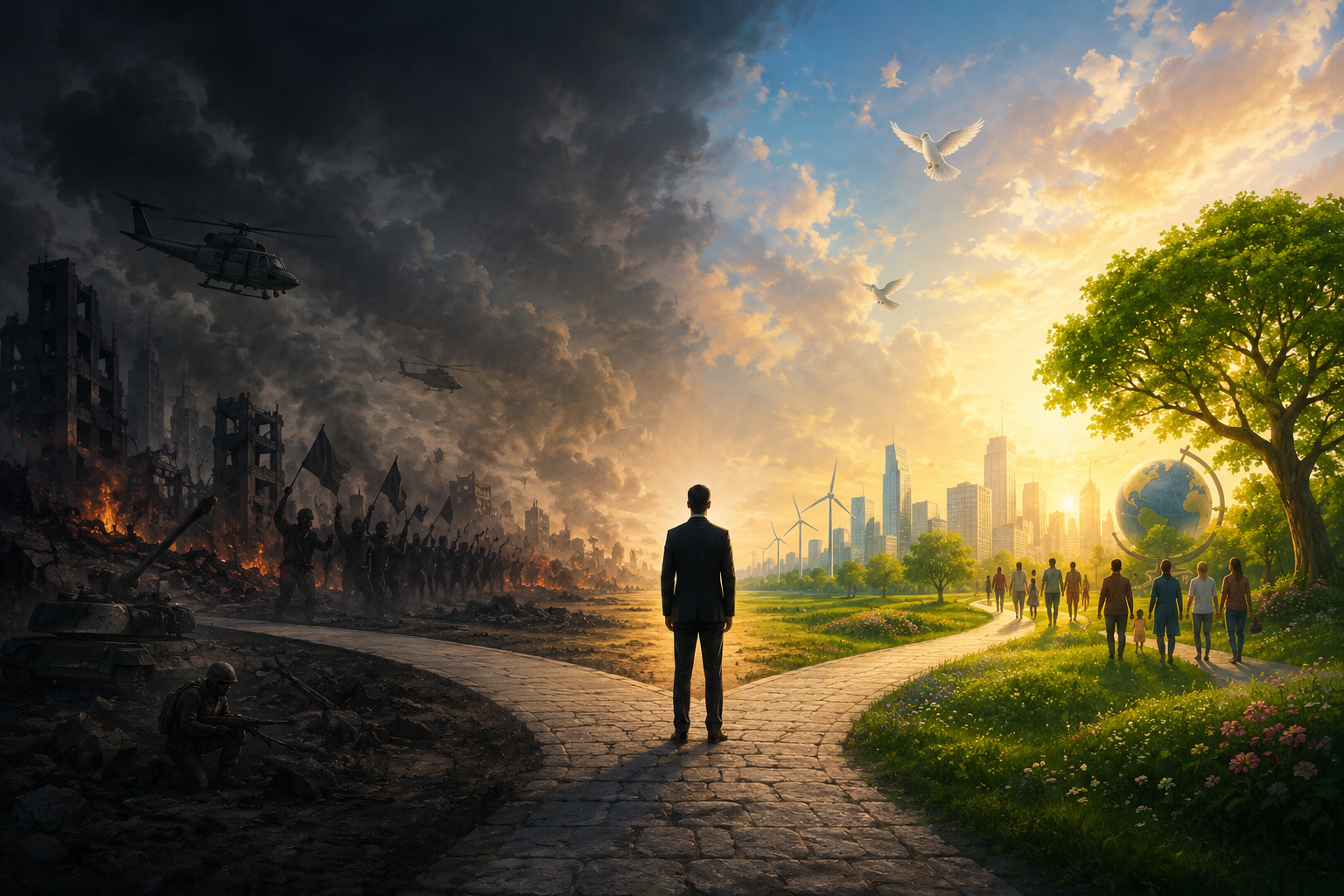
Today, the world stands at a crossroads. One path leads toward nationalism driven by power, geopolitical domination, arms races, and ideological polarization. The other points toward dialogue, coexistence, justice, and global humanism. Regrettably, much of the world appears to be moving rapidly along the first path.
Political parties and ideologies have always shared an inseparable relationship. Ideology serves as the soul of a political movement, shaping its policies, programmes, and governance. In democratic societies, citizens evaluate political parties largely through their ideological commitments. Yet an important question arises: do ideologies still exist in their original ethical form?
A glance at global politics suggests that the answer is far from simple. During the twentieth century, ideological boundaries were relatively clear. Capitalism, socialism, communism, liberalism, and nationalism occupied distinct intellectual spaces. The Cold War divided the world into two ideological camps. However, the end of the Cold War did not usher in the peaceful world order many had anticipated. Instead, the world has entered an era of multipolar competition, economic dominance, technological rivalry, and strategic alliances.
Today, ideologies often function less as principles and more as political strategies. Nations that advocate democracy and human rights frequently apply different standards depending on their strategic interests. Countries that champion international law often reinterpret those same laws when national interests are at stake. This naturally raises an important question: are ideologies still rooted in moral conviction, or have they become instruments of political convenience?
This transformation has intensified global polarization. Polarization is no longer confined to relations between states; it is increasingly penetrating societies themselves. Ideological disagreements gradually turn into hostility. Dissent is treated as opposition, and opposition as enmity. As the culture of democratic debate weakens, bitterness grows stronger. Bitterness destroys dialogue, and the absence of dialogue ultimately gives birth to violence.
It is here that the roots of terrorism become visible. To regard terrorism merely as a law-and-order issue is to underestimate its true nature. Terrorism is fundamentally a mindset that rejects freedom, diversity, and dialogue. It uses fear as a weapon and seeks to legitimize violence. Therefore, terrorism does not represent any religion, ethnicity, language, or nation. It is an anti-human force whose defining characteristic is its attempt to pit one human being against another.
Unfortunately, global politics often lacks unity even in confronting terrorism. A group labelled as terrorist by one country may be viewed differently by another because of strategic considerations. Such selective approaches weaken the global campaign against terrorism. If humanity genuinely wishes to defeat terrorism, it must adopt the same moral standard against every form of violent extremism, regardless of its source.
The Russia–Ukraine war illustrates this dilemma vividly. One side speaks of security and strategic concerns; the other emphasizes sovereignty and independence. Both present their own arguments. Yet who pays the greatest price? Millions of displaced families, thousands of children, and ordinary civilians who had no role in political decisions. This remains one of the greatest tragedies of modern politics: governments make decisions, while societies bear the suffering.
Similarly, the growing tensions between Israel and Iran cannot be understood solely through the prism of religion. They are deeply intertwined with regional influence, national security, strategic balance, energy politics, and global power competition. Whatever the causes of conflict, its ultimate victims are wounded children, shattered families, and refugees—living reminders of humanity’s defeat.
India–Pakistan relations also occupy an important place in this discussion. The legacy of Partition, border disputes, and terrorism have deepened mistrust between the two countries. Yet the aspirations of ordinary citizens on both sides remain remarkably similar. They seek peace, development, education, employment, and dignified lives. Therefore, terrorism cannot be countered solely through military strength; it also requires political and social conditions that leave no space for violent extremism to flourish.
Another defining challenge of the twenty-first century is digital polarization. Social media has expanded opportunities for communication but has simultaneously accelerated misinformation, fake news, and ideological division. Wars are no longer fought only on borders; they are increasingly fought through information, images, algorithms, and public opinion. This information warfare presents a serious challenge to democratic institutions.
In this context, the central question is whether the global order can survive merely through balances of power. History suggests otherwise. Military strength alone has never ensured lasting peace. The First and Second World Wars bear testimony to this truth. The Cold War ended, yet conflicts persisted. Unless the moral foundations of international politics are strengthened, neither political arrangements nor military alliances can produce enduring solutions.
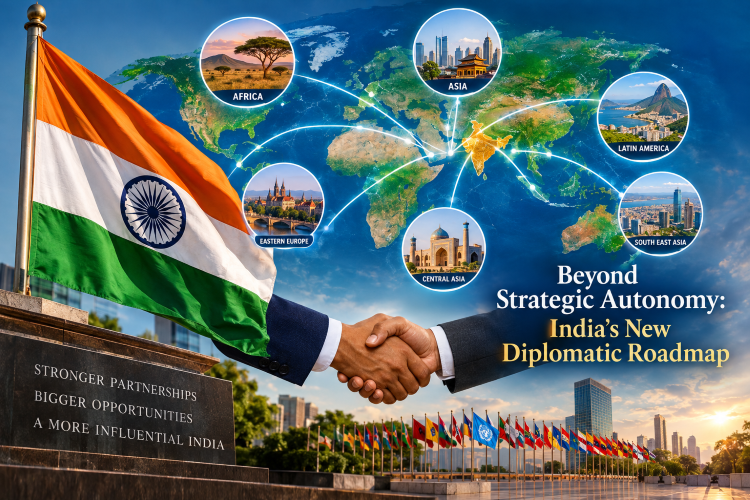
It is here that Indian civilization offers a distinctive perspective. India has not merely contributed spiritual ideas to the world; it has offered a philosophy of coexistence. Vasudhaiva Kutumbakam—“the world is one family”—is not merely a cultural slogan but a universal human philosophy. Its essential message is that humanity constitutes a single family. If this principle were translated into public policy, politics based on conflict could gradually give way to politics based on cooperation.
This vision also finds profound expression in the global humanism of Rabindranath Tagore. Tagore did not reject nationalism altogether; rather, he insisted that nationalism must remain subordinate to humanity. For him, a true nation was one that did not isolate itself from the rest of the world. He warned that if the nation became merely an instrument of power while humanity was forgotten, civilization itself would descend into moral crisis.
Today, Tagore’s warning appears more relevant than ever. The world needs not merely new military strategies but a renewed moral vision. Global humanism is not an abstract ideal; it is a practical necessity for achieving sustainable peace.
In this context, India faces both a historic opportunity and a profound responsibility. If India aspires to become a Vishwaguru (teacher to the world), this should not imply global dominance. Rather, it should signify leadership through knowledge, morality, and dialogue. Such leadership cannot be achieved solely through economic growth or military strength. It requires social harmony, democratic confidence, constitutional values, and respect for diversity.
India’s Prime Minister has often highlighted ideas such as “One Earth, One Family, One Future” and Vasudhaiva Kutumbakam on international platforms. These ideas reflect India’s ancient civilizational ethos. However, they must extend beyond diplomatic rhetoric and become guiding principles in national and global policymaking through inclusion, social harmony, dialogue, and justice. Only then can India play a genuinely constructive role in world affairs.
This responsibility does not belong to any single government or political party. It is rooted in India’s long civilizational heritage. Becoming a Vishwaguru requires moving beyond narrow political interests toward a broader human vision. If India strengthens social cohesion, democratic values, and dialogue within its own society, its credibility on the global stage will naturally grow.
The world must also recognize that ideologies exist for human beings—not human beings for ideologies. An ideology remains meaningful only as long as it protects human dignity, freedom, and security. The moment it becomes more important than humanity itself, it loses its moral purpose.
The same principle applies to nationalism. Nationalism remains constructive only so long as it respects humanity. If it becomes a vehicle for hatred, violence, or permanent hostility, it ultimately undermines its own ethical foundations. What the world needs today is a balanced nationalism, responsible globalization, and a harmonious synthesis of global humanism.
The gravest challenge facing the international order today is not the power of any one nation but the crisis of global trust. Trust can only be restored when international institutions remain impartial, when double standards against terrorism are abandoned, when human rights are defended consistently rather than selectively, and when dialogue is given precedence over war.
Ultimately, history will not ask which nation possessed the largest arsenal or which ideology dominated the greatest number of countries. It will ask who attempted to unite humanity when it was divided, who spoke of peace in times of war, who placed justice above power, and who chose trust over fear.
Humanity stands once again at a crossroads. One path leads toward deeper polarization, conflict, and mistrust. The other leads toward dialogue, harmony, cooperation, and global humanism. The choice is not only for governments; it is one that the entire human civilization must make.
If humanity is to endure, ideologies must become more humane, politics must become more ethical, and development must become more inclusive. Only then will Vasudhaiva Kutumbakam cease to be a lofty ideal and become the foundation of a more peaceful world. Guided by its civilizational wisdom, the humanistic vision of Rabindranath Tagore, and its democratic traditions, India can contribute meaningfully to building such a world—one where the ultimate purpose of power is not the destruction of humanity, but its protection.
That is the call of our time. That is the need of humanity. And perhaps that is the greatest political, moral, and civilizational challenge of the twenty-first century.
(The author is a Professor at the Department of Hindi, Aryabhatta College, University of Delhi.)




[[comment.comment_text]]