The Psychology of Iconoclasm

 3 months, 1 week ago
Even though statues cannot communicate, they can become the focal point of the most heated disputes. Despite their immobility, they appear to arouse enormous terror. They don't oppose any government, run no campaign, or make any arguments, but they are hit by hammers, covered with paint, or covered in black fabric. What? Why does stone cause such anxiety if it is dead? What victory is gained by dehumanising a monument that is only made of marble or bronze?
Politics can never provide a more comprehensive response than psychology. An assault on a statue of a significant historical figure is never really an attack on stone; rather, it is an attack on the communal memory that the statue represents. It is not aimed at a specific person, but rather at the values, moral authority, and historical heritage that that person continues to uphold. Because ideas cannot be shot, history cannot be imprisoned, and memory cannot be called into a courtroom, statues become targets. Attacking their symbols is the simplest alternative. This is the psychology of iconoclasm, the delusion of triumph that results when a society tries to destroy the symbols that stand for ideas because it is unable or unable to interact with them.
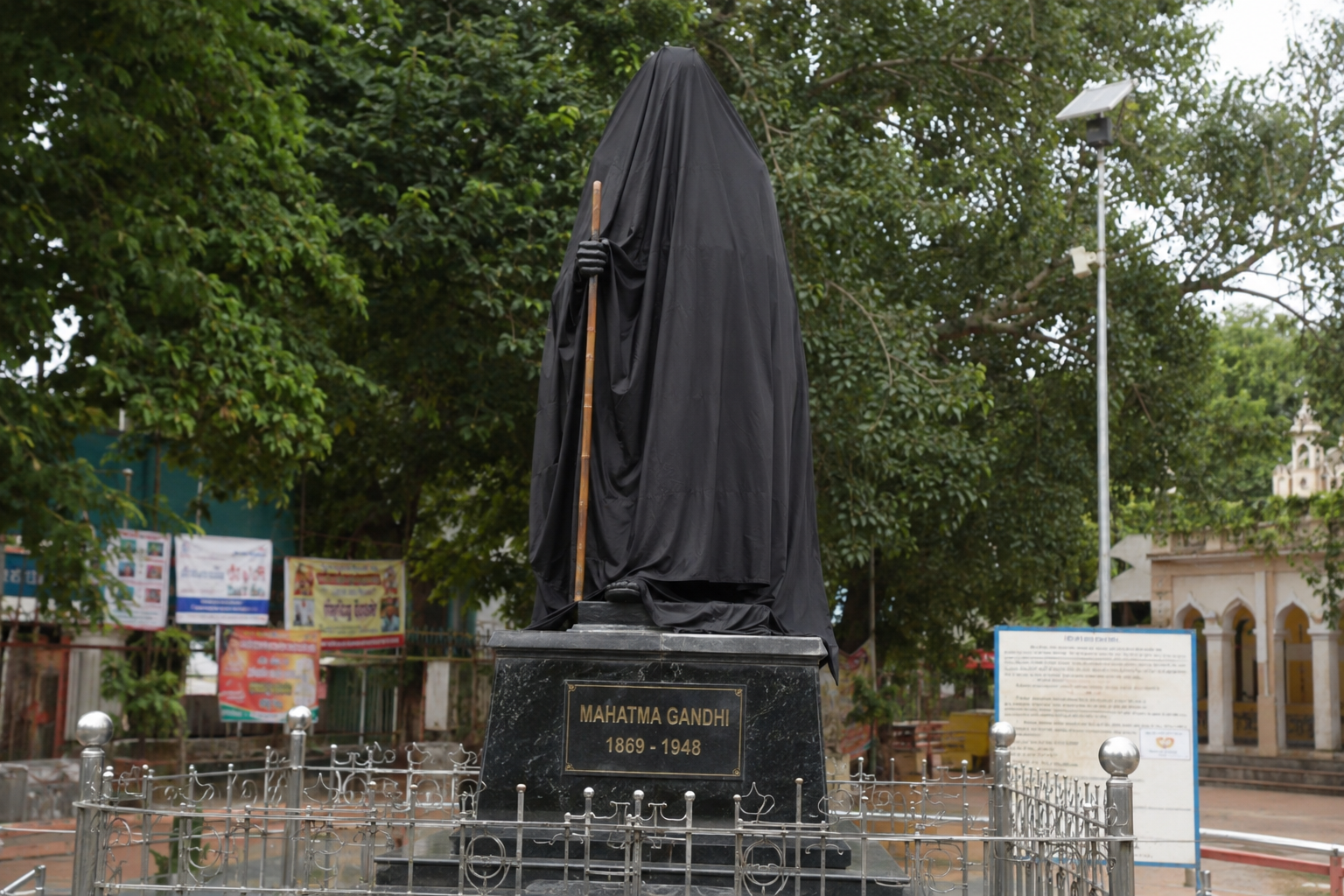
On Tuesday, in Katwa, in the Purba Bardhaman district of West Bengal, a statue of Mahatma Gandhi was shrouded in black fabric. It was written off by many as just another political protest. However, history perceives something far deeper. It was more than just a piece of cloth covering a monument; it was a metaphorical curtain pulled over a memory that once bravely and morally highlighted India's darkest hour. Blindfolding the statue of the man who stood unarmed in the midst of communal violence is a revealing representation of our common mentality, not just a local political gesture.
This is the same Bengal where humanity In 1946, communal violence in Noakhali and Calcutta left humanity scarred and shattered in the same Bengal. scarred and shattered in 1946 by the communal violence in Noakhali and Calcutta. Families were split apart, homes burnt down, trust crumbled, and the government was all but powerless. Even the armed apparatus of the British Empire seemed incapable of quenching the flames of hatred. And yet, at that exact moment, a seventy-seven-year-old man walked barefoot from village to hamlet, lane to lane. He held no office, commanded no security force, possessed no political authority, and carried no firearm. Truth, empathy, and a steadfast belief in the inherent goodness of people were his sole friends. That man was Mahatma Gandhi.
There is a special place in history for the Noakhali march. It was more than just a trek; it was arguably humanity's greatest valiant struggle against the insanity of violence. It proclaimed an everlasting truth—that even where firearms fail, the human conscience can nevertheless prevail.
The act of covering the eyes of Gandhi's statue in Katwa with black cloth today goes beyond the bounds of typical political protest. It develops into a significant moral and psychological event. It forces us to wonder: Is this the same Bengal that Gandhi used to go barefoot through? Is this the place where he battled to keep the last vestige of harmony amid the flames of intergroup animosity? Why is the man who attempted to erase the lines of difference with the footprints of reconciliation now having darkness cast over his eyes?
The right to dissent is guaranteed in a democracy. Criticise Gandhi. I disagree with his economic theory. Question his role during Partition. Discuss his choices using all the rigour of historical analysis. That is what a free society is all about. However, democracy starts to give up its spirit of deliberation to the whims of the masses as soon as symbols take the place of arguments. Draping a monument in darkness is an acknowledgement that reason has run out of things to say, not a response to ideas.
According to psychology, when a person or group is unable to disprove an idea, they frequently turn their animosity toward the symbol that stands for it. One way to interpret this behaviour is as symbolic hostility. People secretly understand that no great historical person, including Gandhi, Ambedkar, Vivekananda, Bhagat Singh, and others, can be erased from the annals of history. Rather, they give the impression that they have vanquished the concept itself by vandalising a statue or a memorial. It's similar to smashing a mirror in an attempt to alter the reflection of your face.
Cognitive dissonance is another important psychological process that underlies this behaviour. An uneasy tension arises in the psyche when historical facts contradict our ideological beliefs. There are only two ways to deal with this unease: either we reconsider our ideas or we challenge history itself. The latter is simpler. Therefore, smearing paint on a statue or covering it with black cloth is an attempt to avoid history rather than engage with it.
Identity politics and this propensity are closely related. More and more people define themselves as citizens only after first defining themselves via the prism of ideology, political affiliation, or group identity. Consequently, historical personalities who do not cleanly fit into their favoured narrative start to emerge as enemies rather than national heroes. A statue transforms from a chunk of stone to the emblem of an opposing ideology. Attacking symbols also turns into a theatrical show of power once politics is reduced to a struggle of identities.
Social media has intensified this psychological habit. Centuries of complicated history are now condensed into viral memes, 30-second movies, and chosen quotes. Algorithms continuously feed us stuff that validates what we already believe—a condition psychologists characterise as 'confirmation bias'. Gradually, people stop trusting history itself and begin to mistake their digital echo chambers for truth. In that situation, damaging a national figure's statue may seem like an ideological victory, but in reality, it only reveals one's intellectual limitations.
Moral disengagement is another potent force at work. A group ceases to view its activities as immoral when it persuades itself that its cause is so great that all means are acceptable. Destroying a statue is now viewed as an act of "resistance" or "justice" rather than vandalism. At this psychological stage, people start to distance themselves from moral obligation and start to justify behaviours they would otherwise denounce.
Equally significant is the phenomenon of collective narcissism. Here, a group begins to believe that it alone possesses the ultimate truth about history, morality, and patriotism. Any historical person who does not fit neatly into its current political narrative is seen as a barrier that needs to be removed. Yet this inclination is not a sign of confidence—it is a symptom of insecurity. Confident societies discuss their heroes. Statues are destroyed by insecure societies.
Statues are raised to preserve a society's collective memory, not just to endure as stone and bronze. An attack on a monument, therefore, is never just an assault on stone. It is an attack on memory, not just metal but history itself, not just a single person but the moral imagination that once motivated a country to improve.
Maybe for this reason, the question of who covered the statue of Mahatma Gandhi in black cloth is not the most crucial one brought up by the Katwa incident. The fundamental concern is whether we are increasingly losing the guts to confront ideas. Have we grown more at ease demeaning symbols than discussing the ideologies they stand for? If this is the case, our democracy's maturity will be the true test, not Gandhi's legacy.
The greatness of a nation is judged not by how enthusiastically it honours its great figures, but by how responsibly it disagrees with them. Democracy gives the right to criticise; it does not excuse the inclination to humiliate. Scholarship, well-reasoned argument, careful writing, and public discussion are the proper ways to respond when one rejects a notion. Painting a statue or covering it with black fabric does not prove that a concept has been refuted. Instead, it is an acknowledgement of the surrender of reason itself.
Ultimately, we must acknowledge that monuments alone do not make a nation great. How a democracy handles its own historical symbols exposes its true nature. A civilisation that abandons discourse with its past eventually loses the potential to determine its future. A hand that desecrates a monument does more than just hit stone; it also damages the democratic culture that upholds free societies as well as its own historical consciousness and intellectual humility.
For this reason, the first thing to consider when a statue is destroyed, defaced, or covered in black should not be whose national symbol has been offended. The more urgent question is this: What ideological impatience, what anxiety, and what insecurity have grown to such an extent that they attack symbols in an attempt to address ideas? We learn a valuable lesson from history: ideas are never vanquished by the toppling of statues. Only when cultures lose the will to reason will they be vanquished.






[[comment.comment_text]]