Crime, But No Offence! Bihar: Rajendra Prasad's Unfulfilled Dream and the Politics of Semantics
 an hour ago
The scenario reminds me of the well-known tale of Princess Vidyottama and Kalidasa, in which scholars created complex interpretations based on a straightforward gesture that involved raising one finger and responding with two. A regular interaction took on enormous connotations thanks to their creativity
It's critical to comprehend the legal jargon used in Bihar Chief minister Samrat Choudhary's recent comment that "there may be crime, but no offence; the very concept of crime has been eliminated" amid the political uproar around it. An otherwise simple legal argument runs the risk of becoming a linguistic and political conundrum in the absence of that distinction. The comment instantly set up a verbal sparring match between the opposition and the ruling establishment, with conflicting interpretations surfacing as if the sentence had some deep intellectual secret.
The scenario reminds me of the well-known tale of Princess Vidyottama and Kalidasa, in which scholars created complex interpretations based on a straightforward gesture that involved raising one finger and responding with two. A regular interaction took on enormous connotations thanks to their creativity.
But let's examine this from a particularly Bihari perspective. Dictionary definitions are insufficient to comprehend Bihar's social and political lexicon. Additionally, it is important to distinguish between the meanings that words acquire in regular communication and the language used in courts. It's possible that the Chief Minister was trying to make a distinction between committing a crime and being a professional or habitual offender. However, the true question is whether we are analysing his statement's intended meaning or, in a semantic game, losing sight of its context.
Legal intricacy is crucial in this situation. The nature of an offence and the criminal history of the accused are two distinct issues. However, it is merely a linguistic misunderstanding to interpret the Hindi word "apraadh" and the English word "crime" as two different legal categories.
"Crime" and "apraadh" are merely two verbal manifestations of the same idea in the context of law. They are not legally different from one another. However, the commission of an offence can be differentiated from the offender's criminal history. A person is not inherently a professional or chronic criminal just because they are implicated in a crime. A court may take into account the offender's prior criminal history, purpose, and the circumstances surrounding the act while considering sentence.
Therefore, the question is more than just whether we can distinguish between criminality and crime. It also concerns whether knowledge, reason, intellectual integrity, and accountability are still valued in public life. After all, why does it appear that Bihar's exceptional intellectual legacy and the calibre of its current political discourse are so dissimilar?
Offence vs. Offender: A Legal Distinction
Defence counsel sometimes claim that their clients are not professional criminals, have no prior criminal history, and may have done the conduct unintentionally during criminal procedures in lower courts. Based on the circumstances and background of the accused, they ask for leniency in sentence.
Such an argument does not refute the existence of a crime. Instead, it aims to prove that the circumstances of the incident, the accused person's past behaviour, and their background are important factors to take into account when deciding on punishment.
For example, if the necessary legal components are proven, an act of assault or domestic abuse within a family may be considered a criminal offence. However, someone who commits such an act for the first time cannot be immediately classified as a professional or chronic criminal. An act is an offence, whereas a person's criminal history and recurrent behaviour constitute habitual criminality. In a similar vein, being charged with a crime and being found guilty are two very separate legal processes.
This distinction may be taken into consideration when interpreting the Chief Minister's comments. However, there is still one essential linguistic and legal fact: the legal meaning of the Hindi term "apraadh" and the English word "crime" are the same. The claim that crime can exist without an offence is not supported by any recognised legal distinction.
The Chief Minister should have said unequivocally that the influence of chronic or professional criminals has been eradicated. It is just as improper to judge an entire system of law and order based on a single sentence as it is to look for an unspoken legal interpretation just to support a political remark.
In the end, the veracity of such assertions must be evaluated in light of the real data, which includes crime figures, police activity, conviction rates, and—most importantly—citizens' actual experiences with safety and security.
Beyond Words, Bihar’s Accountability
A chief minister holds the highest position of constitutional and administrative authority in the state, making him more than just a political speaker. From the police administration to the average person, his comments convey a message. In a state like Bihar, where law and order has long been a contentious political issue, a detailed description of the specific steps used to reduce crime is more important than assertions that it has been eradicated. How many instances have led to convictions? How secure are vulnerable populations, women, children, and business owners? Is it safe for the average person to approach a police station? Can victims truly believe that justice would be served by the system? The sense of security people feel in their daily lives is a better indicator of the effectiveness of law and order than political statements. Only when criminals fear the law and citizens have faith in it does crime begin to decline.
It makes sense if the Chief Minister's remarks were meant to differentiate between the actions of a repeat offender and an isolated criminal incident. However, it presents a linguistic and legal contradiction if it implies that Bihar may have crime but no offence. He needs to make it clear if he was talking about the criminal history of criminals or whether he was saying that crime has been eradicated. After all, changing definitions doesn't alter the reality on the ground, and a government's accountability is based on its citizens' safety rather than its declarations.
Governance Needs Clarity, Not Wordplay
A necessary component of democracy is political discourse. However, the duty of government extends beyond simply enumerating accomplishments; it necessitates gaining the public's trust via accountability, logic, and facts. A chief minister needs to realise that getting rid of crime is not the same as getting rid of criminals. Although they are related, crime prevention, offender identification, prosecution, and court proceedings are not the same.
The mere fact that an act is performed for the first time does not make it any less illegal. On the other hand, a person's criminal history is established by repeated offences. Using this distinction to redefine crime is merely language gymnastics; recognising it is a question of legal comprehension. Today, Bihar needs leadership that is prepared to face facts, accept responsibility for solutions, and admit reality rather than a political lexicon that hides issues.
Rajendra Babu’s Warning, Today’s Leadership
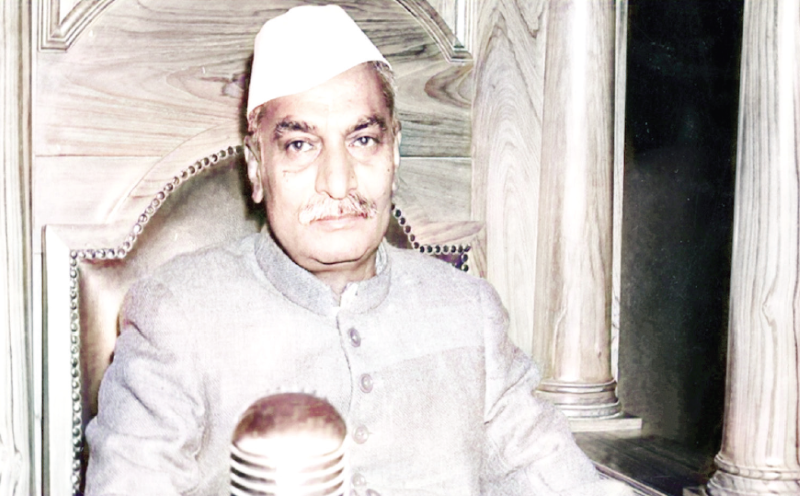
Dr Rajendra Prasad, a renowned academic, constitutional expert, and the first president of independent India, was born in Bihar. Rajendra Babu voiced two regrets in his farewell speech to the Constituent Assembly before the Constitution's adoption on November 26, 1949. One was the lack of minimal requirements for legislators. "We should insist upon high qualifications for those who administer or assist in administering the law, but none for those who make it except that they are elected," he noted.
To put it another way, there are strict requirements for those who carry out the legislation, but there are no requirements for those who create it other than winning an election.
But his worries extended well beyond academic credentials. According to him, elected officials need to be intelligent, have good judgement, think for themselves, and have moral integrity.
There is still no universal minimum educational requirement to serve in a state legislature or as a member of parliament. Arguments for and against limiting democratic representation based on formal education may exist. However, a basic question still has to be answered: why should those tasked with influencing millions of people's futures lack institutional standards for administrative expertise, constitutional comprehension, and public accountability?
It is not argued that an ignorant person cannot serve the public or that a degree makes one a capable politician. The question is straightforward: why shouldn't there be a systematic way to provide those who make laws and run the nation with a fundamental understanding of the Constitution, law, and governance when professional training and educational requirements are mandated for everyone from junior government employees to senior civil servants?
Rajendra Babu was more concerned with the moral and intellectual responsibility of democratic leadership than he was with degrees. His query merits careful consideration in the present day.
Bihar’s Glorious Past, Present Irony
It is very unfortunate that the land of Bihar, where Gautama Buddha taught compassion, wisdom, and the Middle Path, where the world-famous Nalanda University attracted scholars and students from all over the world, has now reached a point in its political discourse where it is necessary to debate the differences between crime and criminality itself.
This is not just a matter of one chief minister's remarks; rather, it is a reflection of a political culture where lofty claims to lead have replaced accountability and bluster has started to supplant reason.
Bihar needs leadership that understands not only the difference between a criminal and a crime but also the fundamentals of law and justice: leadership that speaks within the bounds of constitutional propriety rather than in the language of power and provides every citizen with the assurance of justice and security instead of making broad claims about the eradication of crime.
Today, the worries Dr Rajendra Prasad voiced in the Constituent Assembly regarding the minimal credentials and sound judgement required of lawmakers are even more pertinent.
The tragedy of Bihar is not limited to criminal activity; it also stems from the deterioration of the intellectual heritage that once guided the world toward knowledge. The land of Rajendra Prasad needs public servants who recognise the honour of their position, the sanctity of the Constitution, and their responsibility to the people; the land of Nalanda needs intellectual substance, not verbal gymnastics; and the land of Buddha needs the light of wisdom, not declarations of power.
(The author, a Doctorate in Laws, is a senior lawyer and civil society activist.)









[[comment.comment_text]]