BIG POWERS RIVALRY DESPITE FREQUENT BILATERALS

 39 minutes ago
Nvidia CEO Jensen Huang resigned earlier in November following intense scrutiny over extramarital affairs and an independent board investigation and CFO Colette Kress stepped in as interim CEO. Jesen was linked to Alice Huang, an executive working with Singapore based ‘Megaspeed’ alleged by US to be Chinese Intelligence Asset – a claim denied by Beijing. Jesen later admitted to be unfaithful to his wife and apologized to his family and staff, which followed his resignation. Nvidia H200 Tensor core, known to supercharge generative AI and high performing computing workloads with game changing performance and memory capabilities, which was curbed to be exported to China, was bought by Chinese University with deep ties to People’s liberation Army. Jensen Huang is now facing mounting scrutiny in US over his lobbying to lift restrictions on sale of chips to China.
A New Yorks Times report has found that China’s intelligence agency has prioritized acquiring advanced semiconductor chips and intelligence on the global chip industry for nearly two years to overcome export curbs imposed by US and other western nations. China’s state security ministry has led a campaign and provided help to Chinese companies to smuggle advanced chips and gather intelligence on the sector and its supply chain. The report added that the companies associated with Alice Huang’s family or business associate has channeled about $3.6 billion in Chinese government funding into technology projects, including data centers that received Nvidia chips. Within 11 days of the resignation, under the influence from Donald Trump, Nvidia board reinstated Jesen Huang as its CEO. As Nvidia share jumped by 32% and Trump has personally gained from it, he added, ‘had Washington failed to bring Jesen back, China might have recruited him to lead Huawei’s AI operations.’
Just before Trump left for Shenzhen, his administration imposed new restrictions on chip exports to overseas data centers in countries like Malaysia and Thailand. It will hurt Chinese companies that use those data centers to assess advanced chips to train their AI models. US Commerce department is cracking down on Chinese access to sensitive US technology following a report that the agency had turned the blind eye to smuggling of advanced AI chips to China and failed to curb Chinese access to overseas data centers and allowed users to circumvent the restrictions. Quoting the rule written by US Treasury and Security departments, the Commerce department said, “The rule is designed to ensure that existing restrictions on access to sensitive American technology cannot be circumvented through remote computing arrangements involving data centers in the third countries.”
In Xi Jinping’s state visit to Washington from 23rd to 25thSeptember, the two nations pledged a constructive strategic and stable relationship and further extended support the events hosted by each other i.e. APEC and G20 leaders’ summit. They agreed to set up China-US artificial intelligence dialogue and vouched to take drug enforcement actions targeting precursor chemicals and psychoactive substances. They also reiterated that Iran should hold its commitment not to develop nuclear weapons and no country should impose toll on international waterways.
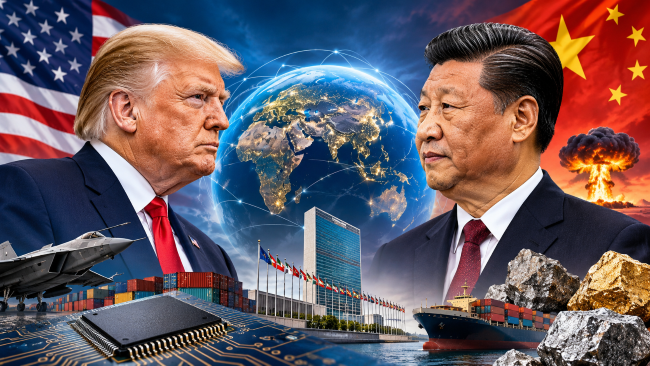
The leaders established a super intelligence/ AI dialogue to manage risks and communication. The broader disputes over tech and export controls between the two remained unresolved. Despite pressure from Beijing, the change in US’s status on Taiwan also did not happen. China’s dominance in rare earth and critical mineral refining remained a major point of friction between the two nations. US officials have expressed frustration over the gap between the pledge and the actual shipments of rare earth magnets. 450 Kg of rare earth magnet is required for each F35 fighter jet manufactured in US. Though many countries are trying to step-up rare-earth production and refining, China still holds the key for the supply chains in defense manufacturing. Xi Jinping’s September visit to Washington did not provide any relief to Americans with regard to rare earth supply.
The race to build a China free “mines to magnet” supply chain has moved quite unevenly, with heavy rare earth separation and metallization continues to be the choke point that require heavy investment and technical inputs. “Mines to magnet” industries are highly polluting, and many countries are not technologically advance enough to create pollution free industries at scale. Attempts have been made in Australia, US and India, but it is not good enough to counter China’s dominance at scale. Western economies are still a long way from achieving critical mineral supply resilience. The US could have a China-free “mine to magnet” supply chain for military needs by 2028, while broader ex-China supply chain may take around 2040 to replace direct Chinese magnet export. Moreover, non-Chinese production faces higher costs, the long-term viability of ex-China supply chain will likely depend up on subsidies or segmented market.
US agricultural export to China also did not take off on the lines as indicated by Trump’s boast after Xi’s Washington visit. Despite pledging to buy $17 billion agricultural products from 2026 onwards, China bought only $7 billion in 9 months. This is the lowest January to September, 9 months total since 2019. The shipments of sorghum, beef and meat have slowed down. Washington has pressed Beijing to step up farm purchases, while later has sought tariff relief first.
Trump’s Republican Party lost control in both houses of US Congress in mid-term election and as a face saver, his visit to Manila for an unexpected QUAD meeting and Shenzhen for ASEN meeting came up. Both these meetings of ideologically conflicting groupings were found to convey only the optics, but without any proper substance.
At Shenzhen, the three Presidents China, Russia and US met on 19th November and agreed on symbolic peace declaration reaffirming that the nuclear war should never be fought. While Trump proposed to scale down the nuclear arsenals, Xi Jinping proposed to completely shut it. There was no other commitment to reduce nuclear arsenals. They, however added to conduct dialogue on reducing nuclear risks and preventing proliferation of nuclear weapons. What has been said is al-right, but what is needed is action on nuclear diplomacy.
In addition to preventing nuclear proliferation, they pledged to advance reform of UN, increase the supply of crude and refined oil for energy needs for all countries and to uphold the immunity enjoyed by state officials for international courts. It is to be remembered that International Criminal Court in Hague had issued arrest warrant three years ago for Putin and other Russian officials over alleged war crimes during Russia’s invasion of Ukraine.
20th November newspaper carried the two stories on the same page; first, world’s three biggest nuclear powers agreeing to scale down nuclear proliferation and the second that the risk of US strikes on Iran grows as both sides escalate skirmishes. The trilateral meeting did not talk about both the wars, the one between Russia and Ukraine as well as the other in the gulf region between US and Iran and Houthis and Saudi Arabia. The trilateral meeting at Shenzhen did not send any serious message to the humanities facing disruptions on account of trade, commerce, environmental degradation and above all the ongoing wars.
China’s ambitions extend beyond hosting a historic meeting, certainly Beijing wants to shape the rules of international order and strengthen its influence across the global south and present itself as defender of multilateral cooperation. The strategic competition, China faces with Washington over advanced technology, artificial intelligence, trade and regional security remains unresolved. Though the rivals have come forward to co-operate among themselves, but strategic competition surfaces all across the declaration as well as what is going on in other parts of the globe. Shunted by western capitals since the invasion of Ukraine in February 2022, Putin can tell his domestic audience and global south that the isolation attempted by western world has not worked.
The expiry of new START treaty between Russia and US has generated a gap in nuclear Arms control, as it does not limit their strategic arsenals. Though Trump has attempted to rope China for a major diplomatic achievement but Beijing has resisted joining the two. China’s nuclear arsenal is considerablysmall as compared to US and Russia, it does not want to bind itself and put any cap on the expansion. China will never like to join and be part of a verifiable arms control agreement.
Shenzhen’s joint declaration does not establish a comprehensive nuclear arms control regime, resolve the war involving Iran, address the future of Ukraine and provide political settlement for Palestine. On the question of the declaration relating to reforms in UN, the world has seen it struggling to respond effectively to major international conflicts. The inability of UN to prevent wars or secure consensus among powerful member states has raised serious questions about its relevance and effectiveness. Shenzhen declaration between the three suggests to reform UN Courts, so as to provide immunity to officials of the member states. This move can please Putin and his officials who were issued warrant three years ago for war crime in Ukraine. The type of reform UN needs is not intended in the declaration. In fact, the declaration on ICC appears to be empty. China neither signed nor ratified Rome Statute, while US and Russia initially signed and subsequently withdrawn. There is need for ICC to accept principle of consent and respect for immunities for state officials, before taking up prosecution against them for war crimes.
UN should certainly be reformed and armed with teeth to bite the member nations, if they do not comply with its directives. UN already has power to impose economic sanctions on member countries, but it has hardly exercised in the present scenario. In fact, US has been imposing economic sanctions on its friends and foes. The other two permanent members of the security council should not be marginalized in any global decision in the interest of peace and security. Trump and Xi one to one, have already met three times in last six months and even meeting on December 14 and 15 for the fourth time on the sidelines of G20 meeting at Miami in US in on schedule, yet the friction in US China relation is visible to all.
If three powerful nuclear nations do not work together to prevent wars, uphold international stability and contain nuclear dangers, then they are not working for humanity, they are working for their personal interests or at the most in the interest of respective countries. US and China are the biggest economies and lay down their policies strategically which is reflected in widening gaps between their promises and fulfillments. China’s manufacturing is at very high level and contributes nearly one-third in green house gas emission. When both cooperate with each other for the wellbeing of the humanity, it will bring a real progress to both.
(The author, a former IFS officer, has served as Head of Forest Force, Karnataka. His email:bksinghretiredpccf@gmail.com)









[[comment.comment_text]]