The Constitution: A Nation’s Moral Promise

 39 minutes ago
A constitution’s ability to safeguard the weak, constrain the powerful, and guarantee equality, justice, and dignity for all citizens is what makes it truly great, not how brilliant its language is
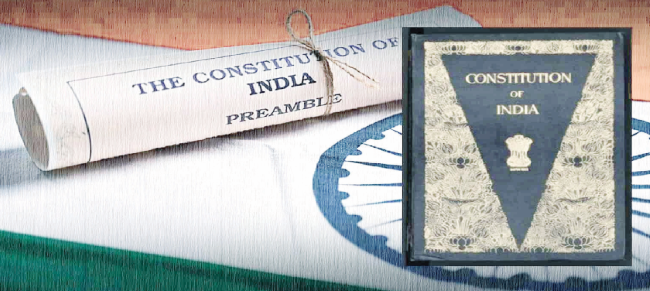
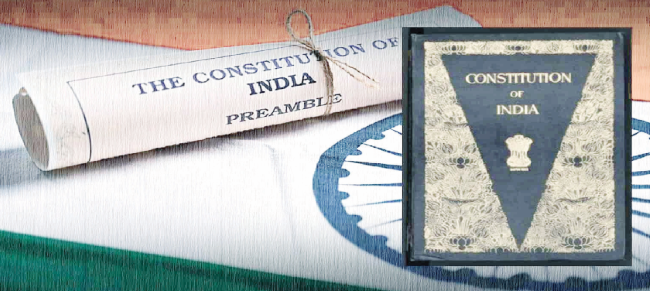
A constitution is much more than just a legal document outlining the state's authority and its citizens' rights. It is the collective conscience of a country, representing its values, goals, and future vision. India's freedom struggle, which aimed to alter society via liberty, equality, justice, and human dignity in addition to freedom from colonial authority, gave rise to the country's constitution.
Our political freedom was guaranteed by independence, and the Constitution provided it with direction, meaning, and a democratic purpose. It turned a diverse people's aspirations into a common national commitment. However, a basic question remains decades after its adoption: have we converted its promises into our people's actual realities?
A constitution's ability to safeguard the weak, constrain the powerful, and guarantee equality, justice, and dignity for all citizens is what makes it truly great, not how brilliant its language is.
Born in Turmoil, Built on Hope
On December 9, 1946, when India was still ruled by the British and on the verge of a violent transition, the Constituent Assembly met for the first time. The future of the nation is clouded by political unpredictability, intercommunal strife, and the impending tragedy of Partition. In the midst of this chaos, its members took on an unusual duty: establishing the constitutional framework for a country split along social, religious, historical, and economic lines.
On December 11, 1946, Dr.Rajendra Prasad was chosen permanent chairman after Dr.Sachchidananda Sinha served as interim chairman during the organisation's first meeting. Leaders from a variety of ideological backgrounds, including Dr B.R. Ambedkar, SardarVallabhbhai Patel, and Jawaharlal Nehru, were present at the Assembly. They had a greater national goal, despite the fact that their arguments were frequently heated and revealed significant disparities in political beliefs.
They had to turn a fractured society into a democratic republic based on justice, liberty, equality, and fraternity—not just draft a constitution or set up a government. They aimed to create a country where constitutional democracy would be the ultimate source of political freedom.
Whose Constitution, Whose Language?
The issue of language was one important but often disregarded component of the constitution-making process. On December 9, 1946, Raghunath Vishnu Dhulekar argued in favour of writing the Constitution in an Indian language and holding the Constituent Assembly sessions in Hindi. Additionally, Dr Rajendra Prasad supported writing the Constitution in Hindi.
Nonetheless, the first draft was written in English in 1947 by Constitutional Adviser B.N. Rau, and the subsequent drafts and discussions also took place mostly in English. Members like Seth Govind Das objected, asking whether the Constitution will ever be translated into Hindi. Dhulekar believed that the nation's founding document's reliance on English went against the spirit of independence. This demand was backed by Algu Rai Shastri.
Language preference was not the only point of contention. It brought up an important question: could a Constitution really belong to the people if a significant portion of them were unable to understand its language?
An authoritative Hindi text of the Constitution was later made available, despite the fact that it was first adopted in English. Political independence can only be fully realised when citizens are able to comprehend, exercise, and assert their constitutionally guaranteed rights, which is why the argument is still relevant today.
Three Years That Shaped a Nation
The creation of the Indian Constitution was a remarkable democratic process. The Constituent Assembly held eleven sessions over 165 days, including 114 days dedicated to reviewing the Draft Constitution, and took two years, eleven months, and seventeen days to do its task. 2,473 of the roughly 7,635 suggested amendments were moved and taken into consideration. Nearly ₹63.96 lakh was spent on the process, which is an impressive expenditure in laying the groundwork for a new republic.
Adopted on November 26, 1949, the Constitution became operative on January 26, 1950, after members signed it on January 24, 1950. Today, Constitution Day honours a nation's collective determination to rule itself via democratic principles as well as the adoption of a historic text.
The Constitution's Social Vision
A constitution is much more than just a set of rules outlining the legislative, executive, and judicial branches' respective powers. It represents the kind of society a country hopes to create and embodies the moral underpinnings of governance. The Indian Constitution must guarantee religious liberty, equality before the law, freedom of thought and expression, protection against exploitation, and the ability to engage in democratic life without fear or discrimination for the average citizen.
Four core principles—justice, liberty, equality, and fraternity—are enshrined in the Preamble and serve as the ethical cornerstones of the Indian Republic rather than just ceremonial declarations. The six major categories of fundamental rights—the Right to Equality (Articles 14–18), Right to Freedom (Articles 19–22), Right against Exploitation (Articles 23–24), Right to Freedom of Religion (Articles 25–28), Cultural and Educational Rights (Articles 29–30), and Right to Constitutional Remedies (Article 32)—provide a practical expression of these ideals. The 44th Constitutional Amendment eliminated the right to property, which was once a fundamental right, from Part III and is now covered by Article 300A.
The Directive Principles of State Policy, which foresee a society based on social and economic justice, equal opportunities, sufficient livelihoods, and human welfare, are equally significant. When taken as a whole, these clauses demonstrate that the Constitution is more than just a tool for national governance; rather, it is a revolutionary social commitment to guarantee that freedom takes on significance, equality becomes a reality, and every person can live with dignity.
When Democracy Was Silenced
The Emergency of 1975 demonstrated how readily democratic freedoms can be compromised when political authority escapes effective control, notwithstanding the Constitution's provision for extraordinary powers during national emergencies. Citing domestic unrest, Prime Minister Indira Gandhi proclaimed a national emergency in June 1975. One of the darkest periods in India's constitutional history, civil freedoms were curbed, political opponents were imprisoned, and press freedom was severely restricted. The 42nd Constitutional Amendment (1976) added "integrity" to "Unity of the Nation" and added the terms "Socialist" and "Secular" to the Preamble. The emergency serves as a potent reminder that democratic institutions must maintain their independence, individuals in positions of authority must be held accountable, and constitutional morality must take precedence over political expediency for constitutional protections to be meaningful.
Ambedkar’s Constitutional Warning
In his landmark speech to the Constituent Assembly on November 25, 1949, Dr B.R. Ambedkar imparted perhaps the most important lesson concerning India's constitutional future. He warned, "I feel, however good a constitution may be, it is sure to turn out bad because those who are called to work it happen to be a bad lot."
Ambedkar's message was profound: a Constitution's strength comes not only from its provisions but also from the honesty, discernment, and dedication of those tasked with carrying them out. Despite having well-defined authorities, the efficiency of the legislative, executive, and judicial branches ultimately depends on the individuals who hold these positions.
He also emphasised how India's undemocratic social structure and political democracy are fundamentally incompatible. How could inequality continue to exist in social and economic connections while equality flourished in political life? He emphasised that the national interest must always come before sectarian issues and cautioned against limited political and religious allegiances.
His caution is still applicable: a constitution may create democracy, but it can only be maintained by the nature of its citizens and the behaviour of its institutions.
India has advanced significantly in terms of institutional development, economic prosperity, and democratic government. Opportunities for education and governance have increased, political power has shifted, and its electoral democracy has survived. However, the discrepancy between actual realities and constitutional promises continues to be extremely concerning.
Religious divisiveness threatens fraternity, caste discrimination erodes equality, and women continue to face structural injustice, violence, and limitations on their freedom. Millions of people are denied real possibilities due to economic inequality, and many workers continue to fight for fair salaries, stable jobs, and respectable lifestyles.
Political discourse cannot be the exclusive domain of social justice. The constitutional principles of equality, religious freedom, and nondiscrimination must be reflected in how religious minorities are treated. Similarly, reservations cannot be used as tools of electoral convenience; instead, they must fulfil their constitutional mandate of guaranteeing substantive equality and redressing historical injustices.
The true measure of India's democracy is not how often we invoke the Constitution, but rather how faithfully we carry out its promises. The question is not whether our Constitution provides a vision of justice, but rather whether the people in charge of the nation have the political will to make it a reality.
Constitutional Awareness: Informed Citizens
The low level of constitutional understanding among common people is one of the biggest problems facing Indian democracy. Many people are still ignorant of their constitutional remedies, their fundamental rights, and the obligations of democratic institutions. The Constitution is often cited in public discussions and political speeches, but its underlying concept is rarely discussed.
It could be good to look at how many elected officials, including members of parliament, have actually read and understood the Constitution. After all, reading a legal text is only one aspect of constitutional literacy; another is understanding its spirit and recognising its limitations on authority.
Elections are not enough to sustain democracy. It requires knowledgeable citizens who are able to question authority, confront injustice, stand up for dissent, and discern between partisan politics and the national interest. Voting rights may be exercised by an ignorant citizen, but democratic power can only be properly utilised by a citizen who understands the constitution.
The Unfinished Constitutional Promise
The Indian Constitution is still a topic of discussion. Some urge revisiting or even rewriting it, while others support maintaining its basic concepts. In a democracy, such discussions are acceptable. However, we must first examine a more basic question: Have we truly fulfilled the promises made in the Constitution?
Political freedom would lead to social justice, economic opportunity, equality, and human dignity, according to the framers' vision of the country. However, economic disparities limit chances, religious identity increasingly influences political discourse, caste still divides society, and criticism is occasionally misinterpreted as betrayal. Indian democracy continues to face significant challenges due to the discrepancy between actual reality and constitutional objectives.
Therefore, Constitution Day ought to be a time for reflection rather than just a formal celebration. The vision of Dr Rajendra Prasad, Dr. B.R. Ambedkar, and the other founders of our Republic must serve as our benchmark. Their legacy calls for accountability in addition to respect.
The magnificence of a constitution stems not only from its wisdom but also from the sincerity with which its provisions are implemented. Its true strengths include safeguarding individual liberty, ensuring accountability, restricting arbitrary power, and protecting the weak.
The Constitution was a pledge to future generations when it was adopted on November 26, 1949. It is our joint duty to keep that pledge. Making the principles of the Constitution a reality rather than just celebrating its existence is the true tribute to it. If not, Constitution Day will continue to serve as a ceremonial reminder of the nation's unfulfilled promises.
(Author a doctorate in laws, is a senior lawyer, columnist, and civil society activist.)





[[comment.comment_text]]