The Great Decimal Disappearance: How ₹5,675 Crore Shrunk to ₹56.75 Crore

 17 minutes ago
A hundredfold reduction in the declared cost of Adani’s Tarali project raises serious questions over financial accountability, Maharashtra’s Forest Department and the protection of wildlife funds as the Centre orders an inquiry.
A project estimated to cost ₹5,675 crore has suddenly appeared in official correspondence as one worth just ₹56.75 crore. The difference is not a minor accounting adjustment. It represents a hundredfold reduction, achieved through what appears to be a simple shift of the decimal point. The controversy has now placed the Maharashtra Forest Department under scrutiny and prompted the Union Environment Ministry to order an inquiry.
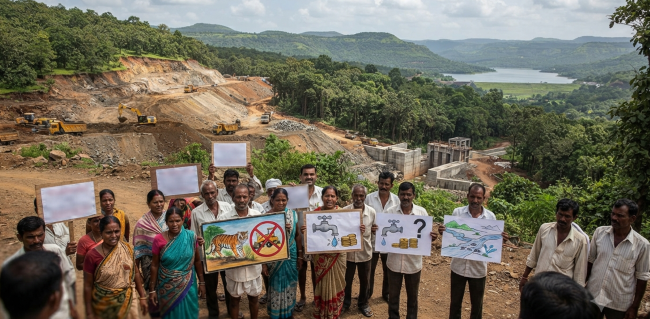
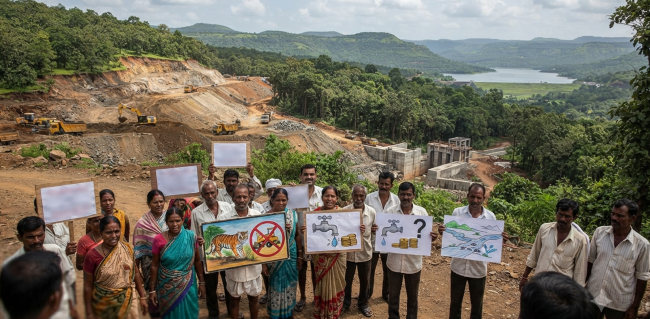
The project in question is Adani Green Energy Limited’s proposed 1,500 MW Tarali Pumped Storage Project in Patan taluka of Maharashtra’s Satara district. Spread across the vicinity of four villages—Nivade, Tondoshi, Kalambe and Jalu—the project is located near the ecologically sensitive Koyna Wildlife Sanctuary, part of the Sahyadri Tiger Reserve landscape.
The proposal was submitted to the Union Ministry of Environment, Forest and Climate Change on 11 February 2025. Its estimated cost was recorded as ₹5,675 crore. Since the project falls within the sanctuary’s deemed eco-sensitive zone, the authorities imposed conditions relating to wildlife conservation.
Under the applicable four per cent contribution requirement, the company was asked to deposit approximately ₹227 crore towards the Sahyadri Tiger Reserve's conservation fund. At a State Board for Wildlife meeting in February 2026, this was among the fifteen conditions attached to the project. In March, Maharashtra's Principal Chief Conservator of Forests and Chief Wildlife Warden, M. Srinivas Reddy, reportedly informed the company that the deposit was necessary before its proposal could proceed to the Standing Committee of the National Board for Wildlife. Then came an extraordinary development.
On 8 September 2026, Adani Green Energy's Chief Operating Officer, Naresh Telugu, submitted a notarised affidavit to the Maharashtra Forest Department. The document cited an analogous estimation and put the project cost at ₹56.75 crore instead of ₹5,675 crore.
The implications were immediate. If the revised figure were accepted, the conservation contribution would fall dramatically. Instead of approximately ₹227 crore, the amount would be calculated on a fraction of the original figure. The company subsequently deposited ₹56.75 lakh, reportedly representing one per cent of the revised estimate. The remaining amount is linked to the final approval process.
More troublingly, a Forest Department letter dated 12 October stated that the revised cost had been approved. This raised an obvious question: how could a project involving a 1,500 MW power facility plausibly be valued at just ₹56.75 crore?
The discrepancy was brought to the authorities' attention by Rohan Bhate, Satara's Honorary Wildlife Warden. On 30 October, he lodged complaints through the Prime Minister's grievance portal and Maharashtra's Aaple Sarkar portal, questioning the dramatic reduction and alleging that the revised valuation could help the company avoid a conservation contribution of nearly ₹225 crore.
The complaints eventually triggered official action. On 5 November, the Deputy Director of Koyna Wildlife Sanctuary was directed to investigate. A day later, the Union Environment Ministry wrote to Maharashtra's Chief Wildlife Warden, calling for an urgent, high-level inquiry and a comprehensive report. The state Forest Department also initiated a separate investigation.
The department's subsequent explanations, however, have only deepened the confusion. While M. Srinivas Reddy reportedly maintained that the company must explain why it submitted an affidavit with a reduced valuation, a later departmental clarification suggested that the revised figures had not yet been accepted and that the authorities were awaiting the company's response.
That position sits uneasily with the 12 October letter reportedly approving the revised estimate. The contradiction demands an explanation. Who approved the revised valuation, on what technical grounds, and under whose authority?
Adani Green Energy has rejected the allegations as misleading. Its explanation is that ₹56.75 crore represents only the estimated cost of site investigation and surveys, not the total project cost. According to the company, the State Board for Wildlife had considered the full project cost of ₹5,675 crore, while the online forest and wildlife portal proposal related exclusively to preliminary investigations. The company also maintains that the project is entirely on private, non-forest land, approximately 3.2 kilometres from the Koyna Sanctuary, and would not harm forests or wildlife.
These explanations must be examined alongside the official records. An investigation by The Indian Express has pointed to a Forest Department letter dated 7 May 2026 which explicitly described the project as falling within the sanctuary's deemed eco-sensitive zone and referred to the four per cent contribution requirement.
The central issue, therefore, is not simply whether ₹56.75 crore represents survey expenditure or the overall project cost. It is why the revised figure entered the official process, how the department responded to it, and whether the conservation contribution was assessed on the correct financial basis. These questions cannot be settled through competing press statements. They require an independent examination of the affidavits, correspondence, approvals and financial calculations.
There is also a larger question of environmental governance. In India's forests, ordinary villagers and forest-dependent communities frequently face punitive action for collecting firewood or accessing resources essential to their survival. Yet when large corporate projects are involved, apparent inconsistencies in official procedures can take months to attract serious scrutiny.
Environmental protection cannot become an obligation imposed selectively on the poor while corporate interests receive the benefit of administrative ambiguity. Nor can conservation funds be treated as negotiable accounting entries.
The controversy also recalls the wider concerns surrounding development projects in ecologically fragile areas, including the protests over tree felling at Mumbai's Aarey forest. Economic investment and infrastructure development are legitimate policy objectives. But neither can justify weakened environmental safeguards or opaque decision-making.
The Union government's decision to order an inquiry is welcome. It must, however, go beyond establishing who submitted the affidavit. Investigators must determine whether the revised valuation had any legitimate technical basis, whether the department acted in accordance with the applicable rules, and whether the conservation fund was deprived of money legally due to it.
A project worth ₹5,675 crore cannot simply become one worth ₹56.75 crore because a decimal point has moved. If the company's explanation is correct, the records must establish it. If the department's approval was irregular, responsibility must be fixed.
The question is no longer merely about a decimal point. It is about the integrity of public administration, the credibility of environmental clearances and the protection of India's forests and wildlife.
When a single decimal point can apparently alter the financial obligations of a corporate giant by hundreds of crores, the public is entitled to ask a far more consequential question: who is keeping the accounts, and who is holding the accountants accountable?
(A well-recognised Delhi-based author and commentator, is a regular TEW columnist on politics, culture, and sports.)









[[comment.comment_text]]