China-Pakistan Army Drills Add a New Dimension to India’s Two-Front Challenge

 2 hours ago
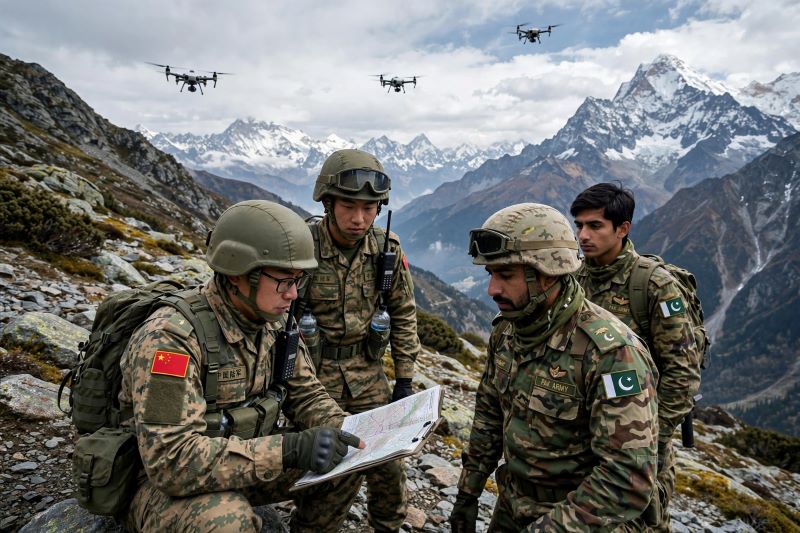
China and Pakistan are set to conduct their first joint regular army exercise, Karakoram 2026, in the Korla area of China’s Xinjiang Uygur Autonomous Region in mid-to-late October. Announced by China’s Ministry of National Defence on October 10, the exercise will focus on counter-terrorism operations in high-altitude terrain. The planned activities include unmanned aerial vehicle operations, mobile target search and firing, long-range sniping, joint command procedures and live-force training. While Beijing and Islamabad have described the exercise as an effort to strengthen counter-terrorism cooperation, its wider strategic implications are significant for India.
The exercise marks a new phase in a defence partnership that has steadily expanded over several decades. China and Pakistan already cooperate extensively in the production and procurement of military equipment, including fighter aircraft, missiles, air defence systems, armoured vehicles and naval platforms. Their armed forces have also conducted regular air and naval exercises, notably the Shaheen and Sea Guardians series. The participation of regular army units in a dedicated joint exercise adds another dimension to this relationship by providing opportunities to develop operational coordination, communication and familiarity with each other’s military procedures.
The choice of Korla in Xinjiang is also noteworthy. The region borders Pakistan-administered territory in the northern subcontinent and lies close to the China-Pakistan Economic Corridor, a major component of Beijing’s Belt and Road Initiative. Training in high-altitude conditions could help both militaries practise operations in challenging terrain and improve their ability to coordinate under demanding circumstances. Although the exercise is officially focused on counter-terrorism, its location and the broader strategic relationship between the two countries make it relevant to India’s security calculations along its northern and western frontiers.
The timing is particularly sensitive because India and China continue to disagree over their boundary. On October 2, India’s Ministry of Home Affairs, in consultation with the Ladakh administration and local stakeholders, standardised the names of 28 places and geographical features in the Union Territory for inclusion on official Survey of India maps. The list included locations near the Line of Actual Control, including Gogra and Hot Spring. Beijing objected to the move on October 13, with Chinese foreign ministry spokesperson Mao Ning declaring that China did not recognise what it called the “so-called Union Territory of Ladakh” and asserting its claims over the western sector of the boundary.
India rejected the Chinese position the same day. Ministry of External Affairs spokesperson Randhir Jaiswal reiterated that Ladakh was an integral and inalienable part of India, adding that Chinese objections could not alter this reality. New Delhi maintained that the naming exercise was intended to ensure accurate identification of geographical locations and improve public awareness. Against this backdrop, the announcement of Karakoram 2026 reinforces the importance of assessing China-Pakistan military cooperation alongside the unresolved boundary dispute and continuing tensions between India and Pakistan.
The principal concern for India is not the existence of another military exercise but the cumulative improvement in interoperability between the two armed forces. Familiarity with each other’s command structures, communications systems, equipment and operational methods can make coordination more efficient during a crisis. Pakistan already depends substantially on Chinese-origin military platforms, while China continues to modernise its armed forces and expand its defence-industrial capabilities. Regular army training could help translate this equipment-based relationship into greater practical cooperation, potentially complicating India’s response if tensions were to escalate along both its northern and western borders.
However, strategic vigilance must not become a substitute for evidence. There is no publicly available proof that Karakoram 2026 is intended to test Chinese weapons systems on Pakistan’s behalf or that Pakistan is financing experimental evaluations of Chinese equipment. Nor does the exercise, by itself, establish that Beijing and Islamabad are preparing for a coordinated offensive against India. The announced focus on counter-terrorism, drone operations, precision shooting and joint command procedures is consistent with the stated purpose. Indian defence planners should therefore distinguish verifiable developments from speculation about undisclosed objectives.
The performance of Chinese military equipment supplied to Pakistan nevertheless deserves close scrutiny. Systems such as the PL-15E air-to-air missile and the HQ-9 air defence system have attracted attention in discussions of regional military capabilities. Chinese-origin armoured vehicles, including newer platforms such as the Type-15 light tank, have also prompted debate about their suitability for demanding combat environments. Yet promotional claims and isolated reports of battlefield engagements cannot establish the overall effectiveness of a weapons system. Performance depends on operator training, maintenance, ammunition quality, sensor integration, electronic warfare, command networks and the conditions in which the equipment is deployed. India needs rigorous technical assessments rather than either exaggerated threat perceptions or complacent assumptions about its adversaries’ capabilities.
Pakistan’s growing dependence on Chinese military technology also has longer-term consequences. The acquisition of advanced equipment expands Islamabad’s military options, but it creates continuing requirements for spare parts, upgrades, technical assistance, ammunition and specialised training. These dependencies can reinforce the supplier’s influence and constrain the recipient’s strategic flexibility. For China, the partnership provides a substantial market for its defence industry and strengthens its strategic position in South Asia. For India, the critical issue is how far this relationship can improve Pakistan’s military capabilities and sustain them during a prolonged confrontation.
The Xinjiang setting introduces another dimension to the exercise. Beijing presents its security policies in the region as necessary to counter terrorism and separatism. However, the United Nations human rights office’s 2022 assessment raised serious concerns about alleged arbitrary detention, restrictions on religious and cultural practices, and other human rights violations affecting Uyghurs and other predominantly Muslim communities. Joint counter-terrorism activities in the region consequently raise broader questions about the definition of security threats and the distinction between combating terrorism and restricting legitimate cultural or political expression. The exercise does not resolve these concerns, which remain separate from the military objectives announced by China and Pakistan.
For India, the immediate task should be to monitor the exercise for concrete indicators of enhanced military cooperation. These include the sophistication of joint command-and-control arrangements, the integration of drones into ground operations, improvements in logistical coordination and the development of common tactical procedures. Any accompanying agreements on equipment, maintenance, technology or training would also merit attention. Such evidence would help determine whether Karakoram 2026 represents a routine training initiative or a more substantial step towards institutionalised cooperation between the two armies.
India must simultaneously strengthen its own defence preparedness. Indigenous weapons production, layered air defence, counter-drone capabilities, electronic warfare, intelligence and surveillance systems, and resilient supply chains will remain essential to meeting emerging challenges. Closer cooperation among the armed forces, public-sector research institutions and private defence manufacturers can accelerate technological adaptation and reduce dependence on external suppliers. Military readiness must also be supported by credible intelligence, realistic contingency planning and the ability to sustain operations across difficult terrain and multiple fronts.
Karakoram 2026 is therefore best understood as a development requiring sustained attention rather than an immediate cause for alarm. Its significance lies in the gradual expansion of China-Pakistan defence cooperation, which now extends beyond arms transfers and occasional joint drills towards more regular army-level engagement. India must neither exaggerate the implications of a single exercise nor underestimate the cumulative effects of greater interoperability and shared military experience. A balanced response combining evidence-based assessment, technological modernisation, credible deterrence and diplomatic engagement will serve New Delhi better than speculation. The challenge is to understand how the evolving partnership between Beijing and Islamabad could change the military balance over time—and to ensure that India is prepared for the possibilities without mistaking them for established facts.
(Author, a senior trilingual journalist, is an editorial adviser to TEW.)











[[comment.comment_text]]