AsimMunir’s Move to Chop Up Pakistan: A Bid to Weaken Political Parties and Expand Military Influence

 an hour ago
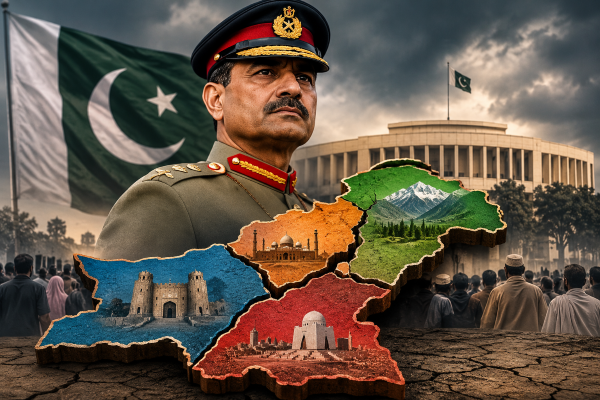
Pakistan’s proposed redrawing of provincial boundaries has opened a troubling debate about who governs the country and whose interests its institutions serve. Presented as administrative reform, dividing the four provinces carries consequences far beyond public-service delivery. At a moment when Field Marshal AsimMunir has acquired unprecedented influence, a serious question arises: is provincial reorganisation being considered for citizens, or to redesign politics in favour of the military establishment? No formal blueprint publicly issued by Munir proves that he personally authored every proposal. Yet the initiative is widely associated with the establishment under his leadership, and senior government figures have brought it into public discussion. Criticism must rest on evidence, not speculation. But the absence of a published plan, transparent consultation or convincing constitutional debate makes scrutiny essential.
Administrative convenience is legitimate, but cannot be invoked selectively without evidence, provincial agreement or safeguards against partisan manipulation by powerful actors.Pakistan’s four provinces are not merely administrative units. They embody historical identities, political struggles and a federal compact forged through a difficult national experience. Punjab, Sindh, Khyber Pakhtunkhwa and Balochistan have distinct social, linguistic and political realities. Changing their boundaries without broad consent risks turning governance reform into a confrontation over identity, representation and resources.
The political implications are difficult to ignore. The Pakistan Muslim League-Nawaz has its principal electoral base in Punjab, while the Pakistan Peoples Party remains deeply rooted in Sindh. Dividing these provinces could dilute established strongholds, weaken elected leadership and create smaller units more dependent on Islamabad. New provincial capitals and chief ministers might multiply, but so could the channels through which a powerful centre influences local politics. Critics therefore see possible political engineering, not simply decentralisation.The concern is sharpened by the military’s expanding constitutional position. Pakistan’s 27th Constitutional Amendment, approved in November 2025, made the army chief Chief of Defence Forces and strengthened the authority attached to that office. It also reset the incumbent’s tenure in the new role. Whatever justification the government offered in the name of coordination and security, concentrating so much authority in one military office raises serious questions about civilian oversight. A federation cannot remain healthy when elected institutions appear subordinate to an unelected power centre.Provincial restructuring could deepen that imbalance. If boundaries are altered through pressure rather than consensus, political parties may be weakened when they should be defending parliamentary democracy. Parties suffer from dynastic control, rivalries and poor governance. But their failures cannot justify replacing political competition with military tutelage. The answer is stronger internal democracy, credible elections and accountable leadership—not a map designed to make parties easier to manage.
Sindh’s resistance illustrates the depth of the issue. The Sindh Assembly has rejected proposals to divide the province or transfer parts of it to federal control. This cannot simply be dismissed as one party’s self-interest. For many Sindhis, provincial autonomy is tied to language, identity, economic rights and protection against central domination. Karachi, the country’s commercial centre, is especially sensitive. Detaching it from Sindh without constitutional consent would inflame distrust and destabilise an already fragile federation. Balochistan and Khyber Pakhtunkhwa require even greater sensitivity. Both have longstanding grievances concerning security, representation, development and control over natural resources. Redrawing boundaries without addressing those grievances would intensify alienation. Smaller provinces do not automatically mean better governance. They need resources, capable institutions, fair revenue arrangements and local accountability. Additional assemblies, secretariats and bureaucracies could also impose substantial costs on a country facing economic pressures.
Munir and the civilian leadership must answer basic questions. What administrative problem is being solved? Who prepared the proposal? What consultation has taken place with provincial assemblies, parties and communities? How will resources be shared? What safeguards will prevent federal interference? And why should citizens trust a process associated with an establishment whose expanding political role is already controversial? A genuine reform agenda would begin with empowered local governments, transparent fiscal transfers, better public services and stronger provincial institutions. It would publish evidence, invite debate and respect constitutional requirements for provincial consent where boundaries are affected. It would not treat political parties as obstacles or provincial identities as inconveniences.Pakistan does not need a stronger military grip disguised as administrative reform. It needs institutions strong enough to hold every institution accountable. Munir’s authority may be formidable, but no individual, however powerful or decorated, should stand above the Constitution or the people. A country is not strengthened by fragmenting its political voice and concentrating power at the centre. If redrawing becomes an instrument for weakening parties and expanding military influence, it will not modernise Pakistan; it will deepen its democratic crisis. Pakistan’s future must be decided by its citizens through constitutional politics, not engineered from military headquarters.
(The author is a commentator on Pak-occupied Kashmir and Gilgit-Baltistan developments. For feedback email: syedjahanzeeb2@gmail.com.)








[[comment.comment_text]]