When Mountains Begin to Give Way

 6 months ago
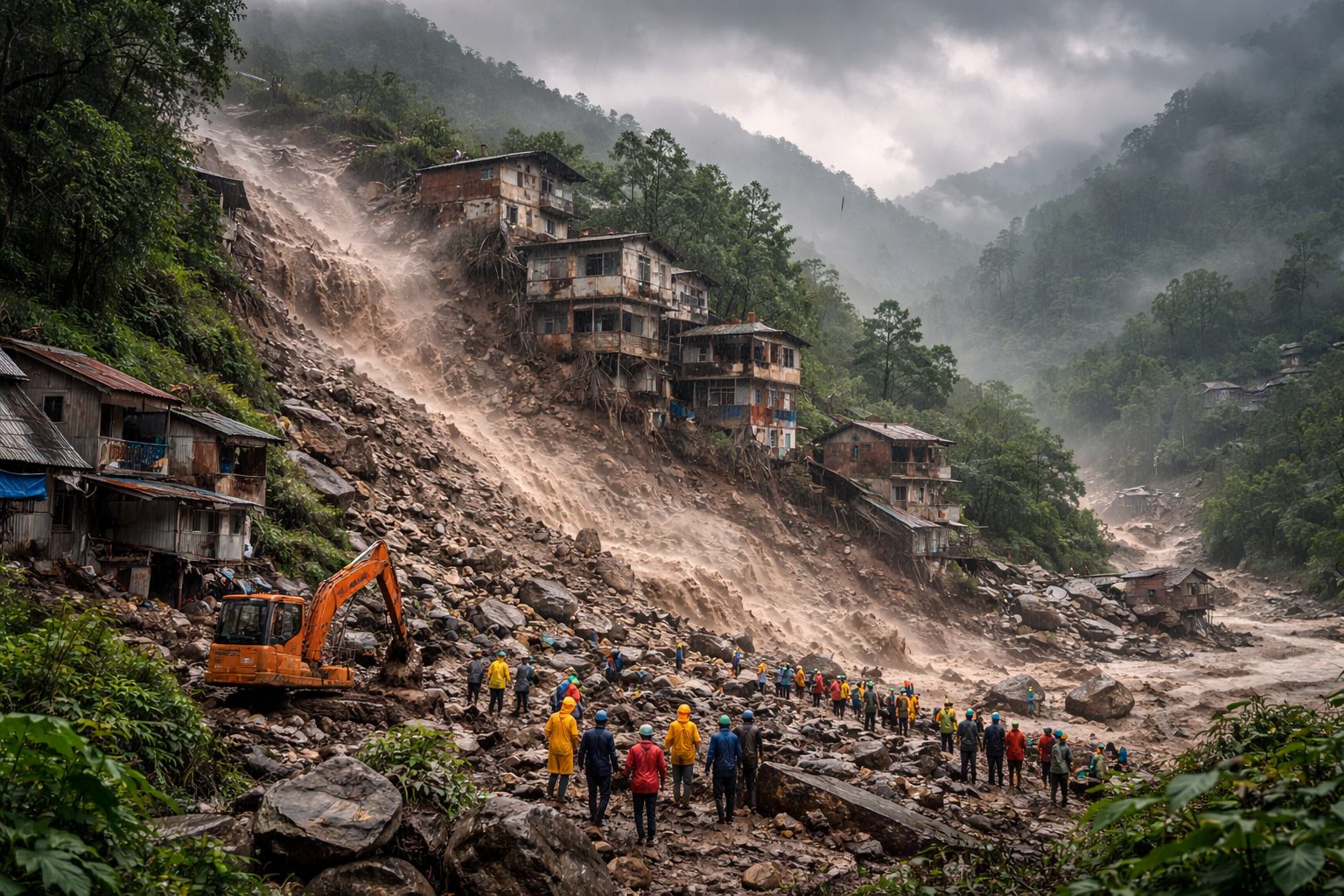
There was a time when life in the mountains was defined by a careful balance between humans and nature. Settlements were sparse, construction was limited, and communities adapted to the terrain rather than attempting to reshape it. Today, that balance is steadily eroding. Across the world—and particularly in developing countries like India—mountains are no longer just shaped by geological forces or seasonal rains; they are being reshaped, and in many cases destabilized, by human ambition. The consequences are becoming increasingly visible. Landslides, once considered unpredictable natural disasters, are now occurring with disturbing regularity, claiming over 4,500 lives every year and causing economic losses estimated at nearly $20 billion globally. What is more troubling is that these tragedies are no longer entirely natural—they are, to a significant extent, human-made.
A recent international study published in Science Advances, conducted by a team of researchers from Austria, Turkey, and Germany, has brought this reality into sharper focus. The study challenges a deeply rooted perception: that landslides are primarily driven by natural factors such as rainfall, earthquakes, or geological fragility. Instead, it reveals that the majority of fatal landslides occur in areas where human activity has significantly altered the landscape. In simple terms, mountains are not just collapsing because of nature—they are collapsing because of what humans have done to them over time.
The findings force us to rethink how we understand disasters. When a hillside gives way after heavy rain, it is easy to attribute the event solely to the intensity of the weather. But the study suggests that the real story often begins much earlier, with the gradual weakening of the slope through deforestation, road cutting, construction, and land-use changes. Rainfall may trigger the landslide, but the conditions that make it catastrophic are often created by human intervention.
One of the most striking aspects of this crisis is the scale at which it is unfolding. Since 1975, the number of people living in landslide-prone mountainous regions has nearly doubled. This growth has been particularly rapid in low and lower-middle income countries, where economic pressures, population growth, and limited land availability push communities into increasingly fragile environments. In these regions, mountains are no longer seen as barriers but as opportunities—for agriculture, housing, tourism, and infrastructure. However, this expansion often takes place without adequate planning or safeguards.
Forests, which once acted as natural stabilizers of mountain slopes, are being cleared at an alarming rate. Trees play a crucial role in holding soil together, absorbing water, and reducing surface runoff. When they are removed, the soil becomes loose, and slopes lose their structural integrity. Add to this the construction of roads that cut into hillsides, the building of houses on steep gradients, and the expansion of agriculture into marginal lands, and the result is a landscape that is increasingly prone to collapse.
The study’s comparative analysis across 46 countries provides a revealing insight into how different development models impact landslide risks. In high-income countries such as Switzerland, Japan, and Italy, only about 7 percent of mountainous terrain has undergone significant human-induced changes. These countries have invested heavily in land-use planning, environmental regulation, and disaster management systems. As a result, even though they face similar or even greater natural risks due to their geography, the number of fatalities from landslides remains relatively low.
In contrast, low and lower-middle income countries have altered up to 50 percent of their mountainous landscapes. These changes include deforestation, agricultural expansion, and unregulated infrastructure development. Countries like Haiti, Sri Lanka, and El Salvador have experienced sharp increases in landslide-related deaths as a direct consequence of these transformations. The difference is not just about natural vulnerability; it is about how human activity amplifies that vulnerability.
India’s Himalayan region offers a particularly telling example. The Himalayas are geologically young and inherently unstable, making them highly sensitive to disturbances. Yet, in recent years, there has been a surge in infrastructure development—highways, tunnels, hydropower projects, and urban expansion. While these developments are essential for economic growth and connectivity, they have also introduced new risks. Large-scale deforestation, slope excavation, and unregulated construction have weakened many parts of the mountain system.
Incidents in states like Uttarakhand and Himachal Pradesh have repeatedly highlighted this vulnerability. Roads carved into steep slopes without adequate reinforcement often collapse during heavy rains. Buildings constructed in unstable zones are swept away when the ground beneath them gives way. What appears as a sudden disaster is often the culmination of years of incremental changes that gradually undermine the stability of the terrain.
The concept that emerges from the study is that of human pressure acting as a “disaster multiplier.” This means that natural hazards do not operate in isolation; their impact is shaped and often intensified by human actions. A forested slope may endure heavy rainfall with minimal damage, but the same slope, once cleared and built upon, may fail catastrophically under similar conditions. In this way, human intervention does not just increase the likelihood of landslides—it magnifies their consequences.
Another critical dimension of this crisis is the unequal burden it places on different sections of society. In economically weaker countries, the most vulnerable populations are often the ones living in high-risk areas. With limited access to safe housing and infrastructure, they are forced to settle on steep slopes or near unstable terrain. When landslides occur, these communities suffer the most, both in terms of loss of life and livelihoods. Recovery is often slow and incomplete, trapping them in a cycle of vulnerability.
Climate change is further intensifying these risks. Changes in rainfall patterns, including more intense and unpredictable downpours, are increasing the likelihood of landslides. In mountainous regions, rising temperatures are causing glaciers to retreat and permafrost to thaw, weakening the structural stability of slopes. When these climatic factors interact with human-induced changes such as deforestation and construction, the result is a highly unstable environment.
The economic impact of landslides extends far beyond immediate damage. Infrastructure such as roads, bridges, and power lines is often destroyed, disrupting connectivity and economic activity. In regions dependent on tourism, such as the Himalayas, landslides can deter visitors and affect livelihoods. Agricultural land is often buried or eroded, leading to long-term losses for farming communities. The estimated global economic loss of $20 billion annually is likely an underestimate when these indirect impacts are taken into account.
Despite the scale of the problem, the study emphasizes that landslides are not inevitable disasters. Their frequency and impact can be significantly reduced through better planning and management. Scientific land-use planning, which takes into account the geological and ecological characteristics of mountain regions, is essential. This includes restricting construction in high-risk areas, preserving forest cover, and adopting sustainable agricultural practices.
Technology also offers tools for mitigation. Satellite monitoring, geographic information systems (GIS), and early warning systems can help identify vulnerable areas and provide timely alerts. However, these tools are only effective when combined with strong governance and enforcement. In many developing countries, regulations exist on paper but are not consistently implemented. Short-term economic gains often take precedence over long-term environmental sustainability.
There is also a need to rethink the broader approach to development in mountainous regions. Infrastructure projects must be designed with ecological sensitivity, ensuring that they do not compromise the stability of the terrain. This requires not just technical expertise but also a shift in mindset—from viewing mountains as resources to be exploited to recognizing them as fragile ecosystems that require careful stewardship.
Public awareness plays a crucial role in this process. Communities need to understand the risks associated with land-use changes and the importance of sustainable practices. Local knowledge, when combined with scientific insights, can help build resilience and reduce vulnerability.
Ultimately, the rising threat of landslides is a reflection of how human activity is reshaping the natural world. Mountains, once seen as symbols of permanence, are now showing signs of strain. The increasing frequency of landslides is not just a warning about environmental degradation; it is a reminder of the limits of unchecked development.
The challenge ahead is not to halt development but to guide it in a way that respects these limits. The evidence is clear: where human intervention is minimal and well-regulated, the risks are lower, even in naturally vulnerable regions. Where it is excessive and unplanned, the consequences are severe.
As mountains continue to bear the weight of human ambition, the question is whether that ambition can be balanced with responsibility. If not, the cost will not just be measured in economic losses or environmental damage, but in the lives that continue to be lost each year.









[[comment.comment_text]]