From Waste to Warming

 6 months ago
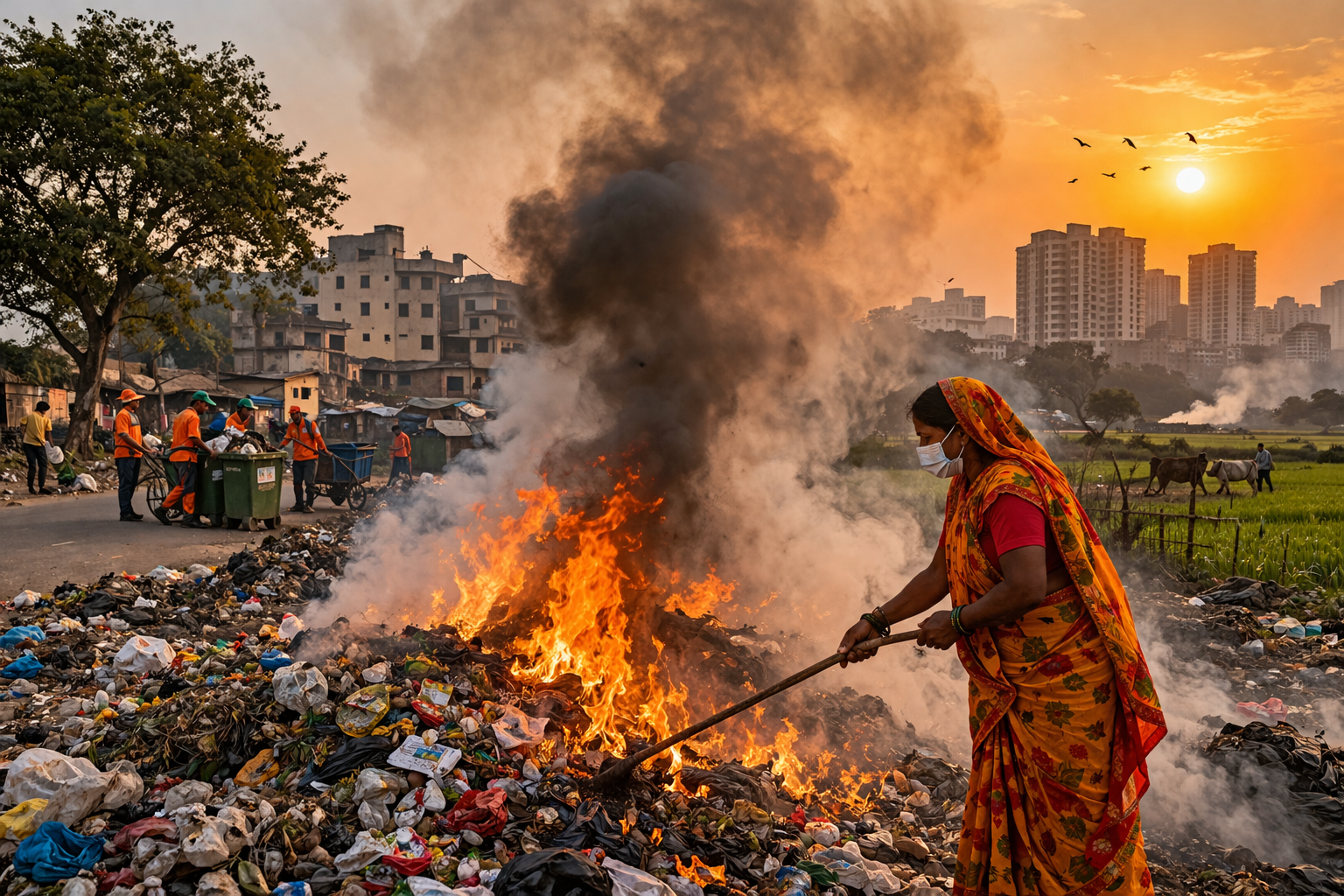
There is a certain normalcy attached to the sight of waste burning in India. At dawn, thin plumes of smoke rise from roadside dumps in small towns; by evening, in the outskirts of major cities, larger heaps of mixed garbage are set ablaze to “clear space.” In villages, behind homes or near fields, waste—now increasingly composed of plastic wrappers and packaging—is periodically burned as part of routine disposal. These are not isolated acts of negligence; they are embedded practices, shaped by systemic gaps in waste management and reinforced by convenience, habit, and the absence of viable alternatives. Yet, what appears ordinary at the ground level is, in aggregate, a deeply consequential environmental crisis—one that is quietly intensifying India’s carbon footprint, degrading air quality, and imposing a silent but significant public health burden.
The scale of waste burning in India is both vast and insufficiently documented. Official estimates indicate that the country generates over 1.7 lakh tonnes of municipal solid waste every day, translating into more than 62 million tonnes annually. While collection efficiency is often projected optimistically, independent assessments suggest that a substantial fraction of this waste—particularly in peri-urban and rural areas—remains uncollected or poorly managed. Even within collected waste streams, inadequate segregation means that large volumes ultimately become “residual waste,” for which there are limited processing options. It is within this gap that open burning emerges as the default solution. Estimates indicate that tens of millions of tonnes of waste are burned in the open every year, including a significant share of plastic waste that cannot be economically recycled. These numbers are not merely statistical abstractions; they translate into daily, dispersed combustion events across thousands of locations, each contributing incrementally to a national crisis.
To understand why waste burning persists, one must examine the everyday realities of waste handling in India. In many urban neighborhoods, the formal waste collection system is inconsistent or incomplete. Municipal workers, often under-resourced, collect mixed waste from households without enforcing segregation norms. This waste is then transported to secondary collection points or informal dumping sites, where it accumulates. As piles grow, they attract animals, emit foul odours, and become visually intrusive. For local residents or sanitation workers, burning becomes a quick and low-cost method to reduce volume. A matchstick replaces a management system. What follows is not controlled combustion but a chaotic burning of heterogeneous materials—organic waste, plastics, rubber, textiles, and even electronic debris—each releasing its own set of pollutants.
In large metropolitan areas, the issue is compounded by the scale of waste generation. Cities like Delhi produce between 11,000 and 14,000 tonnes of waste daily. Despite the presence of structured municipal systems, the sheer volume overwhelms infrastructure. Unauthorized dumping in vacant plots, roadside edges, and construction sites is common. Field reports frequently document instances where such dumps are deliberately set on fire, either by individuals seeking to clear space or by informal waste handlers attempting to extract residual value from metals by burning insulating materials. In recent years, thousands of such burning incidents have been officially recorded in Delhi alone, though the actual number is likely far higher, given the limitations of monitoring systems.
Landfills represent another dimension of the problem, where waste burning becomes both accidental and systemic. India’s major landfill sites—many of which have long exceeded their designed capacities—are prone to fires that can last for days or even weeks. These fires are often triggered by methane buildup within decomposing organic waste, but they are also sometimes initiated intentionally to reduce the volume of accumulated garbage. When a landfill catches fire, the scale of emissions is enormous. Thick, toxic smoke spreads over adjacent neighborhoods, carrying fine particulate matter (PM2.5 and PM10), black carbon, and a range of hazardous gases. Residents living near such sites are exposed continuously, with little recourse to mitigation. The fires at Delhi’s Ghazipur, Bhalswa, and Okhla landfills, or similar incidents in cities like Surat, are not anomalies; they are recurring events that underscore the fragility of current waste management systems.
If urban India presents a visible and often reported picture of waste burning, rural India represents its most extensive and least acknowledged front. With nearly two-thirds of the population residing in rural areas, the absence of formal waste collection systems creates a vacuum that is filled by traditional disposal practices. Historically, rural waste was largely organic and biodegradable, allowing for natural decomposition. However, the rapid penetration of packaged goods—snacks, personal care products, and household items—has transformed the composition of rural waste. Today, even remote villages generate significant quantities of non-biodegradable waste, particularly multi-layered plastics that have no recycling value. In the absence of collection infrastructure or awareness about alternative disposal methods, households resort to burning this waste in backyards or community spaces. This practice is not sporadic; it is routine, normalized, and widespread, involving hundreds of millions of people. Yet, because it is dispersed and small-scale at the individual level, it remains largely invisible in policy discussions.
The environmental implications of this widespread burning are profound. From an air quality perspective, open waste burning is a significant source of particulate matter and toxic pollutants. When mixed waste is burned, it releases fine particles that can penetrate deep into the respiratory system, along with gases such as carbon monoxide, nitrogen oxides, and volatile organic compounds. Studies have shown that localized waste burning events can increase PM2.5 concentrations by 45 to 55 percent in surrounding areas. In cities already struggling with high baseline pollution levels, such incremental increases can push air quality into hazardous ranges. Importantly, unlike industrial emissions, which are often concentrated and regulated, emissions from waste burning are diffuse and largely unmonitored, making them harder to control.
The composition of emissions becomes even more concerning when plastics are involved. Burning plastic releases dioxins and furans—highly toxic compounds that are known carcinogens and can disrupt hormonal systems. These substances persist in the environment, accumulating in soil and water, and eventually entering the food chain. Heavy metals such as lead and mercury may also be released, depending on the materials burned. The health implications of prolonged exposure to such pollutants are severe, ranging from respiratory illnesses and cardiovascular diseases to developmental disorders and cancer. For communities living near frequent burning sites, exposure is not an occasional hazard but a chronic condition.
From a climate perspective, waste burning contributes to greenhouse gas emissions in multiple ways. The combustion of organic waste releases carbon dioxide and, in some cases, methane—a gas with a global warming potential significantly higher than CO₂ over a 20-year period. More critically, the incomplete burning of waste produces black carbon, a short-lived climate pollutant that has an intense warming effect. Black carbon also deposits on glaciers and snow surfaces, reducing their reflectivity and accelerating melting—a phenomenon of particular concern for the Himalayan region. Despite these impacts, emissions from open waste burning are often underrepresented in national greenhouse gas inventories, creating a gap between reported and actual climate contributions.
The persistence of waste burning is closely linked to structural deficiencies in India’s waste management framework. Collection gaps remain a fundamental issue, particularly in smaller cities and rural areas. Even where collection systems exist, they are often irregular or incomplete, leaving significant portions of waste unmanaged. Segregation at source—a critical prerequisite for effective recycling and processing—remains inconsistent. Without segregation, recyclable materials are contaminated, organic waste cannot be composted efficiently, and the volume of residual waste increases. This residual fraction, lacking economic value and processing options, becomes the primary candidate for burning.
Plastic waste, especially low-value and multi-layered packaging, exacerbates the problem. Such materials are difficult to recycle due to their composite structure and lack of market demand. Waste pickers, who form the backbone of India’s informal recycling sector, selectively collect materials with resale value—such as PET bottles and certain types of rigid plastics—while leaving behind low-value waste. This residual waste accumulates and is eventually burned. In this sense, waste burning is not merely a failure of disposal; it is the endpoint of a value chain where certain materials are rendered economically invisible.
Policy responses to India’s waste crisis have largely focused on downstream interventions. Measures such as bans on specific single-use plastic items, targets for recycling, and the promotion of waste-to-energy (WtE) plants have dominated the discourse. While these initiatives have merit, they do not address the root causes of waste generation. Bans are often limited in scope and face enforcement challenges, with alternatives either unavailable or unaffordable. Recycling, though essential, has inherent limitations, particularly for plastics that degrade in quality over successive cycles. Waste-to-energy projects, meanwhile, present their own set of challenges. Indian waste, characterized by high moisture content and organic composition, is not ideally suited for incineration-based energy recovery. As a result, many WtE plants operate below capacity or rely on supplementary fuels. Moreover, they can emit pollutants similar to those from open burning, albeit under regulated conditions. In effect, such projects risk institutionalizing burning rather than eliminating it.
A critical gap in current policy is the limited focus on upstream interventions—measures that reduce waste generation at its source. This includes regulating the production of non-recyclable materials, promoting sustainable product design, and encouraging reuse and refill systems. Extended Producer Responsibility (EPR) frameworks, which are intended to hold manufacturers accountable for the lifecycle of their products, have not yet achieved their full potential. In many cases, compliance is achieved through credit mechanisms or third-party arrangements, without significant changes in material use or product design. As long as the production of problematic materials continues unchecked, downstream systems will remain under pressure, and burning will persist as an outlet.
The human dimension of the crisis adds another layer of complexity. Waste burning disproportionately affects vulnerable populations—those living in informal settlements, near dumping sites, or in areas with limited municipal services. Waste pickers, who play a crucial role in material recovery, are exposed to hazardous conditions, including toxic smoke from burning waste. For them, the risks are occupational and unavoidable. Children growing up in such environments face long-term health consequences, including impaired lung development and increased susceptibility to disease. Yet, these impacts are rarely quantified in economic or policy terms, leading to an underestimation of the true cost of waste mismanagement.
Addressing the issue of waste burning requires a fundamental shift in approach—from managing waste to preventing it. This involves rethinking the entire lifecycle of materials, from production and consumption to disposal. Upstream regulation must become a priority, with stricter controls on the manufacture of non-recyclable plastics and incentives for sustainable alternatives. Decentralized waste management systems, such as community-level composting and material recovery facilities, can reduce the burden on centralized infrastructure and minimize the volume of residual waste. Expanding and strengthening waste collection systems, particularly in rural areas, is essential to eliminate the need for informal disposal practices.
Equally important is the integration of the informal sector into formal waste management frameworks. Recognizing and supporting waste pickers through fair wages, social protection, and access to infrastructure can enhance recycling rates and reduce the volume of waste that ends up being burned. Behavioural change initiatives must move beyond awareness campaigns to provide practical, accessible alternatives to burning. This includes ensuring that households have the means and incentives to segregate waste and that local authorities have the capacity to manage it effectively.
Finally, improving data collection and monitoring is critical. Incorporating emissions from waste burning into national inventories can provide a more accurate picture of its environmental impact and inform targeted interventions. Without reliable data, the problem will continue to be underestimated and inadequately addressed.
Waste burning in India is not a marginal issue; it is a systemic challenge that intersects with climate change, public health, and urban governance. The smoke rising from countless small fires across the country is a visible manifestation of deeper structural failures. Addressing it requires more than incremental policy adjustments—it demands a comprehensive, upstream-focused strategy that reduces waste generation, strengthens management systems, and aligns economic incentives with environmental outcomes. Until such a shift occurs, waste burning will remain an enduring, if often overlooked, contributor to India’s environmental crisis.
(Author is a well-recognised educationist and commentator on social-cultural affairs. Views are personal.)



[[comment.comment_text]]