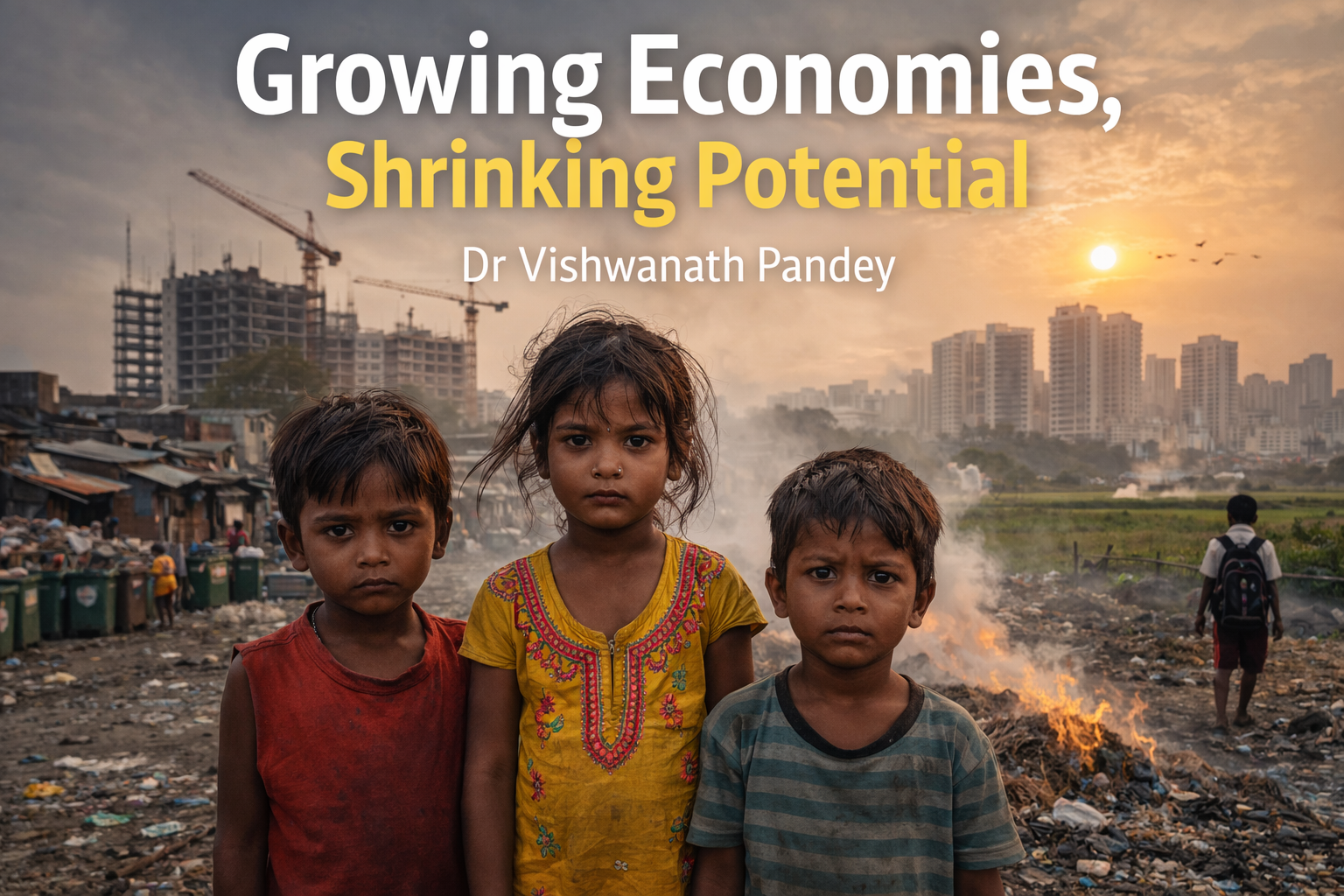
Growing Economies, Shrinking Potential

 6 months ago
For decades, the story of human progress has been told through rising incomes, expanding cities, and improved access to healthcare and education. There has always been an implicit belief that each generation would be healthier, stronger, and better equipped than the previous one. One of the simplest reflections of that belief has been human height. Across much of the developed world, people steadily grew taller through the 20th century, a quiet but powerful indicator that nutrition, healthcare, and living conditions were improving. It was almost taken for granted that this trend would continue everywhere. However, the latest findings from the World Bank challenge this assumption in a deeply unsettling way. In countries like India and several other low and lower-middle income nations, adult height has stopped increasing—and in some cases, it has even declined. What appears to be a small biological shift is, in reality, a warning sign of a much larger crisis: the stagnation of human capital.
At first glance, the idea that average height is not increasing may not seem alarming. After all, development is usually measured through economic growth rates, infrastructure expansion, or technological progress. But height tells a different, more intimate story. It reflects the conditions in which a person grows up—the quality of food they consume, the healthcare they receive, the sanitation they live with, and the illnesses they are exposed to during childhood. It is, in many ways, a cumulative record of early-life experiences. When a population stops growing taller, it suggests that something fundamental is not improving, even if other indicators suggest progress.
The World Bank’s report, Building Human Capital: Where It Matters, uses this very insight to examine the broader condition of human development across countries. Human capital, as defined in the report, is not just about education or workforce participation; it is the combined outcome of health, skills, and knowledge. It begins to take shape from the earliest years of life. The first five years are especially critical, as this is when the brain develops most rapidly and the body lays down its growth trajectory. A child who suffers from malnutrition, repeated infections, or inadequate care during this period carries those disadvantages into adulthood. Even if conditions improve later, the early deficits are often irreversible.
In India and similar economies, this early-life vulnerability remains widespread despite decades of economic growth. National surveys have consistently shown that a significant proportion of children under five suffer from stunting or undernutrition. These are not just numbers in a report; they represent millions of children whose physical and cognitive development is compromised before they even enter school. By the time they reach adolescence, the gap is already visible—not just in height, but in learning ability, energy levels, and overall health. When these individuals enter the workforce, the impact becomes economic, affecting productivity and long-term earning potential.
The World Bank’s comparative analysis of adults born in 1966 and those born in 1996 brings this reality into sharper focus. In high-income countries and many upper-middle-income economies, people born in the later period are taller, reflecting sustained improvements in living conditions. In Western Europe, for example, average height increased by about one centimeter per decade over much of the 20th century. China has witnessed similar gains in recent decades, mirroring its rapid progress in nutrition and healthcare. But in India and several other lower-income regions, the story is markedly different. Adults born in 1996 are, on average, no taller—and in some cases slightly shorter—than those born three decades earlier. In parts of Sub-Saharan Africa, the decline is even more pronounced, with a reduction of around three centimeters over the same period.
This stagnation is not just about physical growth; it is a reflection of deeper systemic issues. Health inequalities remain stark, with access to quality healthcare still uneven across regions and income groups. While urban centers may offer advanced medical facilities, large sections of rural and marginalized populations continue to face barriers in accessing even basic services. Nutrition, too, remains a challenge. The availability of food has improved, but the quality and diversity of diets have not kept pace. The rise of processed and low-nutrient foods has further complicated the situation, creating a paradox where calorie intake may be sufficient, but essential nutrients are lacking.
Education, another pillar of human capital, has expanded in terms of access but continues to struggle with quality. School enrollment rates have improved significantly, yet learning outcomes remain uneven. Many children complete years of schooling without acquiring foundational skills in reading, writing, and arithmetic. This disconnect between years of education and actual learning further weakens the development of human capital. When combined with health and nutrition deficits, it creates a workforce that is less prepared to meet the demands of a modern, knowledge-driven economy.
The economic implications of this trend are substantial. According to the World Bank, differences in human capital account for nearly two-thirds of the gap in per capita GDP between rich and poor countries. This means that the wealth of nations is not determined solely by natural resources or industrial capacity, but by the quality of their people—their health, their skills, and their ability to innovate and adapt. When human capital stagnates, economic growth becomes uneven and less sustainable. It may continue in the short term, driven by investments and consumption, but it lacks the resilience needed for long-term progress.
The COVID-19 pandemic has further complicated this picture, acting as a shock that disrupted already fragile systems. For millions of children and young people, critical years of development were interrupted. Schools were closed for extended periods, cutting off access not just to education but also to midday meals and social support systems. Healthcare services were diverted, leading to missed vaccinations and delayed treatments. The World Bank estimated that the pandemic could lead to a significant decline in human capital, particularly among the 2.6 billion people under the age of 20 who represent the future workforce. In countries like India, where digital access is uneven, the shift to online learning widened existing inequalities, leaving many students behind.
What makes the current situation particularly concerning is that these setbacks are not temporary. The effects of poor nutrition, disrupted education, and inadequate healthcare accumulate over time. A child who misses out on proper learning or nutrition today does not simply catch up tomorrow. The loss becomes embedded in their development, shaping their future opportunities and, by extension, the economic trajectory of the country.
At the same time, the gap between high-income and low-income countries continues to widen. While developed nations invest heavily in advanced healthcare, research, and skill development, many developing countries are still grappling with basic challenges. This divergence is not just about income; it is about human potential. Countries with stronger human capital are better equipped to harness technology, respond to global challenges, and sustain economic growth. Those with weaker human capital risk being left behind, caught in a cycle of low productivity and limited opportunity.
The situation calls for a fundamental rethinking of development priorities. Economic growth, while important, cannot be the sole focus. Investments in early childhood nutrition, healthcare, and education must be treated as central to development strategy, not as secondary concerns. Strengthening public health systems, ensuring equitable access to quality education, and addressing nutritional deficiencies are not just social objectives—they are economic imperatives.
Equally important is the need for better measurement and accountability. Indicators like GDP growth provide a broad picture of economic performance, but they do not capture the quality of human development. Metrics such as child nutrition levels, learning outcomes, and even average height offer deeper insights into the true state of progress. They reveal whether growth is translating into improved well-being or merely masking underlying weaknesses.
The stagnation of adult height in India and similar countries is, therefore, more than a statistical observation. It is a signal that development is not reaching where it matters most—in the lives of people. It suggests that while economies may be expanding, the foundations of human capability are not strengthening at the same pace. This disconnect poses a long-term risk, not just to economic growth but to social stability and equity.
The question is not whether economies are growing, but whether people are truly developing. A nation’s future is shaped not just by its infrastructure or industries, but by the health, skills, and knowledge of its people. If these foundations remain weak, growth will remain fragile. The findings of the World Bank serve as a reminder that progress must be measured not only in numbers, but in human potential. And right now, that potential, in many parts of the world, appears to be standing still—or even slipping backward.






[[comment.comment_text]]