Japla Cement Factory: A Century-Old Industrial Legacy Abandoned, Its Future Still Hanging in the Balance

 14 minutes ago
Once a major source of employment and economic activity in Palamu, the historic plant has remained closed since 1992. Political promises by Narendra Modi and Rajnath Singh, a state government revival proposal and repeated assurances have failed to translate into an industrial revival. With 81.04 acres now under the auction process, the question is whether the land will become another financial asset or the foundation of a new industrial future for the region.
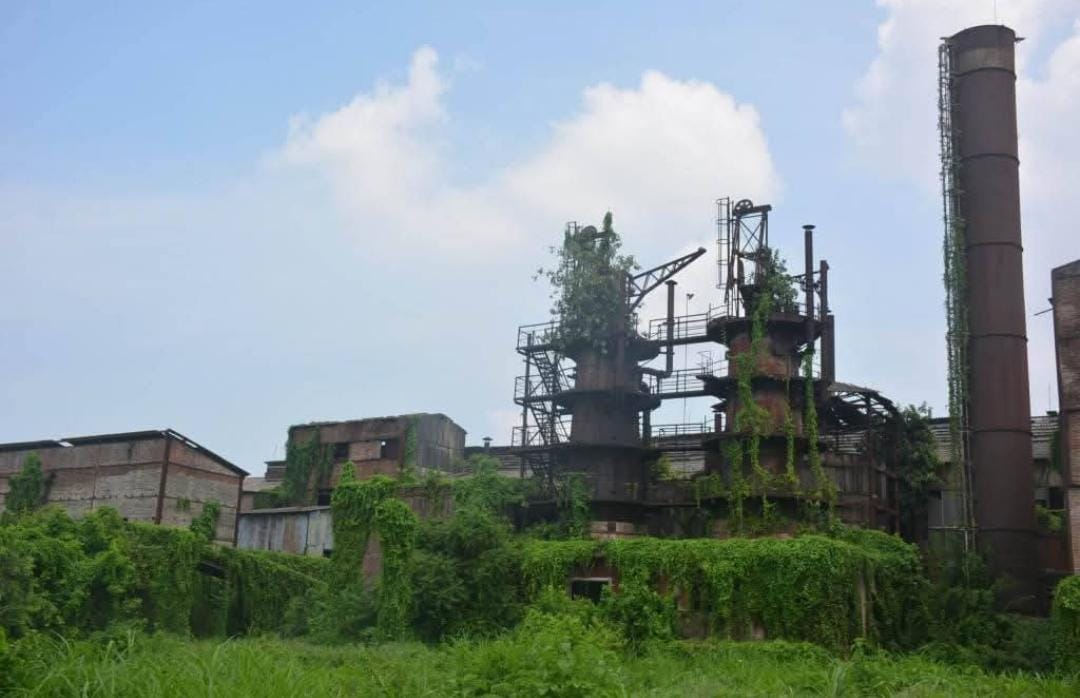
JAPLA, PALAMU: For decades, the chimneys of the Japla Cement Factory stood as a symbol of industrial activity in an otherwise economically underdeveloped part of the erstwhile Bihar and present-day Jharkhand. Established during British rule, the factory became one of India's early Portland cement manufacturing units and played a significant role in shaping the economic and social life of Japla and its surrounding areas. Its operations generated employment, supported local businesses and connected mining, transportation and commercial activities across the region. But the industrial landmark that once sustained thousands of families has remained silent since 1992. More than three decades after its closure, the factory's land and assets have entered another phase of liquidation, while the region continues to wait for the industrial development that successive governments promised.
The story of Japla Cement Factory is not merely about the closure of an old industrial unit. It is also about the loss of employment, the erosion of a local economic ecosystem and the failure to convert an existing industrial asset into a new development opportunity. The latest auction proceedings have brought the issue back into public debate, raising fundamental questions about government accountability, industrial policy, workers' rights and the future of employment in Palamu.
The factory was established in 1917 near the Sone River, and commercial production began on 16 March 1921. Initially known as Sone Valley Portland Cement Company, it was among the early cement manufacturing enterprises in India. The plant was established at a time when industrial infrastructure in the region was limited, making its development a significant economic milestone for the area. Historical accounts identify Martin Burn as the agency associated with establishing the factory.
The factory's industrial infrastructure was remarkable for its time. Limestone was transported from the Boulia area of Rohtas district in Bihar, across the Sone River, through a ropeway system. The plant had its own power-generation facilities, workshops, production infrastructure and railway connectivity for the transportation of raw materials and finished cement. It was not simply a manufacturing unit but an integrated industrial establishment involving mining, transport, energy, labour and trade. The ropeway across the river became one of the most recognisable features of the factory's operations and reflected the scale of the industrial infrastructure developed around it.
The economic importance of the factory extended well beyond its production capacity. It created direct employment for workers and generated indirect opportunities for contractors, transport operators, suppliers, traders and small businesses. A 2009 report in The Telegraph estimated that around 1,400 permanent employees and approximately 4,000 contract workers were associated with the plant. Mining operations in Rohtas district were also linked to its functioning. These figures relate to the period covered by that report and should not be interpreted as the factory's employment strength at the time of closure. Nevertheless, they illustrate the scale of the economic network that had developed around the unit.
For Japla, Hussainabad, Haidernagar, Dangwar and neighbouring settlements, the factory was more than a workplace. Salaries earned by employees supported local markets, shops, transport services and other small enterprises. Families built their lives around the industrial establishment, while generations of workers developed skills and livelihoods connected with manufacturing. The factory also contributed to the region's identity as an industrial centre. Its closure therefore affected not only those directly employed by the company but also a wider network of people whose incomes depended on its operations.
The decline began amid changes in ownership and financial difficulties. After the factory came under the control of the Sinha Group in 1984, its operational and financial condition reportedly deteriorated. A shutdown followed in 1985. Efforts were subsequently made to revive production with financial support, and the factory resumed operations in January 1991. However, the revival was short-lived. Production stopped again in May 1992, and the plant never returned to regular commercial operation. The closure left employees facing uncertainty over wages and other statutory dues, while the local economy lost one of its most important sources of organised employment.
The years that followed brought repeated assurances but little visible progress. The factory's revival became a recurring issue in local and state-level politics. During the 2014 election campaign, Narendra Modi, then the BJP's prime ministerial candidate, reportedly promised at a public meeting in Medininagar that the factory would be revived if the BJP formed the government at the Centre. Rajnath Singh also assured people during the 2014 election campaign in the Hussainabad-Haidernagar area that the factory would be reopened if the BJP came to power in Jharkhand. These promises raised expectations among former employees and local residents, many of whom had been waiting for the plant to resume operations for more than two decades. However, the promised revival did not materialise.
In May 2017, the then Jharkhand Chief Minister Raghubar Das announced another revival initiative. Addressing a public meeting in Hariharganj, he said negotiations were at an advanced stage with the Steel Authority of India Limited (SAIL) for the transfer of limestone mines to the Jharkhand State Mineral Development Corporation. The availability of raw material, he said, would help restart the Japla plant and generate employment for thousands of people. The announcement was significant because it suggested that the government was considering a concrete supply arrangement for the factory. Yet, the proposal did not lead to the resumption of production.
The official record also reveals the gap between announcements and implementation. In a written reply in the Lok Sabha on 24 July 2019, the Ministry of Commerce and Industry stated that the Jharkhand Government had made efforts to revive the closed factory in partnership with private cement companies, including ACC, UltraTech, Dalmia Cement, Shree Cement and Star Cement. However, none of the companies agreed to purchase or operate the plant. The government also informed Parliament that the factory was burdened with institutional debt and that two earlier auction attempts conducted through the Debt Recovery Tribunal had failed because of a lack of participation. Following the Patna High Court's order dated 17 May 2018 concerning liquidation, the machinery of the unit had been auctioned.
The same parliamentary reply contained another important development. On 28 August 2018, the Jharkhand Government had requested the Official Liquidator of the Patna High Court to transfer 137.99 bighas of leasehold land belonging to the factory for the development of an industrial area. This was potentially an important opportunity to convert a defunct industrial establishment into a new industrial zone. Instead of allowing the land to remain unused, the government could have developed infrastructure, invited investors and encouraged manufacturing units capable of generating employment in the region. Yet, the proposal did not translate into a visible industrial project. The absence of a publicly demonstrated, time-bound implementation plan has left residents questioning why an industrial development opportunity identified years ago has remained unrealised.
The issue also highlights a policy gap between the Centre and the state. In December 2015, the Ministry of Heavy Industries and Public Enterprises informed Parliament that the cement industry had been decontrolled in 1989 and delicensed in 1991 under the liberalisation policy. Consequently, the government did not intervene directly in the day-to-day functioning of cement companies. While this explains the limits of direct government intervention in a private company's operations, it does not remove the responsibility of the state to examine alternative industrial uses for the land, facilitate investment, develop infrastructure and address the concerns of affected workers.
The latest developments have brought the factory's future into sharper focus. In October 2026, the Official Liquidator initiated a fresh auction process for the property of Sone Valley Portland Cement Limited at Deorikalan and Kisua villages in Japla. According to the Patna High Court's order dated 29 October 2026, the reserve price was fixed at Rs 34.60 crore, with an earnest money deposit of Rs 8.65 crore. After inter-se bidding, Rajbali Singh, representing Bhumivardhan Vihar, a partnership firm, emerged as the highest bidder with an offer of Rs 35.05 crore. The second bidder, Shrekant Kumar, offered Rs 34.98 crore. The High Court provisionally accepted the highest bid and directed the bidder to deposit the stipulated amount within the prescribed period. The order also provided for consideration of the second bidder's offer if the highest bidder failed to comply with the payment conditions. Thus, the order represents provisional acceptance of the bid, not confirmation that the final transfer has been completed.
The auction has triggered fresh concerns among local residents, former employees and representatives of the affected community. On 21 November 2026, Palamu Zila Parishad member Rahul Kumar Mehta submitted a memorandum to Chief Minister Hemant Soren seeking intervention in the matter. The memorandum raises questions about the publicity given to the auction, the participation of potential investors, the valuation of the property, the ownership and lease status of the land, and the protection of former employees' statutory rights. It also argues that the future of such a significant industrial asset should not be decided solely on the basis of its immediate financial value, without examining its potential contribution to regional development
The memorandum refers to the fact that seven tender forms were reportedly sold, but no completed tender form was received within the stipulated period. It further questions whether adequate publicity reached national and regional newspapers, government portals, major cement manufacturers, financial institutions and potential industrial investors. It calls for an independent examination of the auction process and the valuation of the property. These are concerns raised by the memorandum's signatories and should not be treated as established evidence of irregularity. The relevant auction records, court proceedings and valuation documents would need to be examined by the competent authorities before any conclusion can be drawn.
The memorandum also draws attention to the difference between the 137.99 bighas of leasehold land mentioned in the 2019 parliamentary reply and the 81.04 acres involved in the 2026 auction. These figures arise from different official references and should not automatically be treated as descriptions of identical parcels of land. A clear, parcel-wise verification of ownership, lease conditions, area and transfer permissions is essential. The status of the land is particularly important because any future industrial project will depend on the legal availability of the property.
The larger question, however, is not confined to the auction. It concerns the future economic use of the land and the government's willingness to develop a new industrial base in Palamu. The region continues to face limited organised employment opportunities, and migration remains a concern for many households. The closure of the cement factory removed a major source of local employment, but no comparable industrial ecosystem has emerged in its place. The failure to implement the 2018 industrial-area proposal has therefore become a significant missed opportunity.
There are several possibilities for the future use of the property. A new cement plant could be considered, subject to an assessment of limestone availability, mining rights, environmental clearances, water resources, power supply, transport costs and market viability. The old machinery has been auctioned, so restarting the original plant in its previous form may not be commercially or technically feasible. A fresh investment and modern production technology would be required.
Alternatively, the land could be developed as a multi-sector industrial park or a cluster for micro, small and medium enterprises. Construction-material manufacturing, mineral-based industries, agricultural processing, warehousing and logistics facilities could be examined as potential activities. A planned industrial zone could also accommodate ancillary manufacturing units that supply larger industries in Jharkhand and neighbouring states. Such a model may generate employment through several enterprises rather than depending on a single large factory.
Another possibility has emerged in the form of a proposed railway-related manufacturing facility. In May 2025, Palamu MP Vishnu Dayal Ram reportedly stated that discussions had taken place with the Railway Minister regarding the establishment of a railway factory on the vacant land of the Japla cement plant. He argued that such a facility could provide employment to thousands of unemployed young people. However, this remains a reported proposal and should not be confused with a formally sanctioned or funded railway project. The state and central governments would need to clarify whether any feasibility study, land assessment or formal approval has followed.
For any of these possibilities to become reality, the government must move beyond general assurances and prepare a concrete industrial development plan. The first requirement is a transparent assessment of the land and its legal status. This should be followed by a feasibility study covering infrastructure, transport connectivity, raw materials, energy, water availability, environmental conditions and market demand. Potential investors should be invited through a transparent process, with clear conditions relating to investment commitments, employment generation, local recruitment and project timelines.
The interests of former employees must also be addressed. Their claims relating to unpaid wages, gratuity, provident fund, Employees' State Insurance and other statutory benefits should be verified and resolved in accordance with the law. Any future development plan should include opportunities for skill training and employment for local youth, particularly families affected by the factory's closure. A new industrial project should not repeat the old pattern in which local communities bear the social and economic costs while remaining excluded from the benefits of development.
The state government should also consider setting up a high-level committee involving the departments of industries, mines and geology, revenue, labour and the Palamu district administration. The committee could examine the legal status of the land, review the industrial potential of the property, assess the outstanding liabilities of workers and prepare a time-bound roadmap for future use. The participation of former employees, local representatives and affected residents would help ensure that the process reflects the interests of the community.
The story of Japla Cement Factory is ultimately a story of lost industrial opportunity and unfulfilled political commitments. Prime Minister Narendra Modi and Rajnath Singh raised expectations during the 2014 election campaign. The Raghubar Das government announced a revival plan in 2017. The Jharkhand Government subsequently proposed the development of an industrial area, and the Centre acknowledged that proposal in Parliament in 2019. Yet, the region has seen neither the revival of the original factory nor the establishment of a comparable industrial project. The latest auction has made the question of accountability even more pressing.
The challenge before the Hemant Soren government is now to ensure that the future of Japla's industrial land is not determined exclusively by the liquidation of a company and the settlement of financial liabilities. The legal process must be respected, but the state must also examine every lawful opportunity to secure a productive industrial use for the property. The government should explain what happened to the earlier industrial-area proposal, whether any fresh investment plan exists and what concrete steps are being taken to generate employment in the region.
Japla does not necessarily need the old factory to return in precisely its former form. What it needs is a credible industrial future. A modern manufacturing facility, an industrial park, a railway-related production unit or a cluster of smaller industries could help restore economic activity and create employment. The land, infrastructure and industrial history of the area provide a starting point, but investment, planning and sustained administrative action are indispensable.
A century after production began, Japla stands at another turning point. The factory that once gave the region an industrial identity has become a symbol of prolonged neglect and unfulfilled promises. Whether its land becomes merely another auctioned asset or the foundation of a new employment and industrial development programme will depend on the decisions taken now. For the people of Palamu, the demand is no longer simply to reopen a closed factory. It is to ensure that the region is not denied another generation of industrial opportunity.









[[comment.comment_text]]