Japla Cement Factory: A Century of Industrial Heritage Lost to Government Inaction
 2 hours ago
Closed since 1992, the historic plant once supported thousands of livelihoods in Palamu. Despite election promises by Narendra Modi and Rajnath Singh and repeated revival proposals, no industrial project has materialised. With its land now facing auction, the region's future employment prospects remain uncertain.
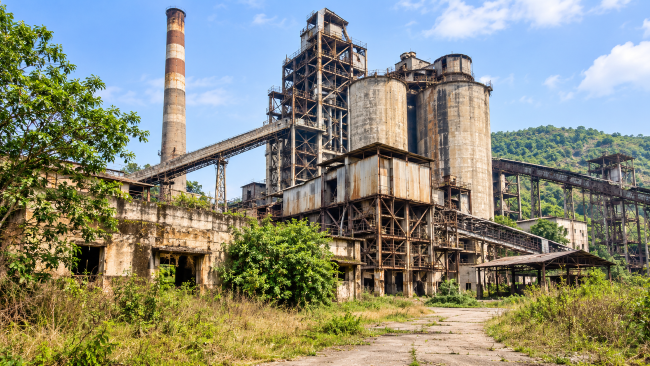
JAPLA, PALAMU: Once a symbol of industrial progress in the Palamu region of Jharkhand, the historic Japla Cement Factory has remained silent for more than three decades. Established in 1917, with production beginning on 16 March 1921, the factory was among India's early Portland cement manufacturing units. It generated employment, supported local businesses and created an industrial ecosystem connecting mining, transport and trade. Its closure in 1992, however, marked the beginning of a prolonged economic decline for Japla and surrounding areas. Today, as the factory's land moves through auction proceedings, a larger question confronts the government: will this historic industrial asset become merely another property disposed of through liquidation, or can it still serve as the foundation for employment and industrial development in Palamu?
The factory, initially known as Sone Valley Portland Cement Company, was established near the Sone River during British rule. Its infrastructure was significant for its time. Limestone was transported from the Boulia area of Bihar's Rohtas district through a ropeway system across the river. The plant had its own power-generation facilities, workshops and railway connectivity. It was not merely a cement manufacturing unit but an integrated industrial establishment that supported mining, transportation, energy and commercial activities. Although some local accounts describe it as Asia's first cement plant, that distinction has not been independently established through reliable historical documentation. Its place among India's early cement manufacturing enterprises, however, remains significant.
The factory's economic contribution extended far beyond its production operations. A 2009 media report estimated that approximately 1,400 permanent employees and 4,000 contract workers were associated with the plant. Mining operations in Rohtas district were also linked to its functioning. The salaries of workers supported local markets, shops, transport operators and small businesses. For thousands of families in Japla, Hussainabad, Haidernagar and neighbouring areas, the factory was a major source of livelihood. Its closure therefore affected not only employees but also the wider local economy.
Financial difficulties and management problems gradually weakened the factory. After coming under the control of the Sinha Group in 1984, its condition deteriorated. Production was interrupted in 1985, resumed briefly in January 1991 and stopped again on 29 May 1992. The plant never returned to regular commercial production. Employees faced uncertainty over wages and other statutory dues, while the local economy lost one of its most important sources of organised employment. Many families were forced to seek livelihoods elsewhere.
The revival of the factory subsequently became a recurring political promise. During the 2014 election campaign, Narendra Modi, then the BJP's prime ministerial candidate, reportedly promised at a public meeting in Medininagar that the factory would be revived if the BJP formed the government at the Centre. Rajnath Singh also assured people during election meetings in the Hussainabad-Haidernagar area that the plant would be reopened if the BJP came to power in Jharkhand. These assurances raised hopes among former employees and residents, but the promised revival did not materialise.
In 2017, the then Chief Minister Raghubar Das announced that discussions were at an advanced stage with the Steel Authority of India Limited (SAIL) regarding the supply of limestone through the Jharkhand State Mineral Development Corporation. The proposal was presented as a possible route to restarting the plant and generating employment. However, it too failed to produce a functioning industrial unit.
The Centre's position was subsequently clarified in a written reply in the Lok Sabha on 24 July 2019. The Ministry of Commerce and Industry stated that efforts had been made to revive the factory in partnership with major cement companies, including ACC, UltraTech, Dalmia Cement, Shree Cement and Star Cement. None agreed to purchase or operate the unit. The government also stated that the factory's machinery had been auctioned following the Patna High Court's order dated 17 May 2018.
The same parliamentary reply confirmed that the Jharkhand Government had requested the Official Liquidator on 28 August 2018 to transfer 137.99 bighas of leasehold land for developing an industrial area. Yet, despite this proposal, no major industrial project has emerged on the site. The absence of a publicly demonstrated, time-bound implementation plan raises questions about why an opportunity identified years ago has remained unrealised. The state government needs to explain what happened to the proposal and what steps, if any, were taken to attract investors.
The latest development concerns the auction of 81.04 acres of land at Deorikalan and Kisua villages in Japla. According to the Patna High Court's order dated 29 October 2026, the reserve price was fixed at Rs 34.60 crore. After bidding, Bhumivardhan Vihar, represented by Rajbali Singh, offered the highest amount of Rs 35.05 crore. The court provisionally accepted the bid subject to payment conditions. This should not be interpreted as confirmation that the final transfer has been completed. The auction has nevertheless renewed concerns about the future of the land and its potential industrial use.
On 21 November 2026, Palamu Zila Parishad member Rahul Kumar Mehta submitted a memorandum to Chief Minister Hemant Soren seeking an examination of the auction process, land ownership, lease conditions, valuation and the interests of former employees. The memorandum questioned whether the auction had received adequate publicity to attract a wider range of potential investors. It also called for an independent assessment of the property's value. These are concerns raised by the memorandum's signatories and require examination of the relevant official records before any conclusion about irregularities can be drawn.
The future of Japla need not depend on restarting the old factory in precisely its former form. Since the original machinery has been auctioned, a modern cement plant would require fresh investment, technology and a feasibility assessment covering limestone availability, mining rights, water, power, transport and environmental clearances. Alternatively, the land could be considered for a multi-sector industrial park, a cluster of micro, small and medium enterprises, construction-material units, agricultural processing facilities or warehousing and logistics operations.
A railway-related manufacturing facility has also been proposed. In May 2025, Palamu MP Vishnu Dayal Ram reportedly stated that discussions had taken place with the Railway Minister regarding the possibility of establishing a railway factory on the vacant land. However, this remains a reported proposal, not a formally sanctioned project. The government needs to clarify whether any feasibility study or official approval has followed.
Any future industrial plan must also address the interests of former employees. Their claims relating to unpaid wages, gratuity, provident fund and other statutory benefits require verification and resolution under applicable law. Local youth should receive opportunities for skill development and employment in any new project.
The responsibility now rests with the Jharkhand Government to move beyond announcements and prepare a concrete, time-bound industrial development plan. A transparent assessment of the land, a feasibility study, investor outreach and clear employment commitments could help turn this neglected property into an economic asset.
Japla's story is ultimately one of lost industrial opportunity and unfulfilled political promises. Successive governments spoke of revival, but the region has yet to see a comparable industrial project. The question is no longer limited to reopening an old factory. It is whether the government will ensure that a century-old industrial legacy becomes the foundation for a new generation of jobs, investment and economic development in Palamu.








[[comment.comment_text]]