Half the Sky, Full of Power: How Bihar’s Women Have Become the Deciding Force in 2025 Elections

 11 months, 1 week ago
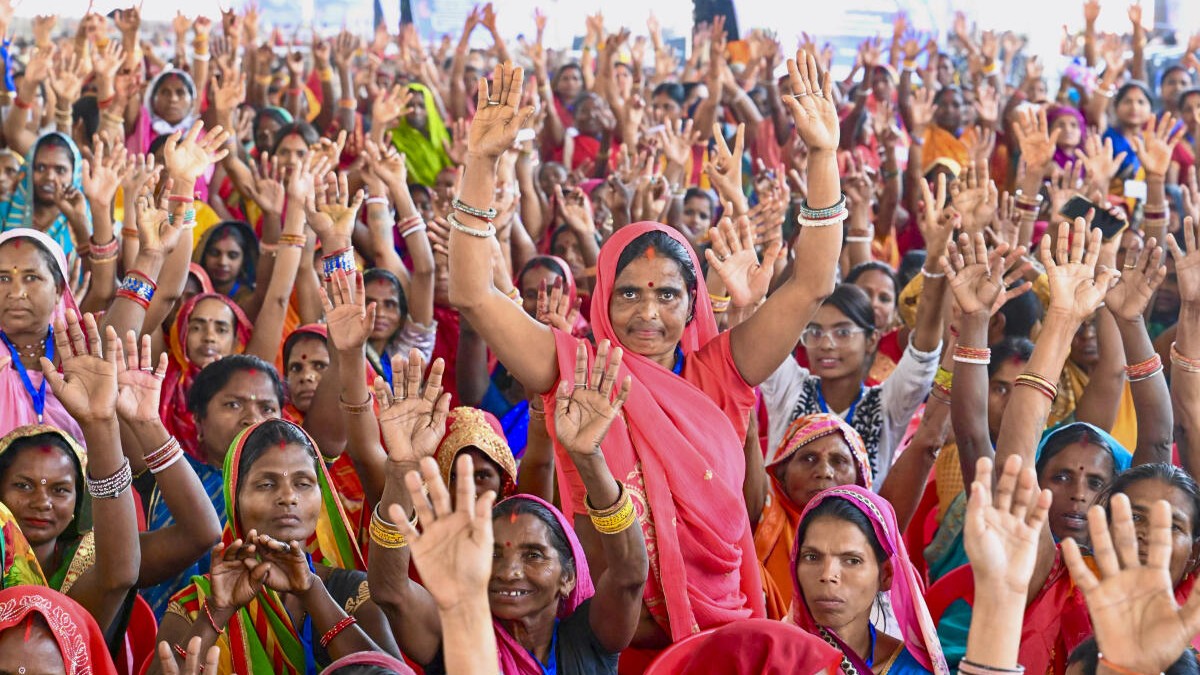
As Bihar heads into the 2025 Assembly elections, one unmistakable truth dominates every campaign — the road to power runs through women’s votes. With nearly 3.5 crore women voters, making up just under half of the state’s 7.43 crore electorate, political parties are recalibrating strategies to win over the constituency that has transformed Bihar’s electoral arithmetic.
Both the National Democratic Alliance (NDA) and the Mahagathbandhan (MGB) have placed women at the centre of their manifestos, promising empowerment, security, and dignity. But beyond the slogans of “Lakhpati Didis” and “Maa–Bahen Maan Yojanas”, the real question is: how much of these promises are grounded in policy, and how much are crafted for politics?
NDA’s ‘Sankalp Patra’: Empowerment Through Enterprise
For Chief Minister Nitish Kumar and Prime Minister Narendra Modi, women are not just a social constituency but the engine of Bihar’s growth story. The NDA’s Sankalp Patra builds on Nitish’s long-standing emphasis on economic empowerment and self-reliance.
Under the “Mission Lakhpati Didi”, the government promises to help one crore women from self-help groups (SHGs) become financially independent through small enterprises and digital literacy. A step further, the “Mission Crorepati” initiative aims to identify and nurture potential women entrepreneurs who could scale up their ventures into the “crorepati” bracket within five years — with support through training, loans, and digital marketing tools.
The Chief Minister’s Women Self-Employment Scheme pledges financial assistance of up to ₹2 lakh to women for launching small-scale businesses or local industries. The NDA leadership insists these initiatives will create a generation of women not dependent on welfare, but capable of wealth creation.
“Women’s economic participation is the backbone of Bihar’s development,” Nitish Kumar said during a campaign rally. “We don’t believe in giving charity — we believe in giving strength.”
Mahagathbandhan’s ‘Tejashwi Pran’: Welfare, Security and Recognition
On the other side, Tejashwi Yadav’s Bihar Ka Tejashwi Pran manifesto seeks to reshape the narrative of women’s empowerment through economic dignity and safety.
At its core is the “Maa–Bahen Maan Yojana”, which promises ₹2,500 per month to every woman in the state. Tejashwi calls it a step toward recognising women as the “finance ministers of their families,” aiming to provide a steady income flow for household stability and autonomy.
The Mahagathbandhan also commits to regularising community mobilisers under the Jeevika scheme, promising them the status of government employees and a monthly salary of ₹30,000. These women, currently associated with self-help initiatives, often earn meagre sums; the promise of regular pay and social security could make this one of the alliance’s most appealing commitments.
Additionally, the manifesto outlines a “Mahila Rozgar Mission” to link women with local employment opportunities and pledges to strengthen women’s police stations and help desks in every district to ensure safety and grievance redressal.
“Our government will make women financially free and socially fearless,” Tejashwi declared, positioning his alliance’s promise as a corrective to the “selective empowerment” of the NDA years.
Between Ambition and Implementation
While both alliances have crafted elaborate promises, the credibility gap remains the real test. Nitish Kumar’s track record — from bicycle distribution schemes to 50% reservation for women in panchayats and self-help group networks — has earned him a strong base among rural women.
Senior political analyst Dr. Ashish Vashishtha notes, “Nitish Kumar’s governance model has delivered tangible results for women. Over 1.25 crore women have benefitted from his self-employment initiatives. In contrast, Tejashwi’s promises sound ambitious but lack fiscal clarity.”
However, the Mahagathbandhan’s strategy appears to bank on emotional and economic appeal — direct financial transfers, stable income, and job regularisation — all of which target women who have grown disillusioned with bureaucratic hurdles in accessing government benefits.
BJP leader Keshav Prasad Maurya, the NDA’s election co-incharge, dismissed the opposition’s plan as “Mahajhooth ka Mahapulinda”, claiming the NDA’s Sankalp Patra represents a practical roadmap for “the rise of farmers, youth, mothers, and sisters.” Tejashwi, in return, quipped that the NDA’s manifesto was not a Sankalp Patra but a “Sorry Patra” — a note of apology to the people of Bihar.
The Deciding Vote
Women’s turnout in Bihar has consistently outpaced men’s in recent elections, particularly in rural areas. In 2020, women voters were credited with tilting several constituencies in the NDA’s favour, reaffirming Nitish Kumar’s image as a “women’s leader.”
This time, however, with the youth vote merging with the women’s vote, the competition is tighter. The NDA’s entrepreneurial pitch and the Mahagathbandhan’s welfare guarantees represent two distinct visions of empowerment — one based on enterprise, the other on entitlement.
As Bihar prepares to vote on November 6 and 11, both sides know that the battle for “half the sky” could very well decide who rules the state’s future.
Because in 2025, women are not just voters — they are Bihar’s most powerful political voice. ...


[[comment.comment_text]]