THE GOLDEN FIBRE, THE RUSTING BELT

 54 minutes ago
Bengal’s unfinished journey from industrial heritage to a green economy
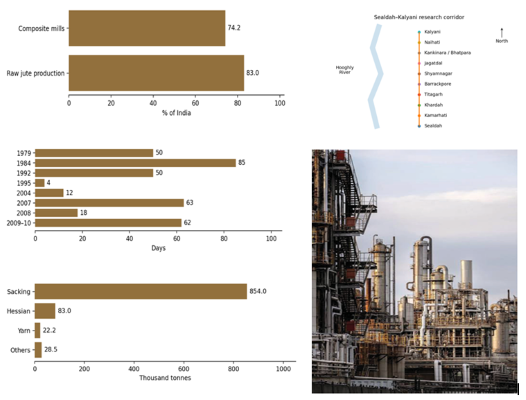
Travel north from Sealdah toward Kalyani and you pass through the geography of one of Bengal’s most consequential industrial inheritances: Khardah, Titagarh, Jagatdal, Kankinara, Bhatpara, Naihati. These settlements were shaped by an industry that turned an agricultural crop into international commerce, manufacturing capacity and multi-generational livelihoods. Jute was never merely a fibre. It linked cultivators, retting workers, mill operatives, artisans and exporters in a single value chain.
Today the world is searching for biodegradable alternatives to synthetics. Bengal still possesses agricultural knowledge, manufacturing infrastructure and a skilled industrial workforce. The question is whether the institutional and incentive structures that have shaped the industry for decades allow it to be redirected.
An industrial inheritance disrupted by multiple forces
The first modern jute mill at Rishra in 1855 began the transformation of the Hooghly corridor. Partition in 1947 severed the integrated economy: much of the growing land went to East Pakistan while most mills remained in India. Independent India had to rebuild raw-material networks while confronting synthetic substitutes.
What followed was not a single story of labour militancy. Employer lockouts, wage and benefit disputes, obsolete machinery, limited reinvestment and repeated industrial disputes all played roles. The Indian Jute Mills Association records eight major general strikes between 1979 and 2010, with a combined duration of 344 days; the 1984 strike alone lasted 85 days. These are episode durations, not worker-days lost. An IIM Ahmedabad study in 1994 examined the difficult triangular relationship among government, owners and workers in modernisation. Industrial disruption cannot be attributed to any one participant alone.
The factories survived. The incentive structure did not evolve
According to the Ministry of Textiles’ September 2026 PIB backgrounder, West Bengal houses 89 of India’s 120 composite jute mills (89 ÷ 120 = 74.2%). Registered capacity, however, is not operational vitality. Official compilations have recorded closed or non-operating mills in recent periods; operating status fluctuates with raw-material availability, orders and financial conditions.
According to IJMA/Office of the Jute Commissioner domestic despatch data for 2024–25, sacking accounted for approximately 86% by weight. Despite reported modernization investments, conventional packaging dominates domestic offtake. The Jute Packaging Materials (Compulsory Use in Packing Commodities) Act, 1987, has helped sustain demand. Whether the procurement framework weakens incentives to diversify is a hypothesis requiring evidence on investment, pricing and product mix over time.
Published national employment compilations indicate that permanent workers constitute a minority of the reported composite-mill workforce. These category figures are national snapshots; they do not by themselves establish the incidence of non-payment of provident fund, gratuity or other statutory benefits in West Bengal mills. Continuity of income and statutory compliance deserve mill-level investigation.
From the Farmer to Beyond the Gunny Bag: The Unfinished Value Chain
Indian jute-goods production stood at around 12.80 lakh tonnes in 2025–26, with exports valued at approximately ₹3,155 crore. The minimum support price for raw jute has risen from ₹2,400 per quintal in 2014–15 to ₹5,925 in 2026–27. These figures demonstrate the industry's continuing economic significance, but not necessarily the prosperity of those whose laboursustains it.
Cultivators face rising input and labour costs, particularly for harvesting and retting, the process of extracting fibre from harvested jute stems. Mill workers confront uncertainties over employment continuity and earnings, while small enterprises and artisans struggle with fragmented markets and limited bargaining power. Recent raw-jute price volatility has further exposed the vulnerability of this interconnected value chain.
The challenge, therefore, is not merely to produce more jute but to generate and retain greater value from every unit of fibre.
Yet conventional sacking accounted for approximately 86 per cent of India's domestic jute-goods despatches by weight in 2024–25. Opportunities in geotextiles, agricultural textiles, engineered composites, interior furnishings and contemporary lifestyle products remain comparatively underexplored.
Scaling these applications requires consistent fibre quality, technological upgrading, design capabilities, product certification, market intelligence and entrepreneurial investment. National programmes have supported improved cultivation, skill development and product diversification, but conventional packaging continues to dominate domestic demand.
The real opportunity lies in transforming this fragmented value chain into an integrated economic ecosystem, where agricultural improvements support industrial innovation, diversified manufacturing creates better employment, and artisans gain access to higher-value markets.
An industry that generates substantial turnover but fails to translate its potential into broad-based prosperity must examine not merely how much it produces, but what it produces, for whom, and who ultimately captures the value.
The unfinished industrial corridor
Titagarh, Khardah and Bhatpara retain generations of industrial experience. Kolkata supplies trading networks and commercial institutions. Nadia links agriculture to research. A coordinated innovation and manufacturing corridor is conceivable, but only if it confronts existing incentives rather than assuming infrastructure and goodwill will suffice. Bhatpara and Kalyani remain two field-research anchors. Bhatpara’s municipal profile refers to workers associated with 16 jute mills; this historical reference is not a current operating count. Its 2018–19 housing project report documents the town’s dependence on riverbank mills and the settlement of migrant workers around them. NBCC’s public asset record identifies Alexandra Jute Mill at Jagatdal as closed, with 52.68 acres of land, including 17.69 acres described as encroached. These records illustrate the scale of the industrial and urban transition, but require on-site confirmation.
Kalyani is not merely a prospective innovation hub. West Bengal’s Labour Department annual report for 2014–15 lists three mills under Nadia (Kalyani): Hooghly Infrastructure (Hukumchandunit), Naihati Jute Mills and Jai Jute Industries (formerly Nuddea Jute Mill). These are historical administrative listings, not proof of current operations or precise municipal boundaries. The survey should establish their present status and whether nearby agricultural and research institutions can support product diversification.
Such an effort requires transparent assessment of viable mills and assets suitable for repurposing; common testing, design and certification facilities; vocational training linked to actual hiring; and performance-linked policy support that encourages diversification while safeguarding existing livelihoods. Any recalibration of packaging reservation should be gradual and contingent on evidence that alternative markets can absorb capacity and sustain employment.
The handicraft and Missing Middle opportunity
Household enterprises, self-help groups and small units produce bags, furnishings and decorative items. Training and exhibitions alone do not create durable enterprises. Artisans need reliable specialised fabrics, working capital, design support, market access and fair commercial terms. Mills could treat these units as a source of diversified demand rather than a residual activity.
Realising this link would address a classic constraint in Bengal’s manufacturing landscape: the difficulty of growing small enterprises into productive mid-sized firms. It would also require mills to view diversification as a commercial strategy rather than a side project. The opportunity for women-led enterprises must be measured through net earnings, repeat orders and sustained employment, not merely participation in training.
The opportunity that still exists
Compulsory packaging has sustained demand and supported livelihoods. That achievement is real. It cannot, however, remain the sole foundation of long-term competitiveness. Products must meet performance standards, compete on cost where possible and demonstrate genuine lifecycle advantages. Successive administrations across parties should be judged by operational factories that modernise, industrial disputes that are resolved rather than recurrent, and employment that is both larger and more secure. The relevant metric is not the number of revival announcements but the shift in output composition and the quality of jobs.
Global interest in renewable materials offers Bengal an opportunity to reconsider its industrial inheritance. Converting that inheritance into prosperity will require more than nostalgia or additional protection. The hypothesis that protected demand, ownership incentives and fragmented employment have constrained the industry’s evolution must be tested against mill-level evidence, including the experience of enterprises that have successfully diversified.
The golden fibre need not remain confined to the economic structures of yesterday. Its future depends on whether Bengal can redesign the incentives, institutional capacity and entrepreneurial conditions that would allow the fibre to support higher-value manufacturing, more secure livelihoods and a genuine contribution to a greener economy. That is a harder task than preserving capacity. It is also the task that would justify calling the journey unfinished rather than stalled.
(The author, a double masters in Business Adminis tration and Political Science, is an accomplished Professor. She is a recognised commentator on education, socio-cultural diversities, and empowerment issues.)










[[comment.comment_text]]