Social Media as India’s Digital Safety Valve: From Street Agitations to Online Venting

 10 months ago
A Changing Landscape of Anger
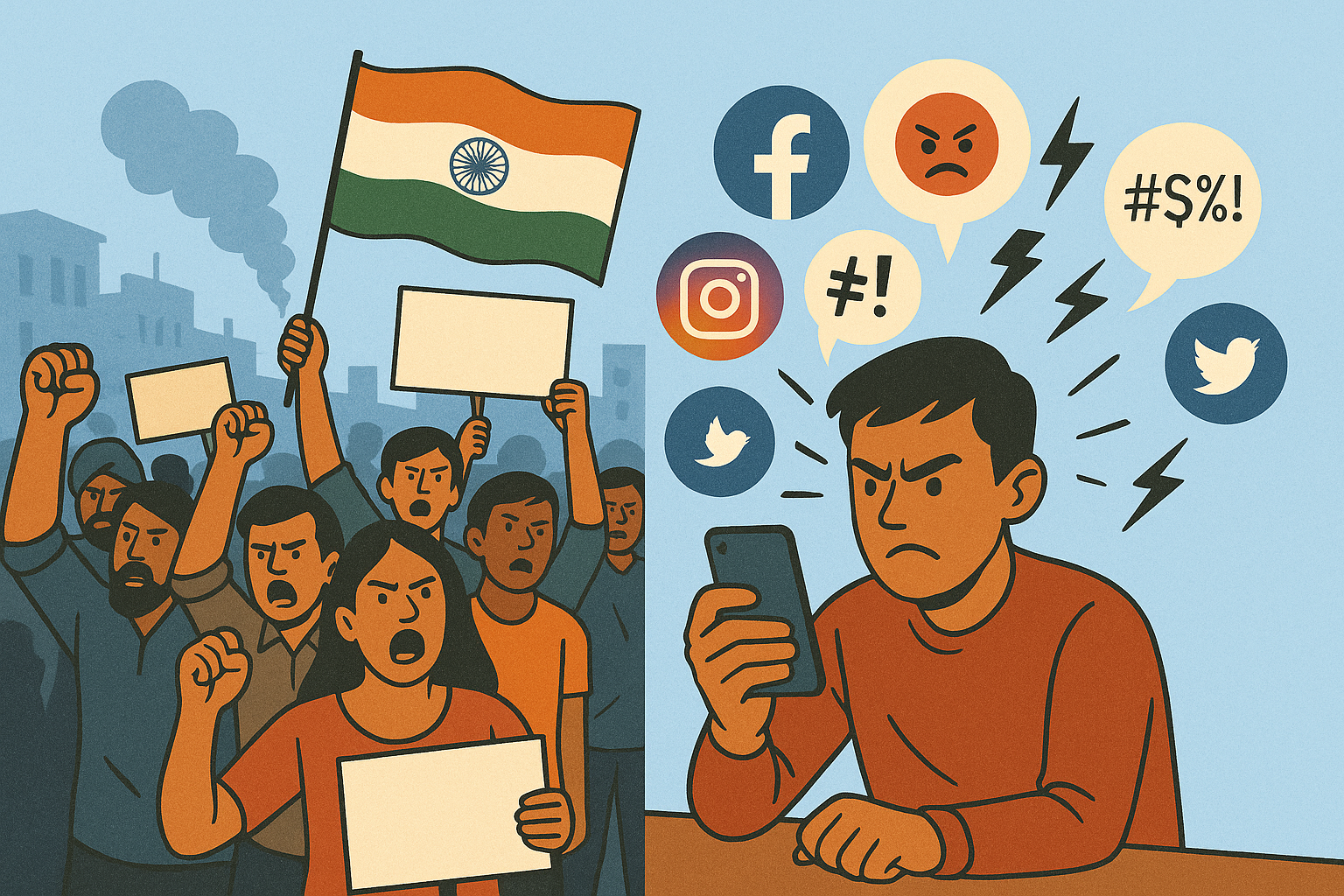
In the 1970s, 1980s and 1990s, Indian society had almost no public platforms where ordinary citizens could freely express rage against corruption, inflation, inequality or state repression. Frustration kept accumulating like steam in a sealed pressure cooker and, when the pressure became unbearable, it exploded in the form of mass movements, strikes, bandhs and long-drawn agitations. The last quarter of the 20th century was therefore an era of relentless political turbulence.
Since the second decade of the 21st century, especially after the explosive growth of Facebook, YouTube, Instagram and Twitter (now X), a paradoxical calm seems to have descended on India’s streets. Large-scale, sustained social movements have become rarer. This essay argues that social media has quietly taken over the role of a “safety valve” – much like London’s famous Hyde Park Speakers’ Corner – allowing people to vent anger digitally and thereby preventing it from materialising into physical unrest.
The Era of Accumulated Rage (1970s–1990s)
India in the pre-digital decades was a society with severely restricted outlets for dissent: The JP Movement (1974–75) and the anti-Emergency struggle, Chipko Movement (1973 onwards), Narmada Bachao Andolan (1985 onwards), Anti-Mandal agitation (1990), Khalistan movement and insurgencies in the Northeast, Peasant revolts, Dalit assertions, and anti-dowry campaigns etc.
These movements were born out of years of bottled-up resentment. With no 24×7 news channels and certainly no social media, grievances travelled slowly through unions, student bodies, pamphlets and word-of-mouth. When critical mass was reached, the only remaining option was to pour onto the streets. Physical mobilisation became the sole medium of cleansing and pressure.
The Digital Revolution and the Birth of Instant Venting
The smartphone boom (post-2010) and the arrival of cheap data (Jio revolution, 2016) changed everything. By 2019, India had over 500 million internet users and more than 400 million active social media accounts. Suddenly, every citizen had an instantaneous, cost-free megaphone.A corrupt official, a bad policy, police brutality, price rise – anything could now trigger millions of angry posts, memes, hashtags and videos within hours. The same emotion that once required months of underground organising could now be released in seconds with a single tweet or Facebook rant.
Social Media as the New Hyde Park
London’s Hyde Park Speakers’ Corner, established in the 19th century, is the classic historical example of a controlled “safety valve”. Anyone can stand on a soapbox and shout the most radical opinions, yet the institution ensures that dissent remains contained, visible, and ultimately harmless to the system.Indian social media performs an almost identical function today.
You can abuse the Prime Minister, expose a scam, or call for revolution – all from the safety of your bedroom. Likes, retweets and angry emojis give an immediate sense of solidarity and moral victory. The dopamine hit of going viral replaces the adrenaline of marching on the streets. Most importantly, the establishment watches, moderates, throttles or co-opts the outrage without having to face lathi charges or burning buses. As one commentator succinctly put it, “Social media absorbs public anger and prevents it from spilling onto the streets.”
Evidence of the Cooling Effect
Several indicators support the “safety valve” hypothesis - Decline in frequency of nationwide bandhs and hartals after 2014–15. Most hashtag movements (#JusticeForSSR, #BoycottChineseGoods, #SaveAarey) peak online but fizzle out without sustained street action. The farmers’ protest (2020–21) and CAA-NRC protests (2019–20) remain notable exceptions, but even these required extraordinary offline organisation and faced heavy online censorship. Middle-class India, once the backbone of anti-corruption street protests (India Against Corruption, 2011), now largely confines its activism to forwarding WhatsApp messages and changing profile pictures.
The Illusion of Action: Slacktivism and Cathartic Consumption
Social media offers what scholars call “slacktivism” or “clicktivism” – low-effort actions (liking, sharing, tweeting) that create a powerful feeling of having “done something” without any real cost or risk. The outrage cycle runs as follows:Anger → Viral post → Temporary solidarity → Trend fades → Return to normal life, This cycle provides emotional release but rarely translates into the patient, long-term organising that earlier movements demanded.
The Double-Edged Sword: When the Valve is Blocked
Paradoxically, whenever the government temporarily blocks or heavily moderates social media (internet shutdowns in Kashmir, farmer protest suspensions), anger quickly spills back onto the streets. This proves that the digital safety valve is effective only as long as it remains open and feels unrestricted. Nepal's recent upheavals was triggered because of government's nationwide ban on major social media platforms,
A Calmer but More Complacent Society?
Social media has undoubtedly made Indian democracy noisier and more expressive than ever before. Yet, by converting collective rage into individualised, instantaneous venting, it has also made society calmer and – arguably – more complacent.
The streets are quieter not because injustices have reduced, but because the pressure cooker now has a permanent, wide-open digital valve. Whether this is a healthy evolution or a clever containment strategy disguised as freedom remains one of the most important questions of our time.
Like Hyde Park’s eccentric speakers who shout at passers-by every Sunday, millions of Indians now perform their daily dissent online – loud, colourful, and ultimately harmless to the structures of power.
(Author, a JNU PhD, is a senior TEW editorial adviser.)

[[comment.comment_text]]