After a Century, Can India’s Left Learn to Speak the Present?

 9 months, 2 weeks ago
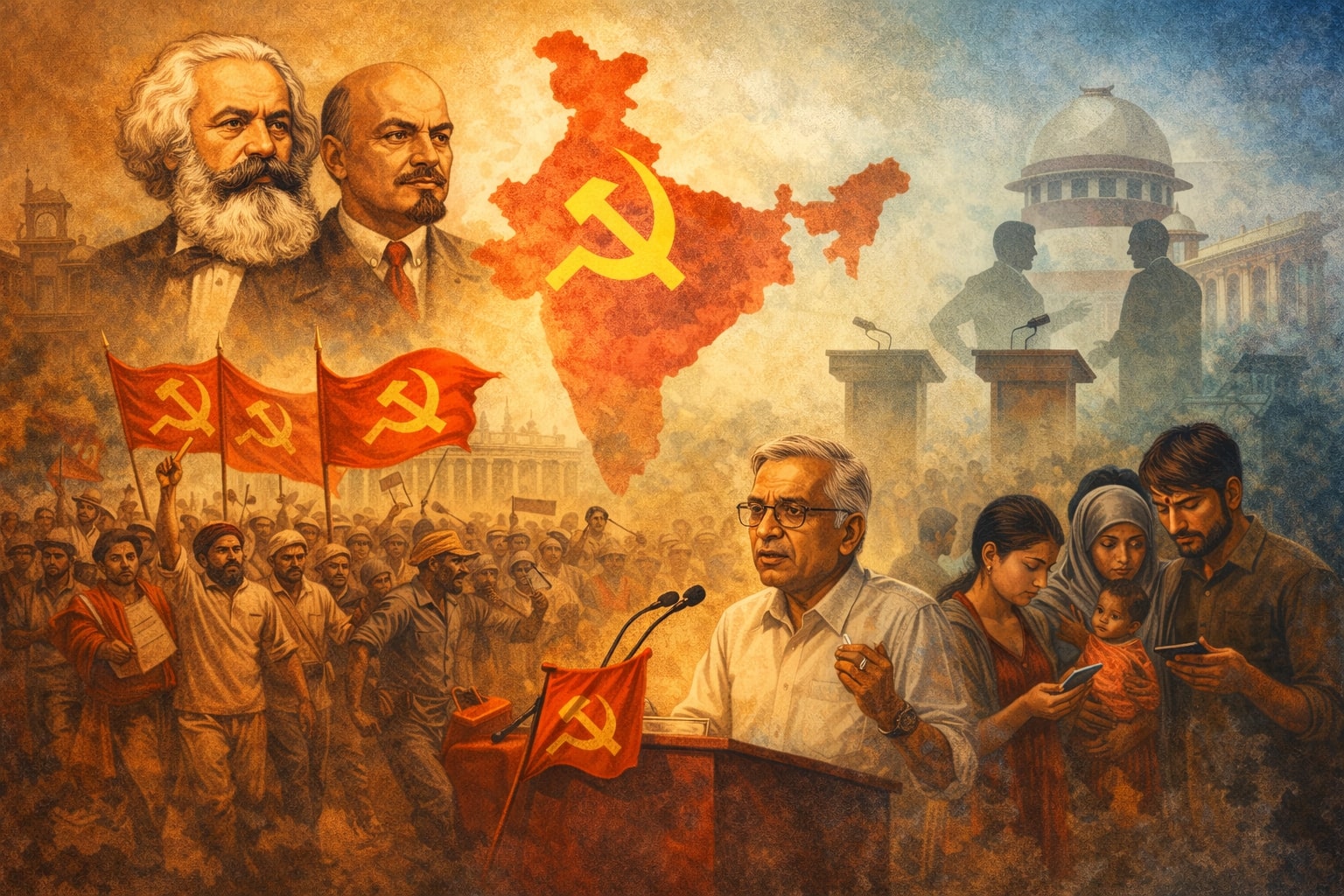
When the Communist Party was founded in Kanpur on December 26, 1925, it carried with it the promise of a radically different India—one built on equality, collective rights, and resistance to exploitation. One hundred years later, that promise feels distant. The centenary of the Communist movement arrives not as a moment of resurgence but as a reminder of how marginal the Indian Left has become in national politics. Once a decisive ideological force, it now confronts a stark question: can it reinvent itself for a country that has changed far more than it has?
The completion of a hundred years of the Communist Party of India marks a significant historical milestone, but it also exposes a profound political decline. The CPI and its more influential offshoot, the Communist Party of India (Marxist), once shaped national debates on labour rights, land reforms, secularism, and federalism. Today, they occupy the fringes of electoral politics. The contrast between their past stature and present marginality is captured most starkly in electoral data. In 2004, the CPI and CPI(M) together held 53 seats in the Lok Sabha with nearly 8% of the national vote. In 2024, the CPI, CPI(M), and CPI(ML) together were reduced to just eight seats and around 3% vote share. This is not merely electoral decline; it is the collapse of a once-coherent ideological presence.
Historically, the strength of Indian Communism lay in its ability to translate theory into lived reform. Unlike many Communist movements elsewhere, Indian Communists adapted early to democratic politics. They built mass organisations, contested elections, and governed states for long periods. In West Bengal, Kerala, and Tripura, Left governments implemented land reforms that altered entrenched power structures, expanded public education and healthcare, strengthened local self-government, and foregrounded the language of rights and welfare well before it became mainstream. These were not abstract ideological exercises but concrete interventions that reshaped everyday life for millions. The Left’s legitimacy rested less on revolutionary rhetoric and more on its record of governance.
Equally important was the Left’s political inventiveness. Long before coalition politics became unavoidable at the national level, Indian Communists practised united front politics, building alliances across class, caste, and regional divides. They recognised that ideology without social coalitions was politically sterile. This strategic flexibility allowed the Left to exercise influence disproportionate to its numbers and to act as a balancing force in national politics. For decades, it provided an alternative moral and political imagination rooted in equality and redistribution.
The erosion of this position cannot be explained solely by external forces such as the rise of the BJP, the decline of organised industrial labour, or the fragmentation of the working class. These structural shifts mattered, but they do not fully account for the scale of the Left’s retreat. The deeper problem has been the failure of the Communist parties to renew their ideas and organisational culture. As India’s economy liberalised and society transformed after the 1990s, the Left’s critique of neoliberalism remained largely oppositional and defensive. It struggled to articulate a persuasive alternative that addressed aspirations for dignity, mobility, and security in a rapidly changing economy.
At the organisational level, stagnation became visible. Leadership renewal slowed, internal debates hardened into factionalism, and party structures increasingly appeared disconnected from the lives of younger generations. In states where the Left governed for extended periods, administrative competence gradually turned into bureaucratic inertia. The language of transformation gave way to the routines of governance, without a parallel effort to reimagine politics for a new social context. For many young voters today, the Left appears as a guardian of past achievements rather than a vehicle for future change.
This stagnation is all the more striking when viewed against global developments. Across the world, Left politics has resurfaced in unexpected forms. The recent rise of the Janata Vimukthi Peramuna in Sri Lanka illustrates how a once-marginal Left force can reinvent itself through democratic engagement, anti-corruption politics, and a renewed emphasis on economic justice. In the United States, the emergence of leaders such as Zohran Mamdani shows how egalitarian ideas can resonate when framed around contemporary concerns like housing affordability, climate action, and public services. These movements do not replicate classical Marxism; they reinterpret Left values for new social realities.
Indian Communists, by contrast, have struggled to engage creatively with the defining challenges of the present. The climate crisis, which disproportionately affects the poor and working classes, has not been made central to Left politics. The informalisation of labour, digital precarity, migration anxieties, and the rise of social conservatism have not been met with sustained ideological innovation or mass mobilisation. Instead, the parties often fall back on familiar slogans and commemorations of past struggles. Nostalgia has too frequently replaced strategy.
The cost of this failure extends beyond the Left itself. Indian democracy is poorer for the absence of a strong, imaginative Left. Without a credible ideological counterweight, political debate narrows into a contest between technocratic centrism and cultural majoritarianism. Questions of inequality, labour rights, corporate power, and environmental justice are either sidelined or addressed in fragmented, episodic ways. The decline of the Left has left a vacuum in India’s political imagination.
The centenary of the CPI should therefore serve as a moment of reckoning rather than celebration. Renewal, if it is to happen, will require more than tactical alliances or electoral recalibration. It demands intellectual courage—the willingness to shed dogma, confront uncomfortable truths, and engage seriously with the realities of twenty-first-century India. It also requires organisational democratisation, opening leadership and decision-making to younger generations, women, and marginalised communities in substantive ways. Whether the Indian Communist Left can undertake such a transformation remains uncertain. What is clear is that its second century cannot be lived in the shadow of its first.
(Author, a sociologist, is a reputed academic commentator on politics, culture and society in India. Views are personal.)




[[comment.comment_text]]