We Need Garbage Management As A Social Responsibilty

 1 year, 1 month ago
Garbage management has become a necessity in all the metro cities and the cities having unmanageable population and urban growth. Even the hill stations are not untouched. We Indians have the habit of throwing our cooked food, vegetables, fruits and other leftovers or burn or bury them in a haphazard way. We, however, refrain from thinking that waste thus generated can be very harmful to human beings and animals, such as, stray dogs, cows, goats etc. Also clear difference is discernible between behaviour pattern of we Indians abroad and within our own country. It is the enforcement factor that matters.Needless to say, one has to pay through nose abroad if found guilty of having committed an offence against cleanliness or anything which is detrimental to the cause of environment.
It is desirable that we eat and drink in low quantity in parties, weddings, festivals, community feasts, rallies and religious functions.These unsustainable habits and happenings create stinking dumps and public nuisance, apart from leading to adverse effect on environment.Wastes not only penetrate into ground water but are also capable of entering food chain. Acceleration in pest infestations, air pollution and deterioration of overall public health take place.
Hazardous Matter
Harmful contaminations can be hazarduous in the long run.Not only these places stink, but invariably children from low strata of society get exposed as they play over there in absence of clean and hygienic play grounds.
In view of the fact that dumping of garbage collected from many localities of a town or a city takes place mainly late at night, it is not possible to keep a watch or carry out monitoring in order to catch the culprits.
Violation of Environmental Laws
It goes without saying that illegal dumping activity violates various environmental laws, such as, Environment Protection Act,1986, Wildlife Protection Act,1972, Solid Waste Management Rules,1986 etc.
Garbage visible over surface can still be taken care of but the one burried under the sub soil is not even seen. Also there is no guarantee about these sites, for, removed garbage can be dumped again at a new location. If this is the practice or scenario who will be held accountable ?
What is Waste ?
Waste is any material that is unwanted, non useful and which has been discarded. It can be solid, liquid or gas. Liquid waste may comprise of dirty water, wash water, waste detergents, organic liquids and rain water. Also we generate solid rubbish, organic waste, recyclable rubbish, and hazardous waste.
Types Of Waste
Industrial waste comes from chemicals, plastics and solid rocks. Agricultural waste, such as, leaves, stubble etc can be very well understood. Solid waste is from packaging materials, food scraps, clothing and household goods. Organic waste comprises of rotten meat, eggs, fish, garden waste and food waste.
Kitchen Waste
When we talk of waste, waste generated in the kitchen can not be ignored. It is in form of vegetable waste, fruit waste, spoiled food, waste paper, napkins, polythene, styrofoam, thermocol, glass & metal objects, old wooden objects, flower pots etc.
Household Waste
Examples of household waste are newspapers, magazines and books, plastic items, such as, bottles, bags, envelopes and packets, glass bottles, broken utensils, cans, discarded cloths and wood products.
Waste Management and Five Rs
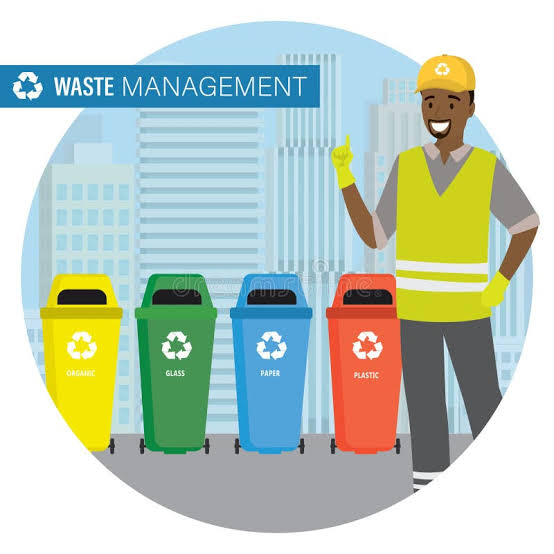
It is the process of handling waste from its creation to final disposal .It includes collecting, transporting, treating and disposal of what is collected. It comprises of landfill, waste compaction, incineration, bio gas production, recycling and vermi composting.We may note that Landfill and domestic composting are relatively easy and inexpensive methods of garbage disposal.
Recycling converts waste into a new type of usable product through industrial processing. Aluminium, paper, glass, and plastic are commonly recycled materials.
Door To Door Collection
This type of collection of garbage, though a relatively new development, is considered a convenient and the most viable way. But we must segregate dry and wet waste prior to passing the buck to collecting boy. Idea is to reduce, reuse and prevent waste.
New idea of TRASH TO CASH is also picking up momentum tather fast. Broad objective essentially is sustainable management of waste. If followed seriously and properly, protection of human wealth and environment , conservation of resources and ultimately, reduction in pollution may be very much possible.
Five "R"s of Waste Management are:
Refuse, Reduce, Reuse, Repurpose and Recycle.
Cases of Delhi, Indore And Other Clean Cities
In a vast mega city of Delhi, round about 30 million tons of garbage is generated by 1.80 Crore citizens on a daily basis, of which only 10 million tons are cleared. But population, number of automobiles, factories and construction activities are also increasing day by day. As such, Delhi's area has become 1,484 Sq.kms.
Only three prominent Landfills of the city are: Ghazipur, set up in 1984, Bhalswa established in 1994 and Okhla which came up in 1996. Of these, Ghazipur is spread is having an area of 70 acres After "attaining" a height of 236 metres, it is higher than Qutub Minar. In what way garbage assembled here is reused or recycled, is not known. Relevant data about Bhalsawa and Okhla sites could not be known.
As Indore has been praised for its waste management initiatives and adjudged India's cleanest city more than once, other cities need to draw lessons from their experience and sustenance methods. It has also earned its name and fame due to its efficient waste segregation, innovative recycling strategy and citizen participation leading to requisite awareness.
In the same way, Surat and Navi Mumbai too have been recognised for their cleanliness, waste management and commitment to eco- friendly initiatives.
For the Eastern Indians it will be a matter of pride to remember that according to latest rankings under the Swachch Sarvekshan for 2024-25, Jamshedpur has been ranked third cleanest city in the category of 3 to 10 lakh population. It is a solid jump from their earlier rank of 43.
Suburbs of N.C.R., such as, Ghaziabad and NOIDA, though expanding very rapidly, still donot have proper landfills, even when tremendous domestic, construction and chemical waste is generated. Garbage being dumped unauthorisedly into Hindon and Yamuna rivers shall have to be stopped immediately.
These towns also abound in large number of diagnostic centres and ill equipped hospitals but not all of them may be having incinerators.One can imagine also about sad state of affairs as regards disposal of bio-medical waste. In first place most of the garbage collectors and carriers may not be aware of the hazards emanating from such waste.Woes and daily struggles of the residents can be very well imagined under such challenging and unhygienic circumstances.
Taking A Cue From Waste Disposal In Singapore
Requisite technology for use of garbage is available in India but are we applying the same ? Before we say yes or no, there is no harm in admitting that we keep our interiors and compounds neat & clean but dump our dirt and disease in streets or also on main throughfares.
In Singapore or Japan no garbage is ever seen on streets.Throwing garbage in a public place in Singapore invites a fine of Singapore Dollar 300 to 1000,(Rs 25 to 80 thousands).A step like this in India will not only prevent prevalence of filthy atmosphere but we Indians may also become more responsible.
In the clean, green, organic and sustainable state of SIKKIM, use of polythene was banned as early as 1989. Later, so many other bans and restrictions for protecting the environment followed.On the spot fine for throwing even a tiny piece of garbage in M.G.Marg(its crowning glory)will be ensured even at night. It needs to be extended to other Dist. Head quarters. Besides, tourists are also told about do's and don'ts of garbage prevention at the entrance of the State itself.
Thus what may appear to be a burden, is likely to become a blessing in disguise in the long run.
Apart from fining, Singapore's technology advancement has to be appreciated in the sense that 2400 trucks collect garbage daily and drive straight to Incineration plants.These convert garbage into electricity round the clock. Smoke too is cleaned by an Advance Filtering system so that no harm is caused to the Sky.
While some may note that Singapore is too tiny with little population and civilised people as compared to gigantic India, so two should not be compared. It is felt that there is no harm in learning from good practices, irrespective of size of a country.
Plight of Aravalli Range
It may be also necessary to draw our attention to garbage dumping taking place along Aravalli hill area in Delhi and Haryana for a long time. A contract worth Rs 3 Crores was given to clear 32,000 tons of household garbage, construction debris and industrial refuse.
In addition, rapid construction activity is also worrisome. From this, one can make out the damage being done to world's oldest mountain range.
The Way Out
Apart from fining people on the spot, taking action against transporters and contractors, concerned officers & staff also have to be held personally liable for grave lapses for harming the cause of environment.
We have to raise our voice against improper garbage management from time to time.
Resident welfare associations, builders and citizen bodies also need to be sensitized effectively in a regular way. Rather, it is high time, we began fining the shrewd and insensitive builders also.Needless to say, they have been managing to shirk responsibility so far upon taking their huge "cuts".
Also if school children could become a force to reckon with and torch bearers against the use of fire crackers, they can be also oriented against unhealthy practices of garbage dumping and its mis- management.
Can We Give A Slogan ?
"CLEAN TOWNS, CLEAN METROS, CLEAN PLANET ".
(Author is a former civil servant. He served as the Chief Secretary in the Sikkim government.)


[[comment.comment_text]]