Making Learners Future Ready: Educating, Skilling, and Emplyability in AI-Driven World

 2 hours ago
However, being social institutions, they are recently exposed and come under pressure to adopt newer roles in skilling , community engagement promoters of employability , facilitators of placements and promoters of entrepreneurship. Performance of HEIs is also evaluated by accreditation and ranking agencies providing due weightage to these new indicators
‘Society should open to new ideas’ Nobel laureate (2025) Prof. Joel Mokyr observed in his award winning work “pre requisite for sustained growth through technological progress”. He argued that long term growth depends on education, innovation and research within the country rather than external forces and the state should act as an enabler of private enterprises not as the driver of innovations. Knowledge enables more innovations to come. Universities and higher educational institutions are the creators and repositories of knowledge. Their primary function is dissemination of existing knowledge while constantly searching for new ideas. It is therefore, that they conventionally confine themselves to teaching and research.
However, being social institutions, they are recently exposed and come under pressure to adopt newer roles in skilling, community engagement promoters of employability, facilitators of placements and promoters of entrepreneurship. Performance of HEIs is also evaluated by accreditation and ranking agencies providing due weightage to these new indicators. Focusing at learning to earn for livelihood is however not new. From ‘Nayee taleem‘(new education) propounded by Mahatma Gandhi (1936) to present New Education Policy (2020), the emphasis has been on skilling in an effort to enable the learner to earn livelihood. A learner is expected to gain breadth of skills in interdisciplinary fields while gaining depth of knowledge in a major chosen field.
This approach is often criticised for its limitations and challenges in respect of uncertainties and complexities, in the Present global environment which is exponentially driven by rapid echnological advancements, creative destructions and artificial intelligence (AI), and educators as well as learners themselves are not sure to be able to get sustainable employment in their area of expertise on account of saturation, obsolescence or automation of that particular sector. In such a scenario the pertinent question is how to make the learners future ready and What would be the priority while striking a balance among education, skills, and employability?
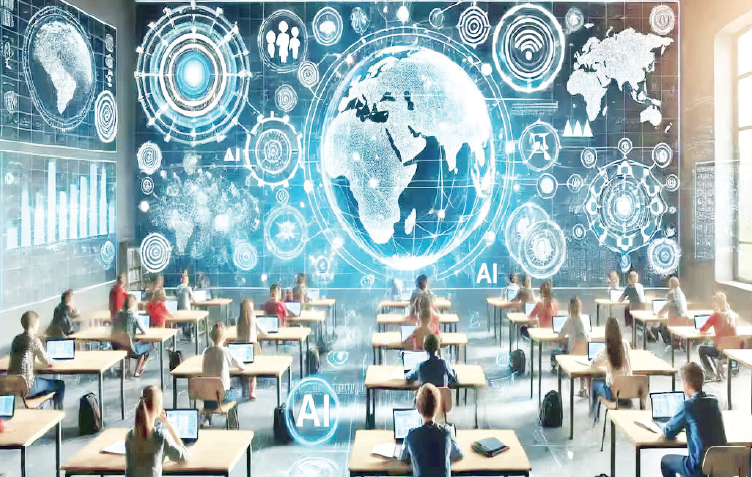
The AI driven world has opened many opportunities while posing several challenges to various facets of human life and the higher education sector is no exception. Besides providing easy, equitable and affordable access to knowledge systems and resources, AI offers a goldmine of information for research, innovation, technological development and their industrial application, which provides tremendous opportunities for knowledge workers including researchers, scientists, inventors, innovators as well as teachers and learners.
Empowering through education is said to be the greatest equaliser and AI has took quality education even to the drawing room of the knowledge seekers providing opportunities for life long education, knowledge updating and exploring diverse career opportunities among others. From content generation to cost effective pedagogies to open access resources availability to digital library and laboratories, efficient enrollment and evaluation systems etc. directly benefitting students at large. However, despite education experiencing a positive impact of AI, it has posed serious challenges in the form of paralyzing creative thinking, dismantling repetitive jobs with robotics and AI platforms and at it worst heading towards decision making replacing human control and thereby posing threats to human life and order. Let us analyse these impacts on its various dimensions to explore the appropriate response in the context of employability, skilling and educating.
Employability
Since the inception of modern formal Higher education in British India in 1835 degrees are deemed as a means to get jobs which definitely transformed the lives and social status of many with their family members. Inspired by positively correlated degree and jobs, the enhanced social aspirations of transformation and empowerment of lives through higher education led to rising demand for it which could be reflected in the post-independence policy of accommodating excess students over sanctioned seats in evening classes which later became evening colleges. After Independence with the growth of HEIs and massification due to rising demand of higher education resulted in growing mismatch between pass outs from HEIs and those who got employed. Initial increase of employment by dot com revolution followed by Liberalisation, Privatisation and Globalisation (LPG) phased out early and witnessed jobless growth.
The unemployment problem got worsened with the passage of time as the passouts in 2023-24 reached to more than 10 millions annually being added to the educated unemployed and it is almost difficult if not impossible to provide employment in the formal sector to each and everyone. Demographic dividend in India is often referred to as great strength as the median age is 28 for India as against 38 in US and 39 in China amidst the ageing population in Japan, China, Russia and some European countries and youth population in India is anticipated to be largest globally by 2030. However, given the alarming unemployment and few employment opportunities, the demographic dividend would have the possibility of becoming a challenge rather than an opportunity.
The educated unemployment is argued as it stems mainly from the skill gaps among pass out students not finding jobs when a significant number of positions in the industry are supposed to have been vacant for desired skills. The strategic solution to the problem of unemployability has been found in skill development. Amid frequent technological disruptions, displacement and task transformations in the AI age, skilling and reskilling is inevitable for sustainable employment. According to Rath and Behra (2014) employability refers to a person's capability for gaining and maintaining employment. So, the employability requires lifelong learning to upgrade and switch over to frequently changing roles in rapid emergence of AI and it gradually occupying the driver's seat.
The issue here is how to be relevant and future ready in VUCA (volatile, uncertain, challenging and ambiguous) times and in a scenario of rising cost of being relevant by continuous improvement through skilling and constantly reskilling as per needs. In such a situation, is it worthwhile to impart technical skill trainings in HEIs who don't possess the essential expertise and capability to deliver it qualitatively and in which type of skill training, the HEIs are best suited for? Alternatively, which structures and institutions should be assigned such a role to play effectively?
Skilling
Employability is greatly dependent on domain knowledge as well as soft skills. Technical or hard skills, primarily in demand from industry for employment, require to be integrated in the curriculum. As hard skills vary with discipline, imparting these effectively is not without limitations, in view of lack of multidisciplinary HEIs and faculty expertise on the one hand and accommodating large numbers of learners in available infrastructure on the other.
Moreover, in fast changing and technology driven world a learner trained in one domain is uncertain to get employment in the same.it may be noted that human adaptability is far less than the exponential growth of change In technology. Life skills or soft skills - communication skills, professional and leadership skills, problem solving skills, emotional skills and universal human values etc. which commonly enhance employability could be implicitly and easily integrated in curriculum and imparted simultaneously with the progression of academic programmes and courses. Therefore, in AI driven world life skills would be more certain than the hard skills and studies show the former is observed to be more effective in overall success rather than the latter. In future. most of the jobs are likely to be replaced by AI and robotics, so it is imperative to train the learners in computers related tech savvy skills in order to make them future ready, enabling faster adaptations of new technologies across various sectors and avoiding being irrelevant.
Educating
Famous historian prof Noval Harari in his bestselling book - “21 challenges for 21st century” anticipated that by the year 2050 with the replacement of repetitive jobs by AI the teacher's role would remain to train the students in emotional intelligence. When the learners are exposed to being trained in emerging skills to remain relevant, and if needed, changing jobs frequently for sustained career and income, the stress and tension could be offset by being resilient and emotionally sound to protect them from being carried over by uncertainties and ambiguities of disruptive changes. So the teachers need to adopt new roles and enable learners to change positively with changes and survive. The overemphasis on Academic excellence or Academic Quotient (AQ) of Present system of education needs to be complemented by Emotional Quotient (EQ) and Spiritual Quotient (SQ) to make it the Intelligence Quotient (IQ) in real sense. The basic aim of education is to make learners realize their best potential and thereby ensure the holistic development of their personality. HEIs are expected to provide such catalytic ambience and culture. Nobel laureate Prof. Alberst Einstein rightly remarked - I never teach my students, I only create ambience for it.
Though HEIs are expected to address the social need of educating the learners to earn a living and satisfy themselves as well as the society, the sole purpose of education could not be getting employment only but it is far wider. True education develops critical thinking and teaches the learners to question the world around us what is right or wrong, the ability to articulate the thesis and antithesis to draw synthetic views, take informed and balanced decisions, stick to humanity and moral values, ideal citizenry etc. Which are human centric skills and presently beyond the periphery of AI. Creativity is said to be the mother of knowledge, inventions and innovations and it has its source in imagination. Einstein said - Imagination is better than knowledge. Academic disciplines like humanities and arts help articulate imagination. Supremacy of US in research, innovations and advanced technology lies partly in giving due weightage to Humanities in each of their universities together with teaching and research in basic sciences. In India the overall decreasing enrollment in basic sciences is an issue of great concern. Similarly, single disciplinary HEIs pose limitations on diverse ideas. The comparative advantage in Research, development and innovation depends largely on multidisciplinary institutions with cross disciplinary or interdisciplinary curriculum free from silos.
To conclude, higher education needs to constantly scan and anticipate the challenges of rapid strides of AI and it's likely impact on employment in higher education and other sectors and respond by carefully planning to adopt the change wisely, to make the learners future ready. HEIs require to focus on soft or life skills and to disseminate qualitatively the hard skills in the respective disciplines by strengthening research ecosystem and culture coupled with promoting fresh ideas and innovations while collaborating with industries. In line with Nobel laureate prof. Mokyr,s theory the government expenditure on research and development should be raised from the present 0.5 percent of GDP to at least one percent in the short run and increase it further to create a research and innovation environment for necessary global competitive advantage. The task of skilling and reskilling in hard skills might be confined to specialised institutions with such programmes, polytechnic colleges and ITIs while building state of the art capacities and capabilities in these institutions. HEIs in general should focus on soft skills and cater only to those hard skill programmes in which adequate capability and expertise is already available. In order to promote AI education and research, assessing the progress made worldwide and craft policies thereto, the establishment of a specialised AI university is the need of the hour.
(The author, a former director for higher education in Uttarakhand government, is a columnist and commentator on educational policy issues. Views expressed are his own and do not represent directorate’s office)




[[comment.comment_text]]