The Smoke Behind LPG Success

 2 hours ago
India’s expansion of liquefied petroleum gas (LPG) connections has been widely projected as a major achievement in improving household energy access and reducing indoor air pollution. The Pradhan Mantri Ujjwala Yojana (PMUY), launched in 2016, has transformed the country's cooking-fuel landscape by extending LPG connections to more than 10.5 crore women from low-income households by July 2026. Yet, the growing number of connections conceals an uncomfortable reality: millions of Indian families continue to depend on firewood and other traditional fuels, even after entering the formal LPG distribution network. The question is no longer how many households have received LPG connections, but how many can afford to use them regularly.
Three recent studies by the Council on Energy, Environment and Water (CEEW), covering more than 4,300 households and migrant workers across different categories, expose this gap between access and actual consumption. The research covered 2,222 rural households across six states, more than 1,100 households in urban informal settlements and over 1,000 migrant workers across ten cities. Its findings demonstrate that the expansion of infrastructure has not automatically translated into a complete transition towards clean cooking.
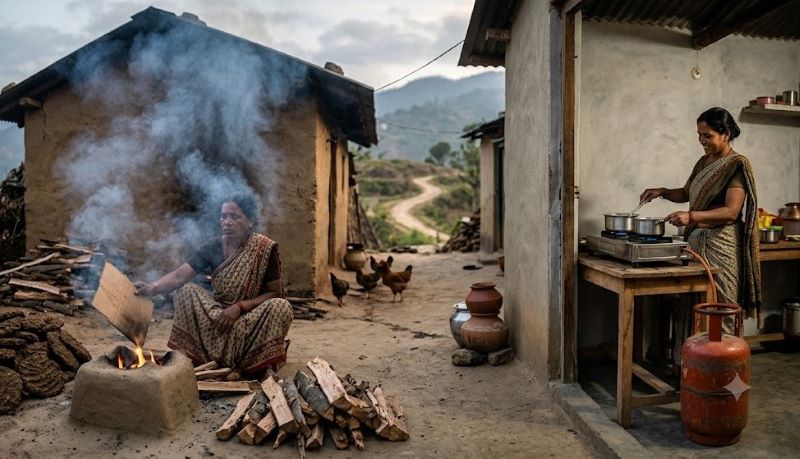
Among rural households surveyed, 73 per cent reported using LPG during the preceding three months, but only 23 per cent depended exclusively on it for cooking. Nearly 48 per cent used LPG as their primary cooking fuel, while approximately 50 per cent continued to rely primarily on firewood. This means that the presence of an LPG connection has not eliminated the traditional chulha from a substantial proportion of rural kitchens. Many families practise what energy researchers describe as fuel stacking, using LPG for selected meals while retaining firewood for routine cooking. The distinction is important because occasional LPG consumption does not provide the same health and environmental benefits as a complete transition to clean fuels.
The findings also correspond with broader national household data. The National Family Health Survey-5 (2019–21) reported that 56 per cent of rural households still used solid fuels, including firewood, dung cakes and coal. Similarly, the Household Consumption Expenditure Survey 2023–24 indicated that approximately 47 per cent of rural households continued to use firewood. These figures underline that traditional cooking fuels remain deeply embedded in rural India's energy economy despite substantial progress in LPG distribution.
The principal obstacle is affordability. For a low-income household dependent on agricultural labour, daily wages or irregular employment, purchasing an LPG cylinder is not simply a matter of convenience; it is a recurring financial commitment. The initial connection may be subsidised, but every subsequent refill requires money that competes with expenditure on food, healthcare, education and other necessities. CEEW's rural study found that 70 per cent of households not using LPG identified cost as a major barrier. The problem is therefore not necessarily a lack of awareness about the advantages of clean cooking, but the inability to sustain its use.
One of the most revealing findings concerns the price households are willing to pay. At least 80 per cent of surveyed households across rural, urban informal and migrant categories said they would shift to exclusive LPG use if a 14.2-kg cylinder were available for Rs 400. Their median stated willingness to pay was Rs 500. These figures are significant when compared with the effective subsidised PMUY cylinder price of approximately Rs 642 in Delhi in July 2026, the reference period used in the study. However, willingness-to-pay responses are based on what respondents say they would pay and should not be treated as proof that every household would actually change its consumption behaviour at that price. Nevertheless, the findings establish a clear affordability concern that deserves attention in public policy.
The distribution system presents another serious weakness. Only 47 per cent of rural LPG-using households surveyed by CEEW reported receiving cylinders at their doorstep. The remaining consumers had to collect refills from distributors or other collection points, adding transportation costs, time and inconvenience. For households in remote villages, the distance to a distribution centre can become an additional economic burden. When the refill process itself becomes difficult, families naturally ration LPG consumption and return to locally available firewood. A clean-fuel programme cannot achieve universal adoption if its last-mile delivery network remains inaccessible to a large section of its intended beneficiaries.
The urban experience offers a different but equally important picture. Around 87 per cent of households in the surveyed informal settlements reported using LPG, while approximately 70 per cent relied exclusively on it. However, access to formal connections remains uneven. Among households without formal connections, 31 per cent reported being turned away because they lacked documents such as proof of address. Some households consequently depend on informal suppliers, often paying considerably more than the authorised market price. CEEW found that informal buyers in these settlements paid around Rs 1,040 for a 14.2-kg cylinder against a retail price of Rs 803 at the time of the survey. Thus, the urban poor often face a paradox: they need clean cooking fuel but may have to pay a premium because they cannot enter the formal distribution system.
The situation of migrant workers is even more complicated. Among the 1,061 migrant workers surveyed across ten cities, 74 per cent reported using LPG in some form, while 26 per cent continued to depend on solid fuels. More significantly, 79 per cent of migrant LPG users lacked formal connections and depended on informal, unregulated supply channels. Fewer than 4 per cent of the surveyed migrant workers were beneficiaries of the Ujjwala scheme. This is despite the 2021 policy provision intended to facilitate access for migrant families through simplified self-declarations.
The problem is closely connected to migration, housing insecurity and the documentation requirements of formal distribution systems. Many workers possess Aadhaar cards, ration cards and bank documents registered at their permanent addresses, but cannot establish a stable residential identity in the cities where they work. As a result, they often purchase smaller quantities of LPG through informal dealers. The economic disadvantage is considerable. CEEW found that informal migrant consumers paid a median of Rs 71 per kg of LPG, compared with Rs 59 per kg for consumers with formal connections, a difference of more than 20 per cent. More than half of informal users relied on smaller five-kilogram cylinders, which generally carry an even higher per-kilogram cost.
Housing conditions also influence fuel choices. The study found that 70 per cent of migrant workers living on footpaths or in open spaces relied exclusively on solid fuels, compared with only 11 per cent of those living in rented accommodation. This demonstrates that clean cooking cannot be separated from the larger questions of affordable housing, urban planning and social security for migrant labour.
The health implications of this incomplete transition are substantial. Burning firewood, agricultural residues, dung cakes and coal in poorly ventilated kitchens releases fine particulate matter and other harmful pollutants. Prolonged exposure to household air pollution is associated with respiratory and cardiovascular diseases. Women, children and elderly people are particularly vulnerable because of their greater exposure to cooking environments. Consequently, the continued use of traditional fuels undermines not only clean-energy objectives but also public health interventions.
The economic and environmental consequences extend beyond individual households. Continued dependence on firewood contributes to pressure on local biomass resources, while inefficient combustion increases emissions and particulate pollution. At the same time, the unpaid labour involved in collecting firewood imposes a disproportionate burden on rural women. Reducing this burden could release time for education, income-generating activities and other productive work. Clean cooking, therefore, should be viewed as an issue of public health, gender equity, energy security and rural development rather than merely a household subsidy programme.
The next phase of India's clean cooking policy requires a shift from distributing connections to ensuring sustained consumption. The government needs to examine refill frequency, household fuel expenditure, delivery reliability and the proportion of families that depend exclusively on clean fuels. These indicators would provide a more realistic assessment of progress than connection numbers alone. CEEW has recommended considering an additional subsidy of around Rs 200 per cylinder to bring the effective price closer to the Rs 400 affordability threshold identified in its surveys. It has also suggested special enrolment drives for migrant workers, flexible partial-refill arrangements and improved incentives for distributors serving remote rural areas.
There is also a case for diversifying clean cooking options. Electricity-based cooking can become a viable alternative in households with reliable power supply and affordable tariffs. Biogas can serve rural communities with sufficient livestock and organic waste resources. However, these alternatives must be supported by appropriate infrastructure, reliable supply and affordable equipment. A transition that simply replaces one unaffordable technology with another will not solve the underlying problem.
India has made measurable progress in extending LPG access, and that achievement should not be discounted. But policy success must be judged by the conditions prevailing inside ordinary kitchens, particularly those of rural labourers, urban informal workers and migrant families. A connection registered in a government database cannot by itself establish that a household has escaped the health hazards of traditional cooking fuels.
The real measure of the Ujjwala initiative and India's broader clean-energy transition will be the number of families that can afford to refill their cylinders, receive them without difficulty and use clean fuel for every meal. Until that becomes a practical reality, the smoke will continue to rise from millions of Indian kitchens, exposing the gap between official achievements and everyday life.
(Author is senior journalist and commentator on current affairs.)


[[comment.comment_text]]