Diwali: Do Lamps Illuminate Every Home?
 an hour ago
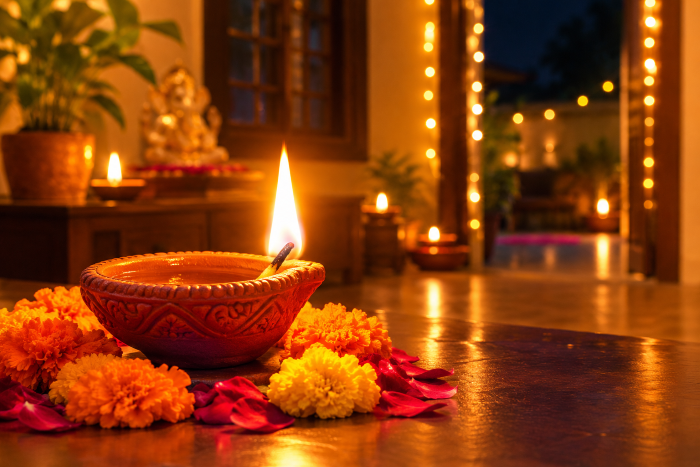
The joy of Diwali lies not merely in the glittering lights of countless lamps, but in transforming the darkness within human hearts into an occasion for hope and celebration. This festival is not simply an opportunity to illuminate our homes; it is also an invitation to reach out to those lives where despair, neglect and deprivation have taken root over the years. Diwali is a festival of happiness and togetherness. Yet, amid all the celebrations, one question deserves serious reflection: Do lamps burn in every home? Does every face wear a smile? Does the spirit of our festivities reach those whose lives are often spent waiting for even the smallest glimpse of happiness?
It is easy to count the number of lamps that illuminate our homes, but much harder to recognise the darkness that may exist in human hearts. We pay considerable attention to decorating our houses, but often overlook the sadness within people around us. Perhaps the true significance of Diwali lies in bridging this very gap.
It is Diwali season. Markets are bustling, shops are crowded, and homes are undergoing the familiar ritual of cleaning and decoration. Colourful rangolis are being drawn, boxes of sweets are being prepared, and houses are being transformed with earthen lamps and strings of electric lights. Social media platforms are flooded with festive greetings. Celebration is everywhere. Yet, amidst this dazzling spectacle, a question repeatedly disturbs the conscience: Is Diwali truly a festival for everyone? Do lamps burn in every home? Does the joy of this festival reach every individual equally?
Diwali is celebrated as the festival of light. It symbolises the victory of light over darkness, hope over despair and truth over falsehood. The tradition of lighting lamps to celebrate Lord Rama’s return to Ayodhya is not merely associated with a historical or religious episode; it also conveys a profound human message. Rama’s homecoming was welcomed not simply with lamps, but with faith, love, expectation and collective happiness. When we celebrate Diwali today, do we incorporate that underlying spirit into our lives? Or have we reduced the festival to external decoration and consumerism?
There is considerable brightness during contemporary Diwali celebrations, but the light of compassion sometimes appears to be fading. Magnificent buildings are illuminated with dazzling lights, while in the same cities there are families struggling to arrange even one proper meal a day. Markets are overflowing with sweets, yet for children in many households, the fragrance of sweets coming from neighbouring homes remains their only reminder of the festival. While some are busy exchanging expensive gifts, others are worried about how they will manage to put food on the table during the festive days.
This contrast is not merely a reflection of economic inequality; it is also a test of our collective social consciousness. The question is not how much we spend on Diwali, but how many people become part of our celebrations. Is our happiness confined to our immediate families, or does it extend to our neighbourhoods, communities and those whose daily struggles are vastly different from our own?
The true meaning of festivals lies in togetherness. This togetherness should not be confined to relatives but should extend to all human beings. Diwali gives us an opportunity to look within and examine whether darkness has also found a place in our hearts. Do we harbour indifference towards someone, hatred towards another or arrogance towards those who are less privileged? While cleaning our homes, we discard unwanted possessions and accumulated clutter. But do we also make an effort to remove old prejudices, bitterness and resentment from our minds? We light lamps in our homes, but do we make any effort to dispel the darkness in our relationships?
We often say that Goddess Lakshmi visits homes during Diwali. This belief is an integral part of our cultural tradition. However, prosperity should not be measured merely in terms of wealth and material possessions. A home without love, where elderly people live in loneliness, where children are denied opportunities to pursue their dreams, or where workers are not treated with dignity remains incomplete despite its material abundance. True prosperity is one in which human dignity is protected, relationships are strengthened by affection and society moves towards equality of opportunity.
Today, Diwali celebrations have become closely associated with the market economy. Shopping, gifts, decoration and consumption have considerably influenced the character of the festival. The marketplace constantly encourages us to believe that buying more means being happier. Expensive decorations, lavish gifts and grand celebrations have increasingly become measures of festive success. But does happiness carry a price tag? Is a small lamp burning in the home of a poor family any less meaningful than the thousands of lights illuminating a luxurious mansion?
Amid the glitter of the marketplace, we must remember that the joy of a festival is determined not by the price of things but by the emotions and intentions behind them. A warm meeting, spending a few moments with someone who is lonely, helping a family in need or making an effort to rebuild a strained relationship can make Diwali far more meaningful. The worth of a celebration should be measured not by expenditure but by compassion.
It is also worth reflecting on the growing tendency towards social display during festivals. Which house is more elaborately decorated, who has given the most expensive gifts and which celebration has attracted the largest gathering have, in many cases, overshadowed the true spirit of the occasion. Sharing festive photographs on social media is easy, but participating in someone’s sorrow is considerably more difficult. We readily display our prosperity, but do we demonstrate our social responsibility with equal enthusiasm, or even greater commitment? The value of a celebration should be judged not by the photographs it produces but by the difference it makes to people’s lives.
Environmental concerns also deserve our attention during Diwali. The noise and smoke generated by firecrackers pollute the air and adversely affect children, elderly people, those suffering from illnesses, and animals and birds. If a festival celebrating light becomes a source of fear, discomfort and illness for others, we must reconsider the way we celebrate it. Respect for tradition becomes meaningful only when it remains sensitive to life and the environment. Lighting lamps, sharing sweets and celebrating together do not require us to regard pollution and excessive noise as unavoidable aspects of festivities.
There are countless people in our society whose hard work makes our Diwali brighter, even though the festive glow in their own homes may be limited. Sanitation workers, construction labourers, domestic workers, small vendors, rickshaw drivers and workers in the unorganised sector make our everyday lives more comfortable. Do we ever make an effort to understand their difficulties? Does recognising their contribution become a priority during festivals? Merely sending them festive greetings is not enough. Respect means acknowledging their labour, ensuring fair remuneration and extending meaningful support to improve their lives.
An important aspect of Diwali is also the reunion of families and the renewal of relationships. The demands of modern life have made people increasingly busy, often distancing them from their own loved ones. Homes are illuminated, but conversations are becoming scarce. People may live under the same roof but seldom find time to listen to one another. In this context, Diwali offers an opportunity to pause, reconnect and revive relationships. Sitting with an elderly family member, enquiring about someone living alone, spending time with children and restoring meaningful communication within the family are equally important parts of the celebration.
Festivals also remind us that human beings are not merely economic units. They are shaped by emotions, memories, relationships and aspirations. Even a small gesture of affection can bring about a significant change in someone’s life. Visiting an elderly person in an old-age home, enquiring about a patient in a hospital, providing educational materials to a child in need or celebrating with a family struggling with loneliness may be more meaningful than any grand event. The lamp of compassion becomes truly significant when it illuminates someone else’s life.
The spirit of Diwali also teaches us that justice, compassion and dignity must remain central to society. The memory of Lord Rama is not merely a religious or spiritual matter; it is also associated with ideals of ethical conduct. If we invoke his name, we must also make an effort to follow those ideals. Insulting the weak, neglecting the needy, committing injustice against anyone or remaining indifferent to another person’s suffering goes against the very spirit of the festival we celebrate with such devotion.
Happiness becomes meaningful when it is shared. Individual happiness may be temporary, but collective happiness strengthens society. The message of Diwali is that light does not diminish when shared; it multiplies. One lamp can light another, gradually pushing darkness away. The same principle applies to human life. Sharing someone’s sorrow, understanding another person’s struggles and bringing hope into someone’s life are lamps that continue to burn long after the festival is over.
Today, we need to view Diwali not merely as a tradition but also as an opportunity to fulfil our social responsibilities. Along with illuminating our homes, let us reach out to households struggling with deprivation. Along with sharing sweets, let us share dignity and confidence. Along with exchanging greetings, let us bridge the gaps in our relationships. And while celebrating, let us ensure that our happiness does not become a source of someone else’s suffering.
The significance of Diwali does not lie in how many lamps illuminate our homes, but in how many lives receive hope because of us. The joy of the festival lies not merely in the brilliance of lamps but in transforming the darkness within human hearts into an occasion for celebration. When hope awakens in the heart of a despairing individual, when someone living in loneliness finds companionship, when a needy family experiences the happiness of the festival and when compassion expands across society, Diwali begins to reflect its true meaning.
This Diwali, let us illuminate not only our homes but also our hearts. Let us light lamps while recognising the darkness created by deprivation, injustice, loneliness and neglect. Let us celebrate, but remember that our happiness is complete only when it includes the happiness of others. For the ultimate question remains: Do lamps burn in every home? If the answer is still ‘No’, then our Diwali remains incomplete.
(Author is a Professor at the Department of Hindi, Aryabhatta College, University of Delhi.)










[[comment.comment_text]]