Social Protests: Bridging the Gap Between Intent and Achievement

 2 hours ago
Social protests emerge when citizens unite to challenge injustice, influence public policy and demand change. Yet mobilisation alone does not guarantee success. A movement’s real achievement lies in translating public anger into institutional reforms and lasting improvements in people’s lives. The ongoing protests over electoral rights and the Special Intensive Revision (SIR) of voter rolls raise a larger question: how can public mobilisation move beyond confrontation to deliver meaningful change?
Lessons from History
India’s history offers several examples of movements that reshaped society and challenged entrenched power structures. Raja Ram Mohan Roy, Jyotiba Phule, Periyar and B.R. Ambedkar confronted social inequalities through reform and advocacy. Mahatma Gandhi’s non-cooperation and civil disobedience movements transformed the freedom struggle into a mass campaign against colonial rule.
Environmental movements associated with Chandi Prasad Bhatt, Sunderlal Bahuguna and Medha Patkar brought ecological concerns and community rights into public debate. Student-led agitations in Gujarat, Bihar and Uttar Pradesh also influenced national politics. The movement associated with Jayaprakash Narayan contributed to the political upheaval that culminated in the defeat of the Congress government in 1977.
These movements differed in their methods and outcomes, but they shared important characteristics: clear objectives, sustained public participation, credible leadership and the ability to convert popular sentiment into political or institutional change.
Jantar Mantar and the Changing Politics of Protest
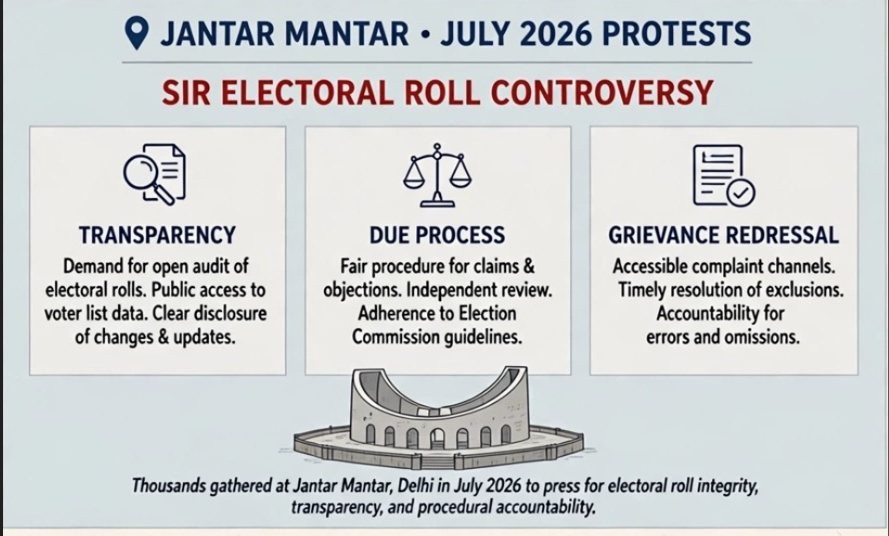
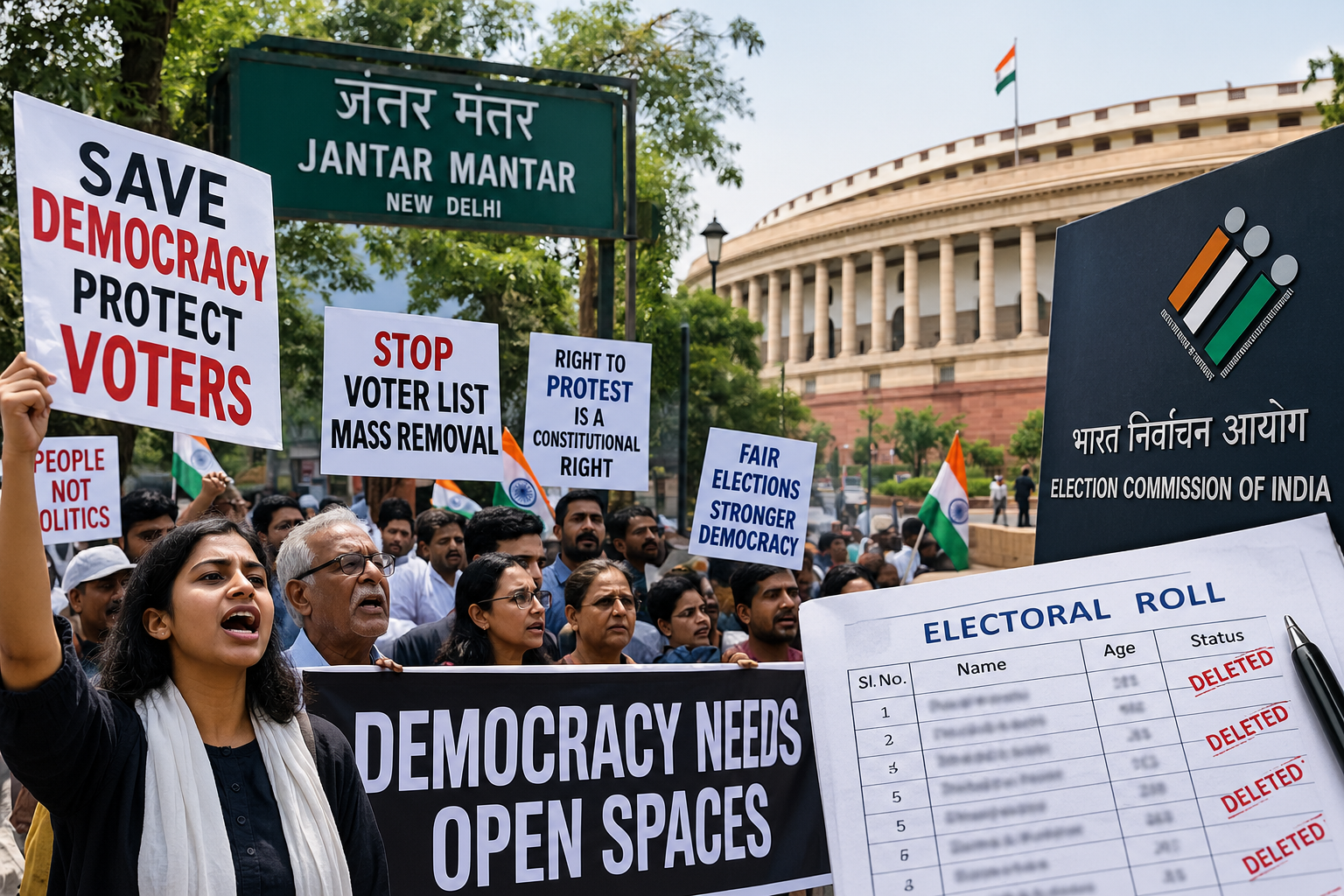
The protests at Jantar Mantar in July 2026 and the subsequent mobilisation against the Election Commission of India (ECI) suggest that the relationship between citizens, particularly young people, and political authority is changing.
Many young Indians appear increasingly impatient with repetitive political narratives and promises unsupported by visible improvements in governance. Greater access to information has also exposed them to protests and political upheavals in neighbouring countries and elsewhere, influencing their expectations of accountability.
The immediate flashpoint is the controversy surrounding the SIR of electoral rolls. Opposition parties allege that the exercise risks disenfranchising legitimate voters and have questioned the handling of applications, objections and deletions. Claims concerning the number of affected voters require transparent verification. Nevertheless, the underlying principle is indisputable: no eligible citizen should lose the right to vote because of administrative errors, arbitrary procedures or inadequate opportunities to establish eligibility.
Electoral roll revision is a legitimate administrative responsibility. Its credibility, however, depends on transparency, due process, accessible grievance redressal and safeguards against wrongful exclusion. The Election Commission must address legitimate concerns through evidence and explanation rather than allowing mistrust to deepen.
When Law Enforcement Becomes the Story
The handling of the protests has raised serious questions about the balance between public order and democratic freedoms.
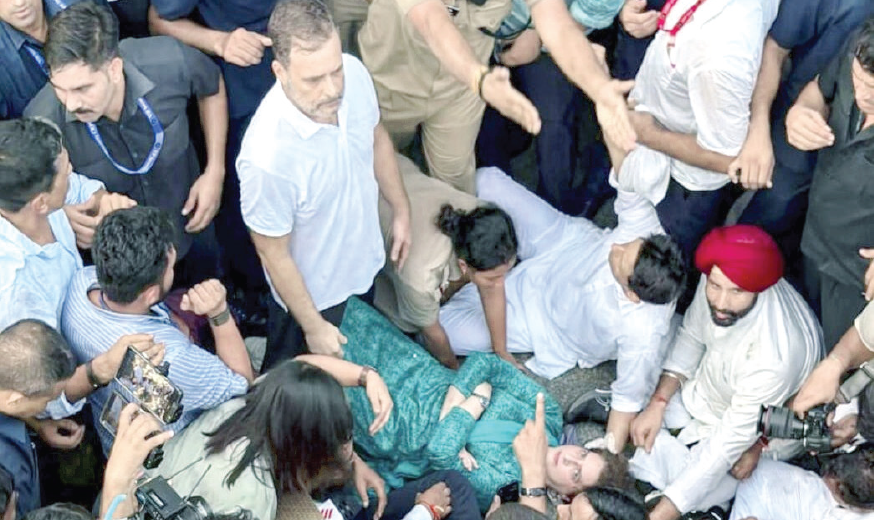
Reports of extensive barricading, heavy security deployment, transport restrictions, internet disruptions and mass detentions have intensified criticism of the authorities. Allegations of protesters being chased, beaten or forcibly dragged into police vehicles also warrant impartial investigation.
The police have a legitimate responsibility to maintain public order and protect infrastructure. However, restrictions must be necessary, proportionate and consistent with constitutional rights. Peaceful assembly cannot be treated as a threat simply because it challenges the government or causes political embarrassment.
Equally, violence, damage to public property and dangerous attempts to escape moving vehicles cannot be justified as democratic dissent. Accountability must apply to protesters and police personnel alike, based on evidence.
Allegations that officers concealed their identities during operations raise further concerns about accountability. Clear identification, documented arrests, access to legal assistance and transparent reporting of detentions should be standard safeguards.
The reported detention of thousands of people, including lawyers and civil society participants, makes judicial scrutiny particularly important. If allegations of excessive force or unlawful detention are substantiated, responsibility must be established and appropriate remedies provided. Democratic institutions demonstrate their strength not by preventing dissent, but by responding to it lawfully.
Political Reactions and Institutional Accountability
Opposition leaders have strongly criticised the police response. Kerala Chief Minister Pinarayi Vijayan has described the crackdown as an attack on democracy, while Trinamool Congress MP Mahua Moitra has condemned alleged brutality against peaceful women protesters. Mamata Banerjee has also used political satire to question the Election Commission’s handling of the controversy and demand accountability.
Such interventions help keep democratic rights in public debate. However, political rhetoric cannot substitute for evidence, judicial scrutiny or a credible programme of reform. Opposition parties must explain how they would strengthen electoral administration and protect voters.
The United Nations human rights system has expressed concern over reported actions against civil society members, lawyers and journalists, emphasising peaceful assembly and meaningful dialogue. The government has rejected the criticism as interference in India’s internal affairs.
National sovereignty does not diminish the responsibility to protect fundamental rights. Equally, international criticism does not automatically establish every allegation. The appropriate response is to examine the evidence, uphold the law and provide credible explanations.
The controversy cannot be resolved through competing statements alone. The Election Commission must address concerns about voter inclusion and procedural fairness, the police must account for their conduct, and the courts must independently examine matters brought before them.
From Protest to Purpose
Large demonstrations inevitably inconvenience ordinary citizens. Road closures, transport disruptions and internet restrictions affect workers, students, businesses and vulnerable groups who may have no direct involvement in the dispute. These costs deserve consideration, but inconvenience cannot become an automatic argument against peaceful protest. Dissent remains essential to democracy.
The larger question is whether the energy displayed by young protesters can be channelled into sustained campaigns against other failures of governance.
The condition of school education, unequal access to affordable healthcare, endemic corruption, bureaucratic delays, environmental pollution and digital fraud deserve equally determined public attention. These problems directly affect opportunity, dignity, economic security and everyday life.
Young citizens could organise campaigns around measurable objectives: better learning outcomes in government schools, accessible primary healthcare, time-bound delivery of public services, stricter enforcement of environmental standards and more effective investigation and redressal mechanisms for cybercrime.
Such initiatives would require more than occasional demonstrations. They would need reliable data, local participation, expert guidance, clearly defined demands and regular monitoring of government performance. Success should be measured not by the size of a rally or the force of a slogan, but by tangible improvements in people’s lives.
Political parties must also move beyond treating every protest as an electoral opportunity. They should translate public grievances into legislative proposals, administrative reforms and enforceable commitments. Civil society organisations and educational institutions can support this process through informed debate and independent monitoring.
The Measure of a Movement
The right to vote occupies a special place in this debate. It enables citizens to hold governments accountable, and no administrative exercise should arbitrarily compromise it. Protecting electoral integrity is therefore a non-negotiable democratic obligation.
But the larger lesson extends beyond the present confrontation. Protest is often the beginning of change, not its culmination. Movements that sustain public engagement, build broad coalitions and establish clear mechanisms for accountability are more likely to achieve lasting results than those confined to episodic outrage.
India’s young people have demonstrated their willingness to question authority and defend their rights. The challenge now is to convert that determination into a sustained civic agenda addressing the everyday failures of governance.
The gap between the aims of social protest and its achievements can be bridged through strategy, evidence, persistence and accountability. A successful movement does not merely compel those in power to listen; it ensures that something changes after the crowds disperse.
(Author, a retired civil servant, formerly served as the Chief Secretary in the state government of Sikkim. He can be reached on email: alok.secyskm@gmail.com)








[[comment.comment_text]]