Decoding Rahul Gandhi’s Chicago Tightrope on Israel and Gaza

 29 minutes ago
Between Conscience and Statecraft
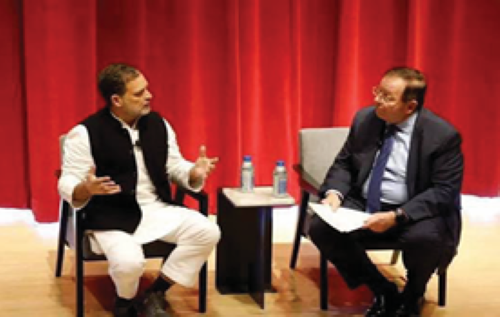
Few remarks by an Indian opposition leader on foreign soil have stirred as fierce an ideological storm at home as Rahul Gandhi’s recent observations on India-Israel relations at the University of Chicago. Speaking on November 19 during an academic interaction moderated by political scientist Robert Pape—a day after addressing students and faculty at Columbia University—the Leader of the Opposition in the Lok Sabha articulated a calibrated position that simultaneously drew sharp condemnation from India’s Left and progressive commentators while reviving a foundational debate over how a rising power reconciles moral conviction with strategic necessity.
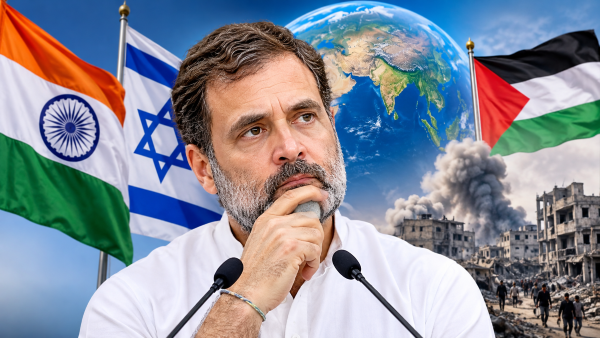
During the Chicago session, Gandhi did not sidestep the conflict in West Asia even though the question posed to him focused broadly on the trajectory of bilateral ties between New Delhi and Tel Aviv. Instead, he laid out a three-part framework: first, that India maintains strong relations with Israel and procures vital military hardware from it; second, that as a nation of roughly 1.5 billion people, India’s foreign policy must be governed strictly by its own national interest rather than external expectations; and third, that while the October 7, 2023 Hamas-led attacks on innocent civilians were indefensible, Israel’s subsequent military campaign in Gaza warranted equally clear condemnation because one wrong cannot justify another.
The Storm Over Moral Clarity
For critics on the Left, however, pairing humanitarian criticism of Gaza with an endorsement of continued defence trade amounted to an unacceptable contradiction. Kerala Chief Minister and CPI(M) leader Pinarayi Vijayan swiftly dismissed Gandhi’s formulation as an "indefensible" balancing act, arguing that advocating arms procurement from Israel amid mass civilian suffering in Gaza undermines Jawaharlal Nehru’s anti-imperialist tradition and historic solidarity with the Palestinian cause. The CPI(ML) Liberation went further, contending that deep strategic and corporate defence links with Israel—alongside the controversial use of surveillance technologies—erode both India’s international credibility and its domestic democratic standards.
Disquiet also surfaced among progressive commentators and sections of the Congress party’s own support base. Several political observers pointed out that Gandhi’s pragmatic tone contrasted noticeably with the sharper rhetoric of senior Congress figures Sonia Gandhi and Priyanka Gandhi Vadra, both of whom have previously described Israel’s offensive in Gaza as a genocide and faulted the Indian government for muted responses to Palestinian suffering. To these critics, diplomacy ceases to be credible the moment strategic commerce is insulated from human rights accountability.
Individual Ethics Versus the Scale of Governance
Yet defenders of Gandhi’s remarks, alongside several foreign policy analysts, argue that much of the outrage stems from conflating the moral absolutism of personal activism with the fiduciary obligations of statecraft. In everyday life, individuals routinely navigate the gap between personal ethics and economic interdependence. Citizens who fiercely oppose particular corporate conglomerates or political ideologies seldom boycott every power grid, telecom network, transport hub, or supply chain connected to those entities.
Purchasing essential goods or using shared infrastructure does not automatically signal ideological endorsement; rather, it reflects practical constraints of availability, accessibility, and cost.
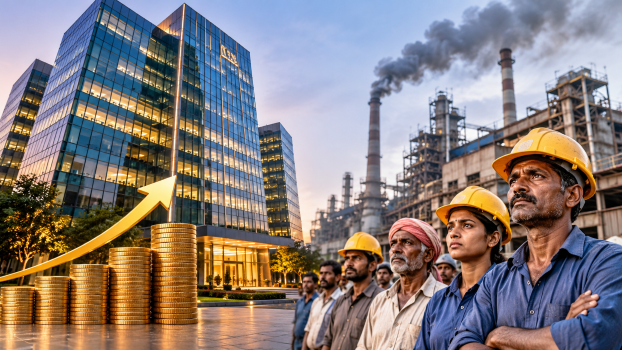
When that ethical equation scales upward, the stakes transform entirely. A business owner responsible for a thousand livelihoods cannot sever ties with a major industrial partner purely as a gesture of personal conscience without weighing the consequences for workers and their families. Multiply that responsibility to 1.4 or 1.5 billion citizens, and foreign policy ceases to be an exercise in moral signaling. A political leader projecting an alternative vision of governance must account for national security, supply-chain resilience, and strategic leverage—domains where abrupt ruptures carry real material costs.
Defence Realities and Strategic Autonomy
The material dimension of India-Israel ties underscores why successive governments in New Delhi have treated the relationship with caution. Global defence procurement assessments covering the 2021–25 period show that India remains the world’s second-largest arms importer even as it steadily diversifies away from legacy suppliers. International trade figures indicate that India’s imports of arms, ammunition, and defence components from Israel stood at roughly $1.25 billion in 2025 alone, spanning missile systems, unmanned aerial platforms, radar suites, and precision munitions.
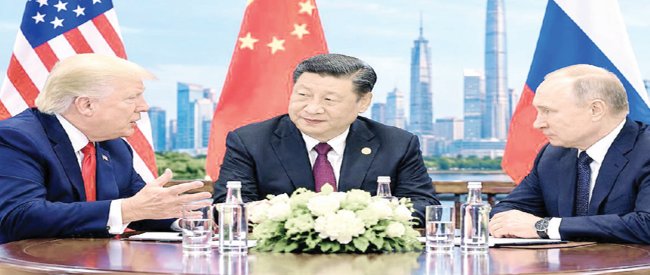
From a realist perspective, abruptly severing defence procurement in the middle of ongoing regional security challenges would weaken India’s own preparedness without altering military realities in West Asia. Proponents of pragmatic statecraft argue that the constructive path lies in pairing clear humanitarian advocacy with strategic self-interest—maintaining essential defence supplies in the short term while accelerating domestic defence manufacturing to reduce external dependency over time. Equally central to Gandhi’s Chicago argument was the assertion that India’s size and standing require strategic autonomy: New Delhi’s choices, he emphasized, should neither be dictated by Washington, Moscow, Beijing, or Tel Aviv, nor reduced to binary alignments.
Continuity in a Shifting Diplomatic Landscape
Viewed against the broader arc of Indian diplomatic history, Gandhi’s remarks reflect institutional continuity rather than an abrupt ideological pivot. Historically, the Congress party championed Palestinian self-determination—opposing the 1947 United Nations partition plan, recognizing the Palestine Liberation Organization in 1974, and recognizing the State of Palestine in 1988—before Prime Minister P.V. Narasimha Rao established full diplomatic relations with Israel in 1992. Since then, Indian foreign policy across administrations has sought to de-hyphenate its bilateral partnership with Israel from its enduring commitment to a negotiated two-state solution. Even in the very week of Gandhi’s Chicago address, India voted in favour of United Nations General Assembly resolutions affirming Palestinian self-determination and opposing Israeli settlements in the Occupied Palestinian Territory and East Jerusalem.
In ultimate analysis, the controversy surrounding the Chicago speech highlights a recurring fault line in democratic politics: voters and activists often demand unambiguous moral alignment, whereas international diplomacy operates in shades of gray. Whether Gandhi’s formula is viewed as mature statecraft or an uneasy compromise depends on what one expects from an opposition leader on the global stage—an uncompromising voice of conscience, or a prospective steward of a complex nation’s competing interests.
(Author, a former member of the history faculty at St. Xavier’s College, Mumbai, is senior TEW columnist on democracy and diversity issues.)






[[comment.comment_text]]