Bihar's Political Metamorphosis from JP to BJP

 5 months, 3 weeks ago
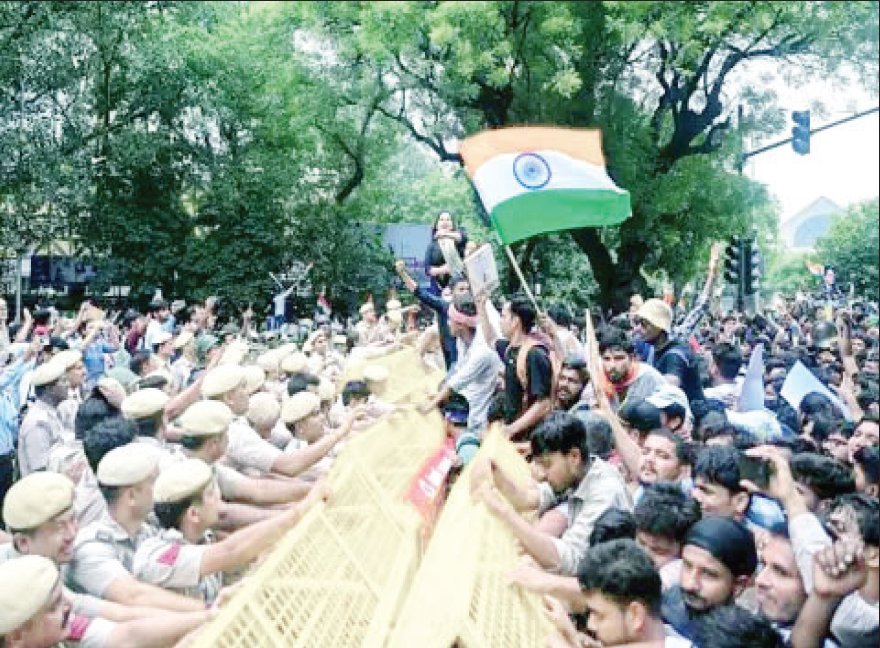
One must read a significant chapter in India's democracy awakening in order to comprehend Bihar politics. In our country, ideas have continuously surpassed discussions and developed into large-scale movements that have frequently altered the balance of power. It was here that Jayaprakash Narayan first voiced the need for a "Total Revolution," an appeal that sought to change the nature of politics itself rather than just a change of leadership.
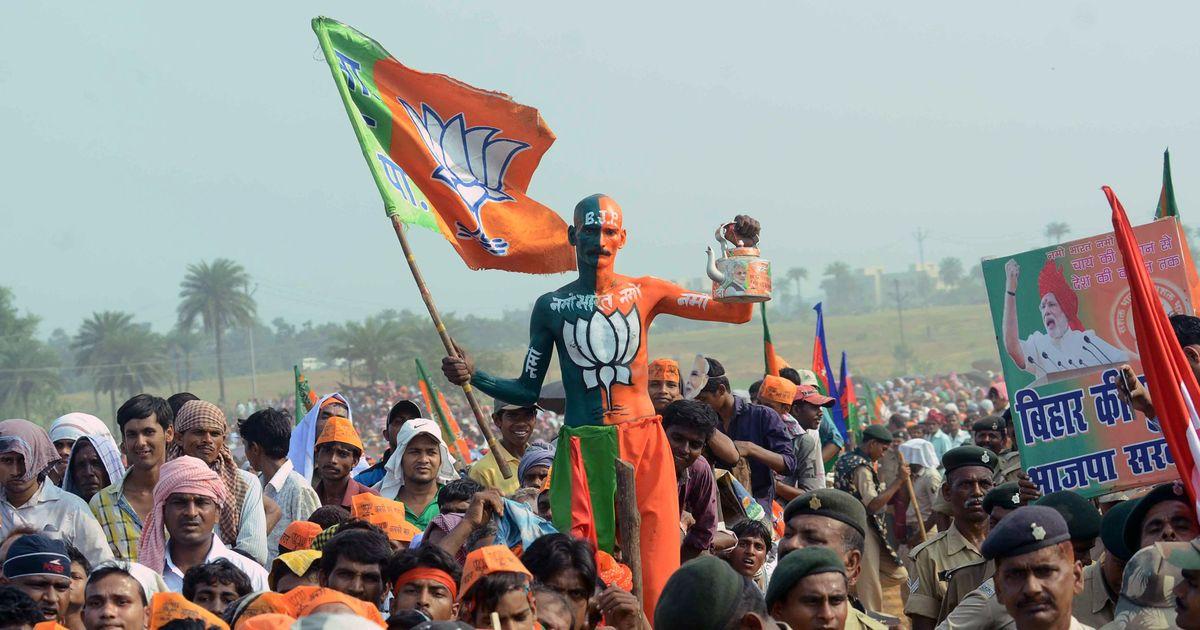
And now, some fifty-nine years later, Bihar seems to be at yet another pivotal moment where the Bharatiya Janata Party appears ready to take the lead for the first time.
This change reflects a lengthy and intricate ideological journey rather than just a change in political power. Systemic resistance, democratic revitalisation, and a moral reimagining of governance dominated politics during the JP era. The 1970s movement rocked the Indian political scene, not just Bihar. It introduced a whole generation to politics, one that refused to reduce democracy to the ritual of elections and learnt to question authority.
The JP movement was fundamentally about decentralisation of power, participatory democracy, and moral politics. It challenged long-standing structures and rekindled the spirit of democracy. However, history has its own paradoxes: the movement that produced a great deal of ideological energy was unable to solidify into a long-lasting institutional framework. Moral activism was the foundation of JP's politics, but later generations were unable to maintain that ethical intensity within the confines of political politics. As a result, the demands of realistic governance caused the idealism of socialism to progressively wane.
In Bihar, socialist politics undoubtedly increased social representation. The power structure underwent a historic change, as marginalised and underprivileged populations gained political voice. But as time went on, a crucial concern surfaced: could social justice politics keep up with the growing demands of employment, development, education, and administrative effectiveness?
This conflict gave rise to a new discourse. In Bihar, a new generation started looking for opportunity, mobility, and contemporary development in addition to representation. These changing goals were difficult to properly express in the language of socialism. As a result, the political center of gravity gradually started to change.
Many of the leaders who came out of the JP movement later adopted different ideologies. Mandal politics, regional party claims, the emergence and development of socialist currents, and a period characterised by coalition governments all occurred in Bihar. Power fluctuated during these periods, but social justice and caste-based alliances remained the major pillars of politics.
The Bharatiya Janata Party's success is not just the result of organisational growth amid this changing political consciousness. It also highlights a growing ideological gap in the communist system. The BJP has attempted to close that gap with its story of nationalism, progress, and capable leadership. Its rise to prominence as a powerful political force in Bihar signifies not only an electoral change but also a more profound shift in the political imagination of the state, where the vocabulary of identity, desire, and governance is once again being rewritten.
The Bharatiya Janata Party's robust organisational structure is the primary factor contributing to its ascent. The BJP focused its efforts on establishing the organization as the main unit of political activity, in contrast to a number of regional groupings that mostly relied on personality-driven politics. It was able to progressively strengthen its ties among a variety of societal segments thanks to a cadre-based structure, ideological training, and long-term strategic planning.
The evolution of political speech itself is the second important aspect. Social justice and caste-based representation dominated Bihar politics for many years. The social structure unquestionably underwent significant changes as a result of this politics. But as time went on, a new generation arose whose goals went beyond simple portrayal. Political expectations started to change as a result of employment, development, education, and access to contemporary options. With amazing political flexibility, the BJP combined this changing discourse with the language of development and nationalism to sell it as a cogent story of ambition and advancement.
The opposition's structural weakness has been the third reason. The development of a durable alternative pole of power was thwarted by ongoing fragmentation, interparty conflict, and internal disputes among regional forces. Due to this political void, the BJP was able to gradually increase its power and solidify its position.
In addition to these state-level factors, Bihar's political environment has been significantly impacted by the BJP's national ascent. State politics have been influenced by strong central leadership, the prominence of national social programs, and the forceful rhetoric of nationalism. Consequently, the BJP progressively transitioned from being a coalition partner to being a major political force on its own.
In this regard, the rise of the BJP in Bihar is a new phase in a protracted and ongoing process of political change rather than a sudden break. In order to truly comprehend it, one must interact with the deeper ideological history that started with the echoes of the JP movement and look beyond the immediate present.
However, to simply read this shift as socialism's failure would be an inadequate perspective. In actuality, Indian politics is a dynamic and self-renewing process in which all ideologies are forced to reframe themselves in response to fresh enquiries and developing goals. JP's influence was never limited to socialism; it was also deeply ingrained in the ethos of challenging authority and democratic awakening.
Because the BJP is ready to take direct control of Bihar's government for the first time, the current situation seems historic. This represents yet another turning point in a political journey that was largely sparked by the JP movement's convulsions. A new generation of politicians emerged as a result of that movement, and this generation in turn influenced socialist currents, the emergence of regional parties, and the changing rhetoric of nationalist assertion.
Bihar has, in fact, traditionally served as a testing ground for political theories. It has seen the growth of social justice movements at the center of power, the consolidation of socialism at various points in history, and now the growing influence of nationalist politics. According to this viewpoint, the journey "from JP to BJP" represents a larger story of ideological change in Indian democracy rather than just a change in political parties.
This trend also has a startling irony: the movement that first opposed the Congress's hegemony finally produced political energy that helped the Bharatiya Janata Party become a major player in Indian politics. An important manifestation of this lengthy historical continuum is its rise to prominence in Bihar.
Therefore, "JP to BJP" refers to more than just the separation between two political acronyms. It tells the tale of over fifty years of changing concepts, conflicts, goals, and reinterpretations of power in Indian politics.
Perhaps when history reflects on this journey, it will perceive it not only as an electoral shift but as the culmination of a political cycle that started with the JP movement's resonant echoes and now manifests itself in a new ideological chapter developing in Bihar's political landscape.
Politics in Bihar has always been more than just a history of shifting governments; it is also a tale of the emergence and fall of ideologies. Jayaprakash Narayan once called for "Sampoorna Kranti"—a vision in which politics was elevated to a moral tool for the reconstruction of society itself rather than limited to the mechanics of governance—on this same land. A democratic awakening against the consolidation of power was sparked by that movement, which also gave rise to a whole new generation of politicians motivated by reform and resistance.
However, when the Bharatiya Janata Party first becomes a powerful political force in Bihar fifty years later, it is natural to wonder if JP's legacy was left unfinished or if the electorate has gradually moved away from the socialist ideological grammar that once shaped the state's political imagination.
From this perspective, the transition "from JP to BJP" is clearly characterised by contradictions, yet it is not wholly abrupt. The same movement that gave the masses political awareness also helped them develop the ability to accept new intellectual currents. In this way, JP's revolution kept Bihar politically flexible and receptive to reinvention rather than solidifying it into a single ideological framework.
Therefore, the current transition is not just about socialism's weariness but also about a larger question: has politics itself been able to change in response to society's changing aspirations? This shifting social and ideological consciousness, where traditional frameworks are reevaluated in light of new expectations of government, identity, and development, can be seen as reflected in the growth of the BJP in Bihar.
In the end, this shift also highlights one of democracy's key advantages: it is not constrained by any one philosophy. Rather, it constantly reorients itself, giving fresh responses to fresh queries. Therefore, Bihar's lengthy transition from the JP to the BJP is more than just a political change; it is a story of ongoing change in which history never ends but continues to rewrite itself.
Niraj Krishna






[[comment.comment_text]]