Autocracy’s Breaking Point: The Signs of Liberal Democracy’s Return
 an hour ago
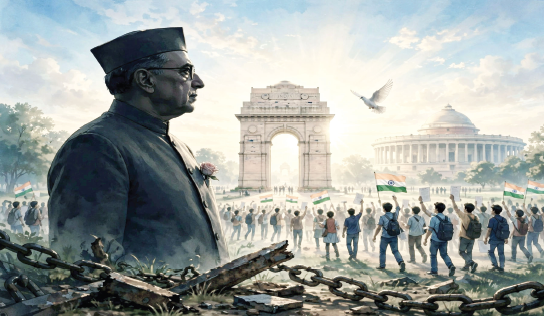
November is the month in which we celebrate the birth anniversary of Pandit Jawaharlal Nehru, India’s foremost freedom fighter, a towering historical personality and the first Prime Minister of independent India. Is it merely a coincidence, or a sign of things to come, that this year we are celebrating Nehru’s birth anniversary against the backdrop of national and international developments that point towards the possible end of an era of repressive, authoritarian and controlled governance, sustained by the support of big business houses and multinational corporations (MNCs)?
All this is happening at a time when supporters of liberal ideology in India, as well as in several countries across Europe, Asia and Latin America, had almost given up hope of a fair and equitable world founded on social justice. They had resigned themselves to living under the dominance and exploitation of capitalism, accepting it as their inevitable destiny. Against this backdrop of widespread pessimism, the possibility of a revival of liberal democracy in India and across the world is a welcome sign.
This certainly does not mean that authoritarian regimes and power establishments, with their mafia-like functioning, have ceased to dominate the world, particularly India. However, recent developments have undoubtedly raised hopes of a change in this direction.
The process began with Zohran Mamdani’s unexpected victory in the New York mayoral election. New York is regarded as one of the major centres of influence of multinational corporations and global corporate business. Mamdani’s victory was followed by another significant development: Mark Carney and his Liberal Party coming to power. Carney successfully stood up to Donald Trump’s pressure and bullying, strengthening Canada’s independent economic and political identity despite being within the sphere of influence of the American superpower. Instead of remaining dependent on American dominance, he sought to develop trade relations with several countries across the world.
While Mark Carney demonstrated that American economic hegemony could be challenged, Iran sent out the message that the United States could not use its military might to make the entire world dance to its tune. Even the most powerful nation in the world, armed with enormous resources and the latest technology, can be resisted with courage and determination. The war in West Asia this year also made it clear that no country or alliance, however powerful, can be allowed to establish a monopoly over the world's natural resources in pursuit of its own partisan interests.
Other developments reinforce this emerging trend. These include Lula’s return to power in Brazil and his political success despite opposition from Trump; challenges to long-entrenched power establishments in Sri Lanka, Poland and Serbia; widespread public demonstrations against right-wing and far-right governments in several European countries; changes of government following successful popular movements in Bangladesh and Nepal; and the crushing defeats suffered by Donald Trump’s Republican Party in the United States and Narendra Modi’s BJP in India in recent elections. Taken together, these developments are clear indications that the world is passing through a period of major political transformation.
Coming to India, the BJP’s defeats in recent elections to Legislative Councils in some states are also a small indication of the aspirations for a fair and liberal society that characterised India before the advent of the Modi regime. With the support of the government machinery, a compromising bureaucracy, big business houses and a media that operates under favourable conditions, attempts have been made to impose a disciplined and controlled socio-political environment on the country. The crowds of unquestioning supporters, conditioned through the teaching of distorted history and intoxicated with religious fervour, have also played their part in sustaining this regime for so many years.
However, the movement launched by the country's youth last May under the leadership of the newly formed Cockroach Janata Party demonstrated that even the seemingly invincible grip of the Modi regime could be successfully challenged. Growing public resentment over rising inflation, high unemployment and the steadily increasing cost of essential public welfare services such as healthcare and education is now beginning to take organised and widespread shape. This is an indication that the era in which authoritarian rule was considered inevitable may be drawing to a close.
Despite his aristocratic and elite background and the enormous powers vested in him, Pandit Jawaharlal Nehru was a true democrat and a politician of liberal convictions. He dreamt of building a non-communal, egalitarian and just social order in a society shackled by feudal inequalities, class divisions and caste hierarchies, and worked consistently towards realising that vision.
The greatest tribute that a grateful nation can pay Nehru on his birth anniversary would be to build a truly free and liberal society, founded on a modern outlook, scientific temper and democratic values.
(A veteran journalist and media guru, Prof. Pradeep Mathur is Head of Media Map News and Chairman of the MBKM Foundation, a voluntary social service organisation.)

[[comment.comment_text]]