The Economics of Hall and Woodford: Understanding the Microfoundations of Macroeconomic Stabilisation

 an hour ago
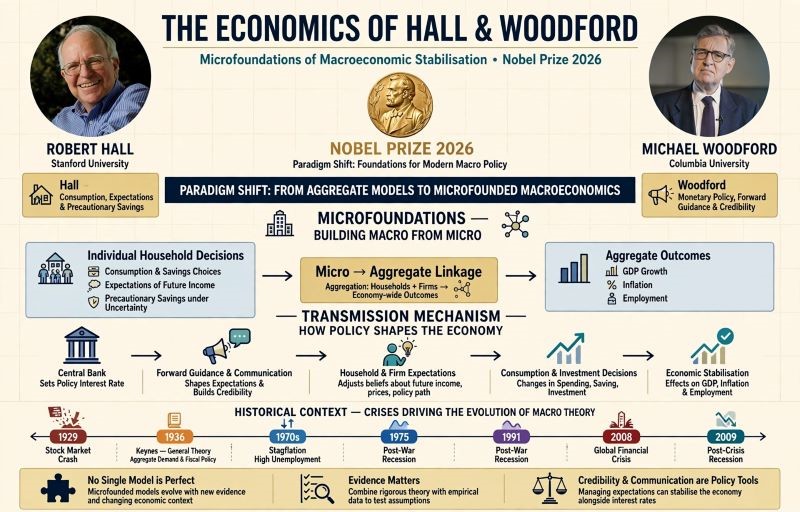
The Nobel Prize in Economic Sciences was announced yesterday as part of the 2026 Nobel Prize announcements. This year, it was awarded to American economists Robert Hall of Stanford University and Michael Woodford of Columbia University for their work on the “microeconomic foundations of macroeconomic stabilisation”.
Their research has helped policymakers develop better ways to reduce economic fluctuations. Central banks in several countries have drawn on such economic models to formulate monetary policy and maintain stability. The aim is to protect economies from prolonged recessions and runaway inflation.
The Royal Swedish Academy of Sciences described their contribution as a “paradigm shift” in stabilisation policy. What does this shift mean for economic policymaking? To understand it, we must go back nearly a century.
It was late October 1929 when turmoil engulfed the American stock market. Share prices collapsed, triggering a crisis that gradually spread across Europe and much of the world. Banks failed, savings disappeared, industries shut down and unemployment soared. Goods remained unsold, businesses cut production, and millions of people lost their incomes. Without jobs or purchasing power, households could no longer sustain consumption. The resulting fall in demand further weakened production and employment, trapping economies in a vicious cycle of contraction.
The crisis raised a fundamental question: could markets recover on their own, or was government intervention necessary to restore economic activity?
The most influential answer came from British economist John Maynard Keynes. In his landmark 1936 book, The General Theory of Employment, Interest and Money, Keynes challenged the assumption that markets would automatically restore full employment. During a severe downturn, he argued, private demand could remain persistently weak. Governments could help revive economic activity by increasing public expenditure and adjusting taxation, thereby supporting aggregate demand, production and employment.
Keynesian economics transformed economic policymaking. Yet subsequent crises revealed that stabilising an economy was more complicated than simply increasing demand.
In the decades following the Second World War, the world economy experienced several downturns, including global recessions in 1975, 1982, 1991 and 2009. The recession of 2009, which followed the global financial crisis, was particularly severe and synchronised across countries. The economic turmoil of the 1970s had presented a different challenge: many countries experienced high inflation alongside weak growth and rising unemployment. These episodes exposed the limitations of relying on simple relationships between aggregate economic variables to explain how economies respond to shocks.
It was against this intellectual backdrop that economists sought a more rigorous account of how individual decisions shape economy-wide outcomes. Robert E. Hall and Michael Woodford made important contributions to this broader research programme, helping advance the analysis of consumption, expectations, monetary policy and economic stabilisation.
Their work belongs to a tradition that seeks to connect the behaviour of households and firms with the movements of aggregate variables such as output, employment and inflation. This approach is known as the microfoundations of macroeconomics.
From the individual to the economy
Robert E. Hall's research has made significant contributions to the study of consumption and expectations. A central question in this field is how households decide how much to spend today and how much to save for the future.
A household's spending decisions depend not only on its current income but also on what it expects to earn in the years ahead. Someone who anticipates a rise in income may be willing to spend more today, while someone worried about unemployment or declining earnings may cut consumption and increase precautionary savings.
When millions of households make such decisions simultaneously, the consequences extend far beyond individual budgets. If uncertainty prompts households across an economy to reduce spending, businesses may experience falling sales, scale back production and postpone investment. Lower production can then lead to reduced employment and income, further weakening demand.
Hall's work on consumption and the role of expectations helps economists examine these connections. Rather than treating aggregate consumption as a mechanical response to current income, economists can investigate the decisions underlying it and the conditions that influence those decisions.
Michael Woodford has made major contributions to modern monetary economics and the development of New Keynesian theory. His research places particular emphasis on expectations, the behaviour of prices and the transmission of monetary policy.
Consider a central bank that raises or lowers its policy interest rate. The effects of that decision depend not only on the current rate but also on what households, businesses and financial markets expect interest rates and inflation to be in the future. Expectations influence borrowing costs, spending, investment and the prices of financial assets.
Woodford's work has helped establish the importance of these expectations in the design and analysis of monetary policy. In modern macroeconomic models, the credibility of a central bank and its ability to communicate its intentions can be as important as the immediate policy action it takes.
Why expectations matter
The significance of expectations becomes particularly clear during a recession. When households fear that their incomes will fall, they may postpone purchases. When businesses expect demand to remain weak, they may defer investment and hiring. Such decisions can reinforce the downturn.
Monetary policy works partly by influencing these expectations. Through “forward guidance”, a central bank communicates how it expects monetary policy to evolve, subject to future economic conditions. If people believe that interest rates will remain low for an extended period, they may be more willing to borrow, spend and invest today.
Forward guidance therefore extends the influence of monetary policy beyond the current interest rate. Its effectiveness, however, depends on the credibility of the central bank, the clarity of its communication and the public's understanding of the conditions that might lead to a policy change.
Fiscal policy also matters. During a downturn, government spending, taxation and transfers can influence household incomes and aggregate demand. The effects of these measures depend, in turn, on how households and businesses respond. Some may spend additional income, while others may save it, particularly when uncertainty is high.
The microfoundations approach helps economists analyse these responses rather than assuming that every policy intervention produces the same result under all circumstances.
The lessons of the financial crisis
The global financial crisis of 2008 and the subsequent recession demonstrated the importance of understanding the interactions among financial markets, expectations, spending and monetary policy. Central banks and governments adopted extraordinary measures to support financial stability and economic activity.
Modern macroeconomic models informed parts of the policy debate, although no single model explains every aspect of the crisis or provides a complete guide to managing one. The crisis also exposed weaknesses in existing economic frameworks, particularly their treatment of financial instability, systemic risk and the interaction between the financial sector and the wider economy.
These limitations underline an important point: microfoundations are not a guarantee of accurate forecasts or successful policymaking. Their value lies in providing a structured way to analyse how individual decisions, market interactions and policy changes combine to produce aggregate outcomes.
Models must still be tested against evidence, revised when necessary and supplemented to account for features they do not adequately capture.
Beyond demand: a broader understanding of stability
The central insight of the microfoundations approach is that the economy cannot be understood simply by examining aggregate indicators in isolation. GDP, inflation and unemployment are outcomes of decisions made by households, businesses, financial institutions and governments interacting with one another.
Just as a building's strength depends on how its individual components fit together, an economy's stability depends on the way its constituent parts respond to changing circumstances. A shock that appears manageable for one household or business can have far-reaching consequences when similar responses occur across the economy.
For policymakers, the challenge is therefore twofold: to understand the incentives and constraints facing individual economic actors, and to anticipate how their collective behaviour will affect output, employment and prices.
The contributions of Hall and Woodford belong to this wider effort to build a more coherent account of macroeconomic behaviour and stabilisation. Their work illustrates why expectations, individual decisions and credible policy frameworks matter in understanding the economy as a whole.
Ultimately, stabilising an economy requires more than tracking key indicators. Policymakers must understand the decisions behind those numbers. Millions of individual choices, taken together, can shape the economic fortunes of an entire nation.
(The author is an Assistant Professor of Economics at B.R.A. Bihar University, Muzaffarpur, and a person of versatile tastes.)











[[comment.comment_text]]