Governance - 24 July 2026

 2 months, 2 weeks ago
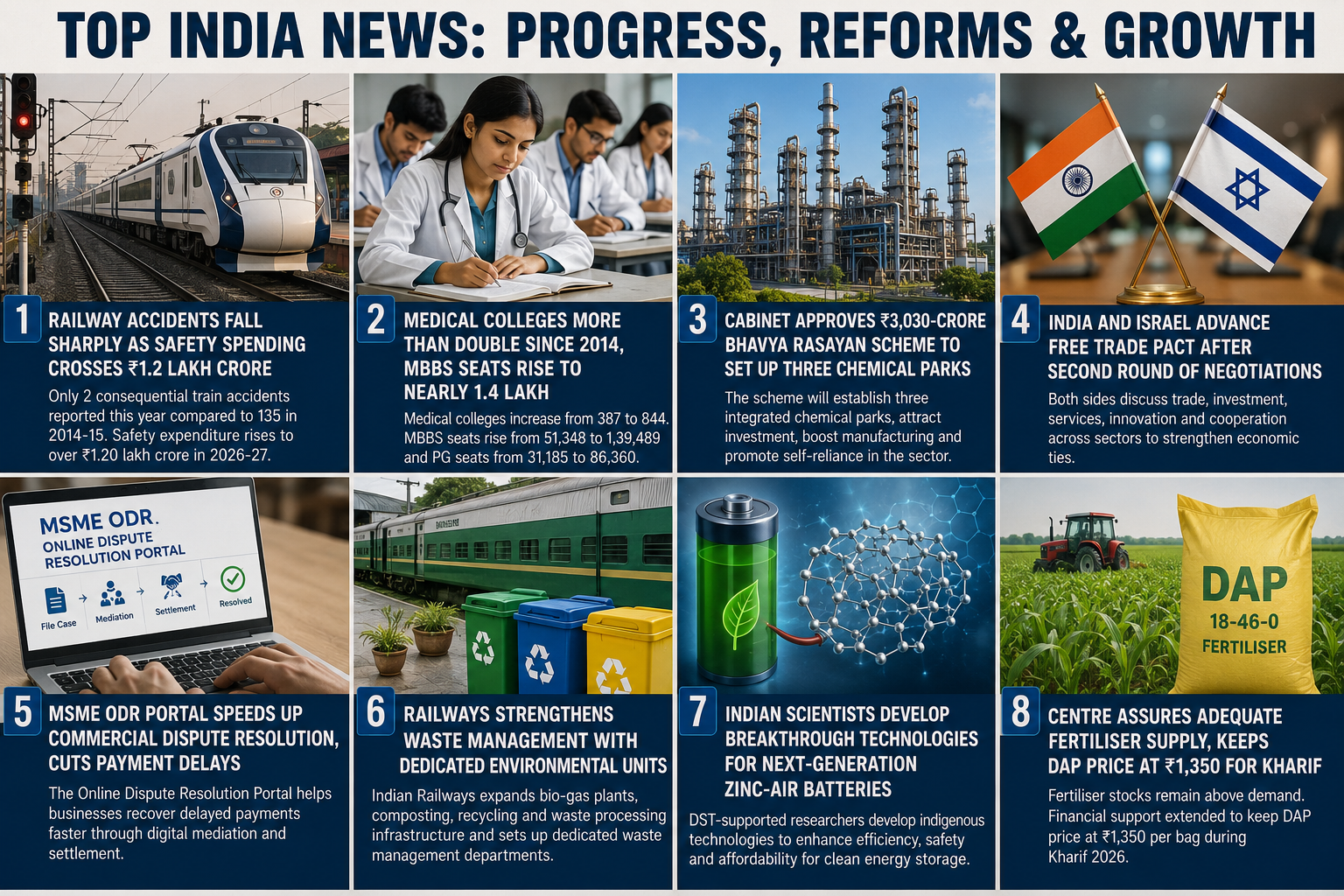
Railway Accidents Fall Sharply as Safety Spending Crosses ₹1.2 Lakh Crore: Vaishnaw
New Delhi, EW-NN: The Union government on Friday said that sustained investments in railway safety infrastructure and technology have led to a significant decline in train accidents across the country, with only two consequential train accidents reported so far in the current financial year compared to 135 in 2014-15.
Replying to a question in the Rajya Sabha, Railway Minister Ashwini Vaishnaw said that safety remains the highest priority for Indian Railways and that the sharp reduction in accidents reflects the impact of a series of structural and technological interventions implemented over the past decade.
The Minister informed the House that expenditure on safety-related activities has increased more than threefold, rising from around ₹39,000 crore in 2013-14 to over ₹1.20 lakh crore in 2026-27. The increased allocation has been directed towards upgrading signalling systems, strengthening track infrastructure, modernising rolling stock, and adopting advanced technologies aimed at minimizing operational risks.
Highlighting the role of technology in improving operational safety, Vaishnaw said that electrical and electronic interlocking systems with centralized control of points and signals have been installed at 6,671 railway stations. These systems significantly reduce the scope for human error in train operations by automating route setting and signal management, thereby enhancing the reliability of train movements.
The Minister also said that interlocking has been provided at 10,395 level crossing gates, improving coordination between train movements and road traffic while reducing the risk of accidents at crossings.
The government's statement underscores Indian Railways' continued emphasis on preventive safety measures rather than reactive interventions. Over the past several years, the national transporter has accelerated investments in signalling upgrades, track renewal, bridge rehabilitation, elimination of unmanned level crossings, and deployment of indigenous safety technologies as part of a broader modernization strategy.
While the sharp decline in consequential train accidents indicates measurable progress in railway safety, experts note that sustaining this trend will depend on continued investments in asset maintenance, timely infrastructure upgrades, expansion of automatic train protection systems, and rigorous monitoring of operational standards across the country's vast rail network.
_______________________________________________________________________________________________________________________
Medical Colleges More Than Double Since 2014, MBBS Seats Rise to Nearly 1.4 Lakh: Government
New Delhi, EW-NN: The Centre on Friday informed Parliament that India's medical education infrastructure has expanded significantly over the past decade, with the number of medical colleges more than doubling and undergraduate as well as postgraduate medical seats witnessing substantial growth to address the country's healthcare workforce requirements.
In a written reply to the Lok Sabha, Minister of State for Health and Family Welfare Anupriya Patel said the number of medical colleges has increased from 387 in 2014 to 844 at present. During the same period, MBBS (UG) seats have risen from 51,348 to 1,39,489, while postgraduate (PG) medical seats have increased from 31,185 to 86,360.
The government said the expansion is aimed at strengthening the availability of qualified medical professionals across the country and improving access to healthcare services, particularly in regions that have historically faced shortages of doctors and medical institutions.
Patel informed the House that the establishment of new medical colleges in remote and underserved areas, along with the sharp increase in MBBS seats, is expected to enhance the availability of doctors and contribute to better healthcare delivery across the country. The expansion forms part of the Centre's broader strategy to address regional disparities in medical education and public health infrastructure.
The Minister also highlighted the Family Adoption Programme (FAP), which has been integrated into the MBBS curriculum as a community-based learning initiative. Under the programme, medical colleges adopt villages, while MBBS students are assigned to adopt families within those villages. The initiative is designed to expose future doctors to rural healthcare challenges and improve equitable access to primary healthcare services by fostering continuous interaction between medical students and rural communities.
The government's data reflects one of the largest expansions of medical education capacity in the country since Independence. The increase in colleges and seats is expected to strengthen the healthcare workforce over the coming years, although public health experts have noted that sustained improvements in faculty availability, teaching infrastructure, hospital capacity, and quality of medical education will remain essential to ensure that the rapid expansion translates into improved healthcare outcomes rather than merely higher enrolment numbers.
_____________________________________________________________________________________________________
Cabinet Approves ₹3,030-Crore BHAVYA Rasayan Scheme to Set Up Three Chemical Parks
New Delhi, EW-NN: The Union Cabinet on Friday approved the Bharat Audyogik Vikas Yojana Rasayan (BHAVYA Rasayan), a ₹3,030-crore central sector scheme to establish three dedicated chemical parks across the country with an aim to strengthen domestic manufacturing, attract investments, improve export competitiveness and develop world-class industrial infrastructure for the chemical sector.
The decision was taken at a meeting of the Union Cabinet chaired by Prime Minister Narendra Modi. The scheme, announced in the Union Budget 2026-27, will be implemented over five years from FY 2026-27 to FY 2030-31.
According to the Ministry of Chemicals and Fertilizers, the scheme has a total financial outlay of ₹3,030 crore, comprising ₹3,000 crore for developing common infrastructure and basic utilities within the parks and ₹30 crore towards administrative expenditure. The Centre will provide financial assistance of up to ₹1,000 crore for each chemical park, while the respective state governments will be required to contribute at least ₹500 crore.
The three parks will be selected through a challenge-based competitive process and developed by state governments. Each park must have a minimum contiguous land area of 2,000 acres (about 8 square kilometres) free from encumbrances. The parks will be equipped with plug-and-play industrial infrastructure, including Common Effluent Treatment Plants (CETPs), Treatment, Storage and Disposal Facilities (TSDFs), hazardous waste management systems, water supply and distribution networks, solvent recovery and distillation units, steam generation and distribution facilities, interconnected pipeline networks, and integrated logistics and warehousing infrastructure.
The government said the scheme is intended to create integrated manufacturing ecosystems covering upstream, downstream and ancillary chemical industries, thereby reducing logistics costs, improving resource efficiency and enhancing the global competitiveness of Indian manufacturers. The shared infrastructure model is expected to lower operational costs and facilitate easier compliance with environmental regulations through centralized waste treatment and pollution control facilities.
The Cabinet noted that the chemical and petrochemical sector serves as a critical input industry for agriculture, textiles, pharmaceuticals, nutraceuticals, construction, automobiles and electronics. By creating modern industrial clusters, the scheme is expected to attract both domestic and foreign investments, expand production capacity, strengthen India's integration into global value chains, increase exports, reduce import dependence and generate large-scale employment.
The approval comes as the government seeks to position India as a global manufacturing hub under the Atmanirbhar Bharat initiative while advancing its long-term Viksit Bharat 2047 vision through the development of globally competitive industrial infrastructure and environmentally sustainable manufacturing ecosystems.
______________________________________________________________________________________________________________________
India, Israel Complete Second Round of FTA Talks; Negotiators Push for Early Comprehensive Trade Pact
New Delhi, EW-NN: India and Israel have concluded the second round of negotiations for the proposed India-Israel Free Trade Agreement (FTA), with both countries reaffirming their commitment to expediting discussions on a comprehensive trade pact aimed at expanding bilateral trade, investment and economic cooperation.
The four-day negotiations, held at Vanijya Bhawan in New Delhi from July 20 to 23, covered a wide range of trade and regulatory issues as both sides sought to narrow differences and identify areas of convergence. According to the Ministry of Commerce and Industry, the discussions were conducted under the Terms of Reference (ToR) signed in November 2025, which provides the framework for negotiations across multiple sectors.
Technical experts from both countries held detailed deliberations on key chapters of the proposed agreement, including trade in goods and services, rules of origin, sanitary and phytosanitary measures, technical barriers to trade, intellectual property rights, customs procedures, trade facilitation and economic cooperation. The ministry described the negotiations as constructive and forward-looking, with steady progress made towards a balanced and mutually beneficial agreement.
India's Chief Negotiator and Additional Secretary in the Department of Commerce, Ajay Bhadoo, reiterated India's commitment to securing a comprehensive FTA that strengthens bilateral trade and economic relations while safeguarding the interests of both sides. Israel's Chief Negotiator, Yifat Alon Perel, Senior Director for Trade Policy and Agreements and Deputy Trade Commissioner in Israel's Ministry of Economy and Industry, welcomed the progress achieved since the inaugural round of negotiations and stressed the need to maintain momentum towards an ambitious agreement.
Official data shows that India-Israel merchandise trade stood at USD 3.93 billion during FY 2025-26, reflecting a diversified trade relationship spanning chemicals, diamonds, machinery, electronics, pharmaceuticals, agriculture and defence-related industries. The government said the two economies possess strong complementarities that could be leveraged through a comprehensive trade agreement.
The proposed FTA is expected to provide greater market access, facilitate investment flows, streamline customs procedures and strengthen integration into global value chains. It also aligns with India's broader strategy of concluding high-quality bilateral trade agreements to boost exports, attract foreign investment and diversify international economic partnerships. Both countries agreed to continue negotiations with the objective of reaching an early conclusion on a balanced and comprehensive FTA that deepens their long-standing strategic and economic partnership.
_____________________________________________________________________________________________________________________________
MSME Ministry Highlights ODR Portal's Success as Digital Platform Speeds Up Commercial Dispute Resolution
New Delhi, EW-NN: The Ministry of Micro, Small and Medium Enterprises (MSME) on Friday highlighted the growing effectiveness of its Online Dispute Resolution (ODR) Portal, saying the digital platform is enabling faster settlement of commercial disputes, particularly delayed payment cases, and strengthening the financial resilience of micro and small enterprises across the country.
Showcasing the impact of the platform under the Raising and Accelerating MSME Performance (RAMP) Programme, the ministry cited two recent cases in which enterprises recovered pending payments through amicable settlements facilitated by the portal.
Mumbai-based Zeedesign Engineering Pvt. Ltd., an Udyam-registered micro enterprise, recovered ₹21.06 lakh within 24 hours of filing a petition on the ODR portal. The ministry said the dispute was resolved through a mutually agreed settlement, allowing the company to receive its outstanding dues without prolonged litigation.
In another case, Kolkata-based M/S Shiva Chemicals recovered ₹4.99 lakh against two pending invoices after approaching the portal and filing its claim before the Micro and Small Enterprises Facilitation Council (MSEFC) under the MSMED Act, 2006. The matter was settled amicably, following which the case was voluntarily withdrawn.
The ministry said the ODR portal provides MSMEs with a transparent, cost-effective and fully digital mechanism to resolve commercial disputes, particularly those related to delayed payments, reducing dependence on lengthy court proceedings and helping businesses maintain healthy cash flows.
A key feature of the platform is its pre-MSEFC negotiation mechanism, which encourages buyers and suppliers to resolve disputes through structured online negotiations before formal proceedings begin. The portal also offers a Digital Guided Pathway, which analyses disputes and provides an indication of likely outcomes, enabling parties to make informed decisions and encouraging realistic settlements.
Designed with simplified workflows and support for vernacular languages, the portal enables enterprises across the country to access online negotiation, conciliation and arbitration services irrespective of their location. According to the ministry, the initiative supports the government's Digital India and Ease of Doing Business objectives by making commercial dispute resolution faster, more accessible and transparent while allowing MSEFCs to focus on more complex cases requiring formal intervention.
________________________________________________________________________________________________________________________________
Indian Railways Sets Up Dedicated Waste Management Departments Across Network; Expands Cleanliness Infrastructure
New Delhi, EW-NN: Indian Railways has established dedicated Environment and Housekeeping Management (EnHM) Departments at the divisional, zonal and Railway Board levels to strengthen waste management and improve cleanliness across its network, Railway Minister Ashwini Vaishnaw informed the Rajya Sabha on Friday.
In a written reply, the Minister said the national transporter has adopted a comprehensive mechanism for the collection, treatment and scientific disposal of waste generated at railway stations and aboard trains. The initiative comes in line with the Solid Waste Management Rules, 2026 and directions of the Supreme Court aimed at strengthening environmental compliance across public infrastructure.
Vaishnaw said Indian Railways has commissioned 13 bio-gas plants with a combined processing capacity of 5,095 kg per day, 171 composting plants capable of processing 24,817 kg per day, and eight Material Recovery Facilities (MRFs) with a capacity of 7,725 kg per day. In addition, 858 plastic bottle crushing machines have been installed at stations to facilitate recycling and reduce plastic waste.
The Railway Board has also issued a comprehensive Standard Operating Procedure (SoP) covering waste segregation, collection, transportation, processing and scientific disposal at railway stations, trains, hospitals, workshops, production units, colonies and other railway establishments. Zonal Railways have been directed to identify units qualifying as bulk waste generators under the new rules and undertake waste characterization and quantification studies to assess the volume and nature of waste generated across the network.
To strengthen implementation, dedicated nodal officers have been appointed by Zonal Railways to prepare action plans, conduct periodic audits, monitor compliance and submit regular reports to the Railway Board.
On passenger amenities, the Minister said On Board Housekeeping Services (OBHS) are currently available in 1,450 pairs of long-distance trains, ensuring continuous cleaning and hygiene during journeys. The Clean Train Station (CTS) Scheme has also been implemented at 63 railway stations, covering 2,800 trains. Under the programme, trained housekeeping teams clean coach toilets and washbasins and remove garbage from onboard dustbins during scheduled halts.
The government said the integrated waste management framework is intended to improve sanitation standards, promote scientific waste processing and support environmentally sustainable operations across the Indian Railways network. The initiative also aligns with the broader objective of enhancing passenger convenience while ensuring compliance with evolving environmental regulations.
______________________________________________________________________________________________
Indian Scientists Develop Key Technologies for Next-Generation Zinc-Air Batteries
New Delhi, EW-NN: Scientists supported by the Department of Science and Technology (DST) have developed a series of indigenous technologies that could significantly improve the performance, safety and affordability of electrically rechargeable zinc-air batteries, offering a potential alternative to lithium-ion batteries for grid-scale energy storage and electric mobility.
The Ministry of Science and Technology on Friday said researchers at SASTRA Deemed University, Thanjavur, led by Dr. S. Devaraj, have developed a nanofluid electrolyte that addresses two major technical challenges limiting the commercial deployment of rechargeable zinc-air batteries—zinc corrosion and hydrogen gas evolution—while simultaneously improving oxygen reaction efficiency at the battery's cathode.
Supported under the Nano and Advanced Materials Division of the DST, the researchers created the electrolyte by dispersing small quantities of inexpensive silica and zinc oxide nanoparticles into a conventional electrolyte. Unlike traditional corrosion inhibitors, which often reduce battery performance, the nanofluid electrolyte suppresses corrosion and unwanted hydrogen generation without compromising electrochemical efficiency. The technology has already received an Indian patent (IN570691) and is ready for industrial application.
The ministry said the electrolyte remains stable for more than three months, making it suitable for commercial use in zinc-air battery manufacturing. The technology is expected to support India's growing demand for large-scale renewable energy storage and clean transportation solutions.
The research team also developed a range of earth-abundant bifunctional catalysts to improve oxygen reduction and oxygen evolution reactions, eliminating dependence on expensive platinum and ruthenium-based catalysts. Among the materials tested, copper-doped α-MnO₂ emerged as the best performer, surpassing commercial benchmark catalysts with only 2 per cent copper doping.
In another innovation, the researchers converted discarded activated carbon from household water filters into manganese dioxide-carbon nanocomposites for use in battery electrodes and supercapacitors. The process has been patented, while a separate technique chemically upcycled used surgical face masks into high-surface-area activated carbon capable of delivering oxygen reduction performance comparable to platinum-based materials.
According to the ministry, the technologies have applications beyond zinc-air batteries. The waste-derived carbon materials could be adapted for multiple energy-storage systems, while the nanofluid electrolyte concept may also be extended to other aqueous battery technologies. Officials said the innovations represent an important step towards developing low-cost, environmentally sustainable and domestically developed energy-storage solutions that could reduce India's dependence on imported battery technologies while supporting the country's clean energy transition.
______________________________________________________________________________________________________________________
Government Assures Adequate Fertiliser Supply for Kharif; Extends Support to Keep DAP Price at ₹1,350
New Delhi, EW-NN: The Centre on Friday assured Parliament that adequate stocks of all major fertilizers have been maintained across the country for the ongoing Kharif 2026 season through advance planning, continuous monitoring and coordinated action with state governments. It also announced the continuation of special financial support to ensure that Di-Ammonium Phosphate (DAP) remains available to farmers at ₹1,350 per 50 kg bag, despite volatility in global fertilizer prices.
In a written reply to the Lok Sabha, Union Minister for Chemicals and Fertilizers Jagat Prakash Nadda said the Department of Agriculture and Farmers Welfare, in consultation with state governments, assesses fertilizer requirements before every cropping season. Based on these projections, the Department of Fertilizers prepares monthly supply plans and monitors the movement of subsidised fertilizers through the Integrated Fertilizer Management System (iFMS), while holding weekly review meetings with state officials to address supply-related issues. Distribution within states is carried out by the respective state governments.
According to the government, fertilizer availability at the national level has remained above projected requirements during the current season. Between April 1 and July 21, 2026, India had 166.78 lakh metric tonnes (LMT) of urea available against a requirement of 112.09 LMT, while DAP availability stood at 40.29 LMT against a requirement of 32.35 LMT. Stocks of MOP and NPKS also exceeded estimated demand, indicating a comfortable supply position.
To shield farmers from international price fluctuations, the government has extended additional financial assistance over and above the Nutrient Based Subsidy (NBS) for Kharif 2026. The support includes ₹3,500 per metric tonne towards logistics, GST and other costs to maintain the retail price of DAP at ₹1,350 per bag for both imported and domestically produced supplies.
The minister also highlighted the government's continued focus on balanced fertilizer use through the Soil Health & Fertility Scheme. Since its launch in 2014-15, over 26.09 crore Soil Health Cards have been issued to farmers, supported by the establishment of 1,020 school mini soil laboratories, farmer training programmes and demonstrations promoting scientific nutrient management. Studies cited by the government indicate that adoption of Soil Health Card recommendations has reduced excessive fertilizer use, lowered cultivation costs and improved crop productivity.
The government maintained that the combined strategy of assured fertilizer availability, targeted subsidies and scientific soil management is aimed at safeguarding farm productivity while ensuring that essential agricultural inputs remain affordable during the peak sowing season.



[[comment.comment_text]]