Who Is a Minority in India? Rethinking Welfare, Demography and Constitutional Balance

 9 months, 2 weeks ago
- Minority protection must go hand in hand with the responsible use of public resources. State support should reach genuinely vulnerable minority communities, not become a blanket entitlement. A balanced and data-driven approach is essential to uphold fiscal discipline, social harmony, and national unity. Minority status should ideally be determined at least at the state level, reflecting regional realities; alternatively, if defined nationally, it should be limited to communities comprising two per cent or less of the population, ensuring that minority policy remains rooted in vulnerability rather than numbers or political influence.
Minority Protection: Constitutional Intent and Policy Evolution
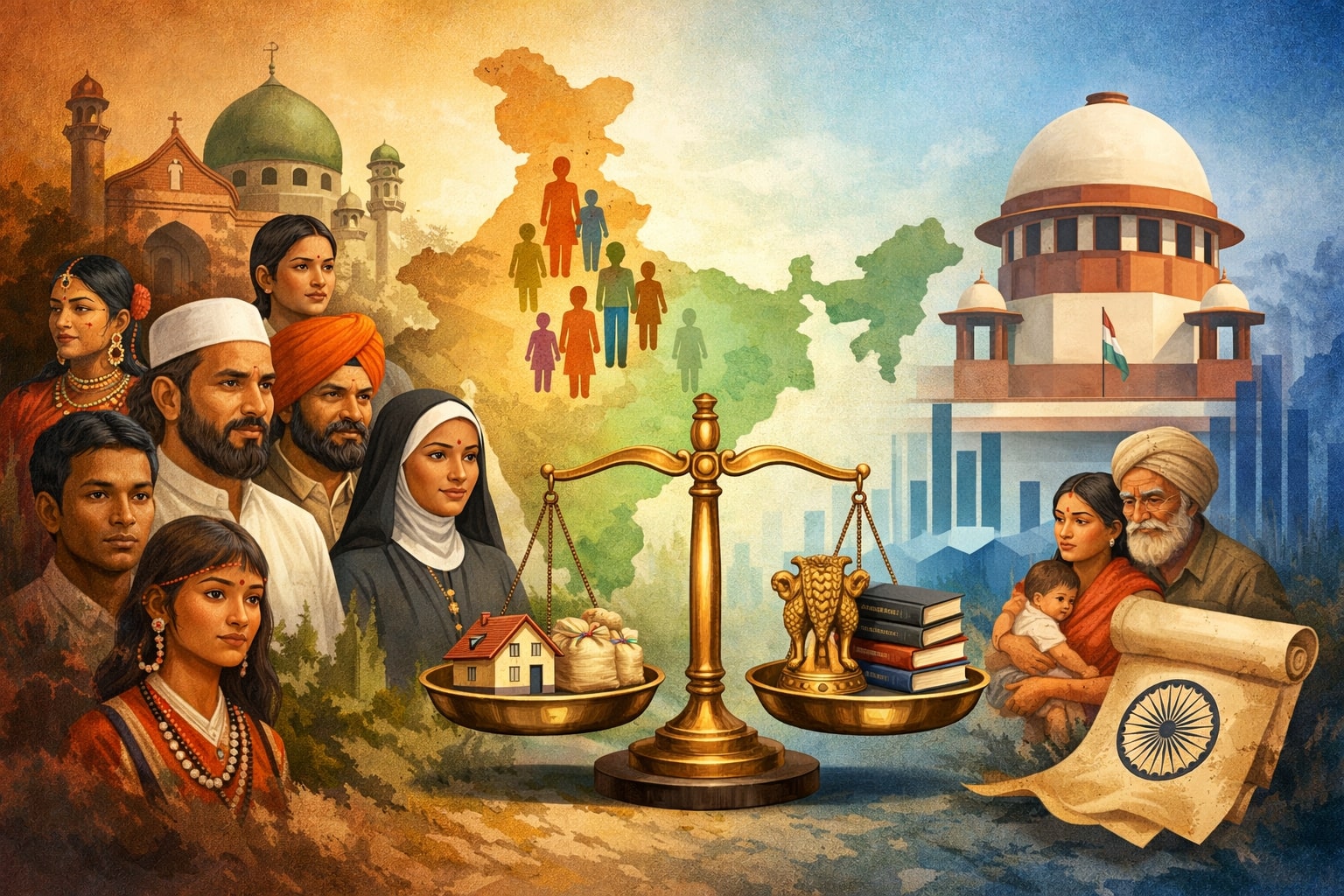
Minority protection has long been a defining feature of India’s constitutional and political imagination. Born out of the trauma of Partition and the recognition of India’s immense religious, linguistic, and cultural diversity, the idea was never merely about numerical strength. It was about ensuring that communities vulnerable to domination or exclusion could preserve their identity, participate equally in public life, and access opportunities denied to them by history or circumstance. Articles such as 29 and 30 of the Constitution enshrine these protections, particularly in the domain of culture and education. However, while the Constitution uses the term “minority,” it conspicuously avoids defining it. This omission, while perhaps prudent in the early years of the Republic, has over time become a source of ambiguity and policy distortion.
The task of identifying minority communities was later assumed by the executive through the National Commission for Minorities Act, 1992, which empowered the central government to notify minority groups. As of now, six religious communities—Muslims, Christians, Sikhs, Buddhists, Jains, and Parsis—are recognised as minorities at the national level. The absence of Jews from this list itself highlights the lack of a transparent, data-based criterion. More importantly, the designation is uniform across the country, irrespective of state-level or district-level demographic realities. This national-level approach may have seemed administratively convenient, but in a federal polity as diverse as India, it has created anomalies that increasingly undermine the original purpose of minority protection.
Minority status today is not merely symbolic. It carries tangible policy implications, including access to targeted welfare schemes, scholarships, and institutional exemptions. Minority educational institutions enjoy autonomy under Article 30 and are exempt from the Right to Education Act and from reservation norms applicable to other institutions. These provisions were designed to protect cultural autonomy and compensate for disadvantage. Yet, when such protections are extended without regard to changing demographic and socio-economic realities, they risk becoming blunt instruments rather than tools of justice.
Demography and the Limits of a National Yardstick
India’s demographic complexity makes a single national definition of minority increasingly inadequate. According to the 2011 Census, Hindus constitute 79.8% of the population, Muslims 14.2%, Christians 2.3%, Sikhs 1.7%, Buddhists 0.7%, Jains 0.4%, and Parsis a minuscule 0.006%. At the national level, Muslims are clearly a minority. However, governance in India is not conducted at the national level alone. States and districts are the primary arenas where welfare schemes are implemented, resources allocated, and social relations negotiated.
When demographic data is disaggregated, a far more complex picture emerges. Muslims form an overwhelming majority in Lakshadweep, accounting for over 96% of the population, and a clear majority in Jammu and Kashmir at over 68%. Beyond these exceptional cases, there are several large states where the Muslim population significantly exceeds the national average: Assam (34.22%), West Bengal (27.01%), Kerala (26.56%), Uttar Pradesh (19.26%), Bihar (16.9%), and Jharkhand (14.53%). In these states, Muslims are not marginal communities struggling for visibility; they are substantial social and political actors.
The concentration becomes even more pronounced at the district level. In Bihar, 11 districts have Muslim populations above the national average, with Kishanganj approaching 68%. In Uttar Pradesh, 15 districts cross the national average threshold, including Moradabad and Rampur, where Muslims constitute a majority. West Bengal presents a similar pattern, with 13 districts above the national average and Muslim majorities in Murshidabad and Malda. Assam and Jharkhand also contain multiple districts with dense Muslim populations, including several where Muslims are the majority.
A similar, though less discussed, situation exists with Christians. Christians form a majority in three states and are significantly concentrated in several others. In total, there are 14 states where the Christian population exceeds the national average. Yet, despite these regional concentrations, Christians continue to be treated as minorities uniformly across the country.
These realities raise a fundamental policy question: can a community that is locally dominant, socially entrenched, and politically influential still be treated as a minority for the purpose of special protections and benefits? The answer is not merely academic. When minority status is detached from local context, it ceases to reflect vulnerability and instead becomes a permanent label, immune to demographic change.
Welfare, Fiscal Stress, and the Politics of Perception
Minority welfare schemes are justified on the grounds of inclusion and equity. However, when benefits are distributed primarily on the basis of religious identity rather than socio-economic deprivation, serious distortions arise. In several states, communities that are regionally strong and socially organised continue to access minority benefits, while genuinely disadvantaged groups—often among the majority community or among smaller, less organised minorities—remain underserved. This misallocation undermines the principle of targeted welfare and weakens public trust in state policy.
The fiscal implications are equally significant. Welfare schemes, scholarships, and development programmes require sustained public expenditure. When eligibility criteria are broad and poorly targeted, state governments face increasing financial pressure without commensurate social returns. In an era of constrained public finances, fiscal discipline is not an abstract concern. Resources diverted to groups that are not genuinely vulnerable reduce the state’s capacity to address pressing needs such as healthcare, nutrition, education, and employment generation.
Beyond economics, there is the issue of social perception. When sections of the population believe that benefits are being distributed on the basis of religious identity rather than objective need, resentment builds. Minority protection was never intended to create permanent privilege; it was meant to provide security and opportunity to those at risk of marginalisation. If minority status is seen as a route to special entitlement rather than a safeguard against discrimination, it erodes social cohesion and strengthens identity-based politics.
India’s own history offers a sobering reminder of the dangers of communal politics. The politics of selective appeasement and competitive mobilisation contributed to the tragic Partition of the subcontinent. While contemporary India operates within a strong constitutional framework, the underlying lesson remains relevant: policies perceived as privileging religious identity over equal citizenship can have long-term corrosive effects. In a democracy, numbers matter, and communities with significant population strength are capable of exerting political pressure. This reality makes it all the more important that state policy be grounded in objective criteria rather than political expediency.
Towards a Balanced Framework: Reforming Minority Policy
The challenge, therefore, is not to abandon minority protection, but to reform it in a way that restores its moral and constitutional legitimacy. One possible approach is to shift the determination of minority status from an exclusively national framework to the state level. A community that forms a majority—or a near-majority—in a particular state should not automatically qualify for minority benefits in that state. Such an approach would align policy with federal realities while preserving protections where they are genuinely needed. District-level determination may be administratively complex and politically contentious, but state-level assessment is both feasible and constitutionally defensible.
An alternative approach is to retain minority status at the national level but restrict it to communities below a clearly defined population threshold, such as two percent or less of the total population. By this standard, only numerically small and demonstrably vulnerable communities would qualify as minorities. This would restore conceptual clarity and ensure that minority protection is linked to demographic vulnerability rather than political influence.
However, demographic criteria alone are insufficient. The most important reform must be a shift in focus from religious identity to socio-economic backwardness. Deprivation, not denomination, should be the primary basis for state support. Regular, data-driven evaluations of minority welfare schemes are essential to ensure that benefits reach the truly needy. Outcome-based assessments, rather than mere expenditure tracking, should become the norm. Transparency in eligibility criteria, beneficiary data, and outcomes would go a long way in rebuilding public confidence.
India’s unity lies in its diversity, but diversity cannot be sustained without justice and balance. Minority protection and national integration are not opposing goals; they reinforce each other when pursued with fairness and transparency. As the Census approaches, policymakers have a rare opportunity to rethink minority policy in a manner that strengthens fiscal discipline, social harmony, and the idea of equal citizenship. Protecting minorities must remain a constitutional commitment, but it must be grounded in demographic reality, economic need, and the larger objective of national cohesion.
(Author is a senior journalist and commentator on socio-cultural and diversity issues.)







[[comment.comment_text]]