The New Politics of Memory: How History Is Becoming India’s Fiercest Battleground
 10 months ago
From national icons to freedom-era slogans, from historical anniversaries to long-settled debates, India’s political contest is increasingly being waged in the realm of memory. Parties across the spectrum are reshaping symbols, reclaiming heroes, and reframing past events to legitimise present agendas. As history becomes a tool of persuasion—and polarisation—the struggle is no longer just about the future of Indian politics, but about who gets to define its past.
There was a time when history lived mostly in school textbooks, in state archives, or in the pages of scholarly debates. Today, it lives on the frontlines of political contest. It animates election rallies, resurfaces in Parliament, travels through WhatsApp forwards, and shapes the ideological vocabulary of an entire generation. In contemporary India, history is no longer a backdrop—it has become the battleground itself. The question is not just what happened, but who gets to tell the story. And in the telling, whose politics prevails.
Across the political spectrum, parties have realised that the fight over symbols, icons and collective memory is as consequential as the fight over economic policies or governance models. Because memory is power. It creates legitimacy. It mobilises emotions. It defines identity. And it offers a way to anchor the present moment in a narrative that feels both organic and inevitable. This is why India’s political discourse is now saturated with references to historical grievances, reinterpretations of national heroes, reframings of colonial trauma, and competing versions of the freedom struggle. The past is not just being recalled—it is being repurposed.
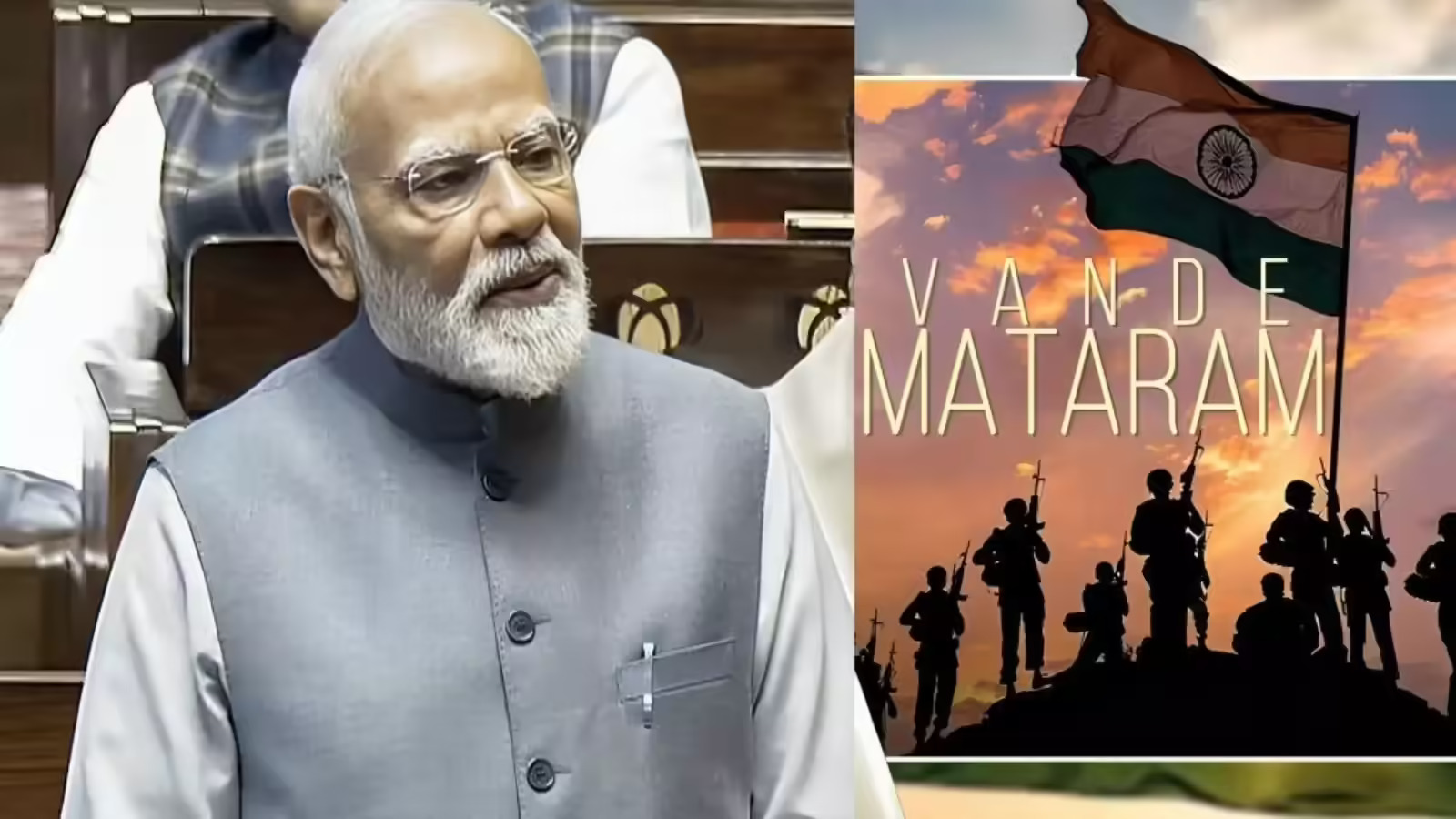
The latest flashpoint came in the Lok Sabha when Prime Minister Narendra Modi, during a discussion on 150 years of Vande Mataram, used the national song to mount an ideological critique of the Congress, accusing it of “surrender” to the Muslim League and truncating the song under pressure. The debate quickly turned into a contest over ownership: Who inherited the legacy of Vande Mataram? Who betrayed it? Who represents the “true” nationalist lineage? It was not a historical seminar; it was a political moment—an example of how historical memory is deployed in real time to shape present-day legitimacy.
But this contest is not limited to a single episode. Over the past decade, India has seen an unmistakable shift: political parties are using history as a tool to reorient identity, correct perceived injustices, and construct narratives that can mobilise constituencies across caste, region, religion and class. The politics of memory has become central to the politics of power.
One of the driving forces behind this shift is the belief that the national story itself has gaps—heroes who were not honoured enough, sacrifices that were not acknowledged, traumas that were underplayed, and institutions that were shaped by a selective version of history. The debate over who was the “real hero” of the freedom struggle—Gandhi, Bose, Patel, Bhagat Singh, Savarkar—has become a marker of ideological identity. For the BJP and the wider Sangh ecosystem, this is framed as an act of correction: an attempt to recover parts of Indian history that they believe were marginalised by post-Independence Congress-led narratives. But the Opposition also fights over historical space, accusing the government of rewriting history to fit its ideological template.
The truth is that no political formation is free from the temptation to wield history. The Congress has traditionally claimed the legacy of the freedom movement as its political bedrock. Regional parties use historical pride to fuel sub-nationalism—be it in Tamil Nadu’s Dravidian movement, Bengal’s cultural nationalism, or Maharashtra’s invocation of Shivaji. The AAP projects itself as the inheritor of the anti-colonial spirit of resistance, framing corruption as a continuation of colonial exploitation. Even caste-based movements draw strength from rediscovered histories—Valmiki as a Dalit icon, Suheldev as a backward-caste warrior, Ayyankali and Narayana Guru as symbols of social emancipation. Every political project needs a memory to stand on.
This recycling and reinterpreting of memory is not inherently harmful. Every society evolves its collective understanding of the past. Symbols acquire new meanings; forgotten episodes resurface; historical scholarship deepens; public conversations expand. But history becomes a battleground when political incentives demand simplification, polarisation, or selective recall.
Take the growing politicisation of anniversaries. From the 150th birth anniversary of Mahatma Gandhi to 350 years of Guru Tegh Bahadur, from Patel’s birth anniversary to Savarkar’s legacy, from Netaji’s INA celebrations to Subramanya Bharati’s literary contributions—every commemoration has become a stage for contemporary claims. These observances shape how communities remember their identities, how young Indians perceive political inheritance, and how governments project their ideological compass.
Or consider the renaming of public spaces, cities, museums and institutions. Renaming is never just administrative—it is symbolic. It signals who deserves honour and who does not, whose history matters and whose should be unlearned. The government’s renaming spree—roads, stadiums, islands, awards—reflects an attempt to centre an older civilisational narrative over colonial or Nehruvian markers. Critics argue this is erasure, not reclamation. Supporters call it decolonisation.
But the politics of memory extends far beyond these visible acts. It is increasingly embedded in school curricula, museum displays, official speeches, cinematic storytelling, digital campaigns and even judicial arguments. The battles are fought as much in WhatsApp groups and YouTube channels as in Parliament or academia. The narrative that reaches the citizen first often becomes the narrative that prevails.
This raises a deeper question: What happens to a society when every historical event becomes a political weapon? When memory no longer binds, but divides? When national symbols become partisan identifiers?
One consequence is the shrinking of a shared civic space. Earlier, despite ideological differences, there was broad agreement on certain national icons—ambiguous, perhaps, but unifying. Today, even these spaces are contested. Should Savarkar be honoured or criticised? Should Nehru be celebrated or blamed? Should Tipu Sultan be remembered as a reformist king or a persecutor? Should Vande Mataram evoke unity or division? When symbols become markers of ideological allegiance, national sentiment fragments.
Another consequence is emotional mobilisation. History provides a reservoir of feeling—pride, grievance, resentment, nostalgia. These emotions can be powerful tools for political mobilisation, but they can also distort democratic discourse. If the past becomes a permanent referendum, the present loses nuance. Instead of debating policies on merit, political energy gets channelled into competing historical claims.
Yet it would be simplistic to view the politics of memory as mere manipulation. For many communities, reclaiming suppressed histories is a source of dignity. Dalit groups demanding recognition of their heroes, Adivasi communities reviving their cultural memory, and regional movements insisting on their historical rights—all of these are acts of empowerment. Memory is political because identity is political.
The challenge, therefore, is not to depoliticise memory but to democratise it—to ensure that the past is neither monopolised by the state nor weaponised against citizens. A mature democracy requires a historical culture that is inclusive, self-critical and open to multiple truths. What we are witnessing today, however, is a race to simplify history to fit the urgency of political messaging. Nuance is lost in the noise.
The historian Eric Hobsbawm once wrote that nations are built not just on history but on invented traditions—symbols and stories that create imagined continuity. India, a civilisation thousands of years old and a nation barely 75 years old, is particularly vulnerable to this tension. Its political parties know that whoever controls the narrative of the past has an advantage in controlling the imagination of the future.
But India’s strength has always lain in its multiplicity of memories. It has room for Gandhi’s non-violence and Bose’s militancy, for Ambedkar’s constitutionalism and Phule’s radicalism, for Patel’s pragmatism and Nehru’s internationalism, for Savarkar’s nationalism and Tagore’s universalism. A nation as diverse as India does not need a single history—it needs a shared conversation.
The danger today is that conversation is being replaced by contest. Instead of expanding the historical imagination, political actors are narrowing it. Instead of acknowledging contradictions, they are forcing coherence. Instead of building a plural memory, they are pushing for uniform narratives. When history becomes a battlefield, the nation becomes a casualty.
Yet, there is another way to see this moment. The intense contestation over memory also reflects a society deeply engaged with its past—a sign of democratic vitality. India is not indifferent to history; it is obsessed with it. And this obsession, if channelled well, can lead to a more informed, self-aware public. The question is whether political leadership will allow history to become a source of illumination rather than agitation.
The politics of memory is a mirror. It reveals what a society chooses to celebrate, erase, question or defend. It exposes insecurities and aspirations. It shows how the past is used to justify the present. And in doing so, it tells us as much about today’s India as about yesterday’s.
The challenge before the country is not to stop political actors from invoking history. That is neither realistic nor desirable. The challenge is to insist that the past not be reduced to a toolkit for polarisation. That historical complexity not be sacrificed at the altar of political convenience. That national symbols not be transformed into ideological weapons. And that the telling of India’s story remain open to multiple voices.
History will always be contested in a democracy. But it must not be corrupted by it. Memory will always be political. But it must not be poisoned. The new politics of memory may be India’s fiercest battleground today, but it also offers an opportunity—to build a more thoughtful, more inclusive, and more honest engagement with the past. Whether that opportunity is seized or squandered will determine not just how India remembers its history, but how it makes its future.

[[comment.comment_text]]