AI Takes Charge of Shravani Mela Security; VIP Darshan Scrapped in Deoghar

 3 months, 1 week ago
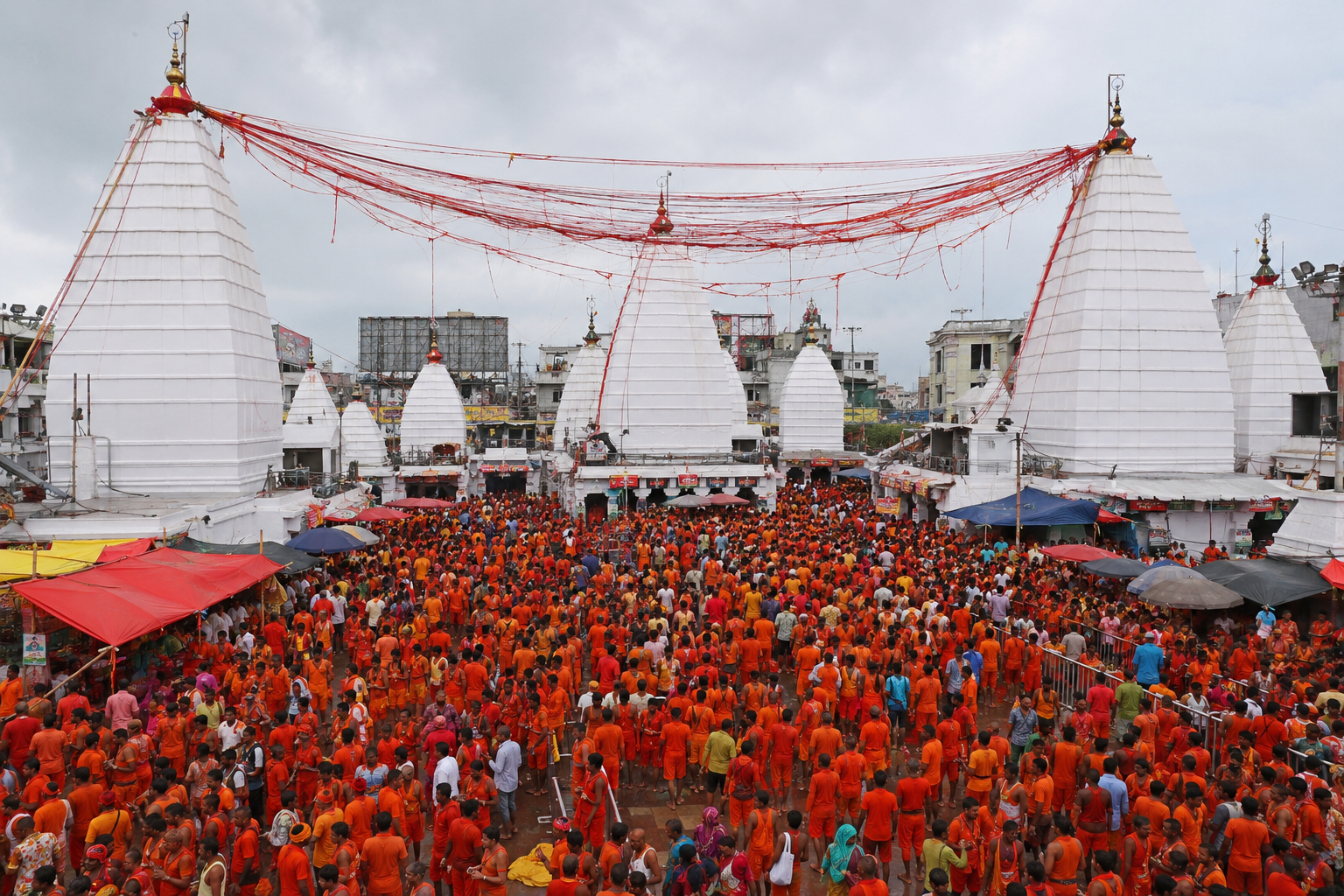
Deoghar: Preparations for the Shravani Mela 2026, one of eastern India's largest annual religious gatherings, have entered the final phase with authorities from Bihar and Jharkhand unveiling an integrated security and crowd management strategy that will, for the first time, leverage Artificial Intelligence (AI) and a 24x7 WhatsApp-based communication network for real-time monitoring of the Kanwariya route.
The high-level interstate coordination meeting was held at the Deoghar Circuit House on Saturday under the chairmanship of Santal Pargana Commissioner Sanjay Kumar. Senior administrative and police officials from border districts of Bihar and Jharkhand participated in the meeting to finalize joint arrangements for security, traffic regulation, disaster response, and crowd management during the month-long pilgrimage.
Addressing the meeting, Commissioner Sanjay Kumar stressed that all districts along the Kanwariya route—from Sultanganj in Bihar to Deoghar and Basukinath in Jharkhand—must function as a "single operational unit" to ensure seamless coordination throughout the pilgrimage.
A key feature of this year's arrangements is the introduction of AI-enabled surveillance and a round-the-clock WhatsApp-based information-sharing system. Officials said the technology will facilitate real-time monitoring of the pilgrimage route, enabling faster detection of incidents and immediate response to emergencies.
The Deoghar district administration has also announced stringent measures to regulate crowds at the Baba Baidyanath Temple. Deputy Commissioner Saurabh Kumar Bhuvania said that VIP and out-of-turn darshan will remain completely suspended during the fair, particularly on Sundays and Mondays when pilgrim turnout is expected to be the highest. Every devotee will be required to join the common queue for offering prayers.
To enhance public safety, the administration has prohibited the entry of double-decker Kanwariya vehicles into Deoghar. Authorities will also take strict legal action against vehicles transporting pilgrims on rooftops. Such vehicles will be stopped and penalized at the Bihar-Jharkhand border itself.
As part of improved pilgrim facilities, the administration has established modern holding points and tent cities at key locations along the route. These facilities will provide uninterrupted electricity, fans, safe drinking water, advanced sanitation facilities, bathing areas, mobile charging stations, and medical camps to accommodate and assist devotees during peak pilgrimage days.
Bhagalpur Divisional Commissioner Prem Singh Meena said the administrations of Bhagalpur, Banka, Munger, Jamui, Deoghar, Dumka, and Godda would maintain continuous coordination through real-time information sharing. Police stations located along the interstate border have been directed to remain on high alert, with 24-hour vehicle checking, patrols, and rescue teams deployed throughout the fair.
Officials also announced additional deployment of magistrates and police personnel on Sundays and Mondays, along with coordinated crowd management between Deoghar and Basukinath.
Special awareness campaigns will be conducted to encourage parents and elderly pilgrims to carry identification slips containing contact numbers and addresses. A joint coordination mechanism between Bihar and Jharkhand authorities will help reunite missing children and elderly persons with their families quickly.
During the meeting, Deoghar Sub-Divisional Officer Ravi Kumar presented a detailed overview of the preparations through a PowerPoint presentation, outlining the operational plan for the smooth conduct of the Shravani Mela.
The interstate coordination initiative reflects the administrations' focus on combining advanced technology with integrated governance to ensure that Shravani Mela 2026 remains safe, orderly, and convenient for the millions of devotees expected to visit the Baidyanath Dham during the annual pilgrimage.



[[comment.comment_text]]